
Glassware rarely fails all at once. It dulls. A tumbler leaves the dishwasher with a faint ring near the rim, a storage jar develops haze across its lower third, and within months a whole shelf looks tired. The film is usually blamed on detergent or on the glass itself, when the cause is more ordinary: water carries dissolved minerals, every rinse leaves a thin residue, and every drying cycle fixes it more firmly to the surface.
Hard water stains come off glassware when you dissolve the mineral deposit instead of scrubbing it: soak the piece in a one-to-one mix of white vinegar and warm water for about 30 minutes, rinse in distilled or softened water, and dry it immediately with a lint-free cloth. For deposits left for months, work a paste of three parts baking soda to one part water over the surface first, then spray undiluted vinegar onto the paste to break it down. Anything that survives both treatments is no longer a stain but etched glass, and no cleaner will bring it back.
Telling those two conditions apart decides which method is worth your time, so start with what is actually on the glass.
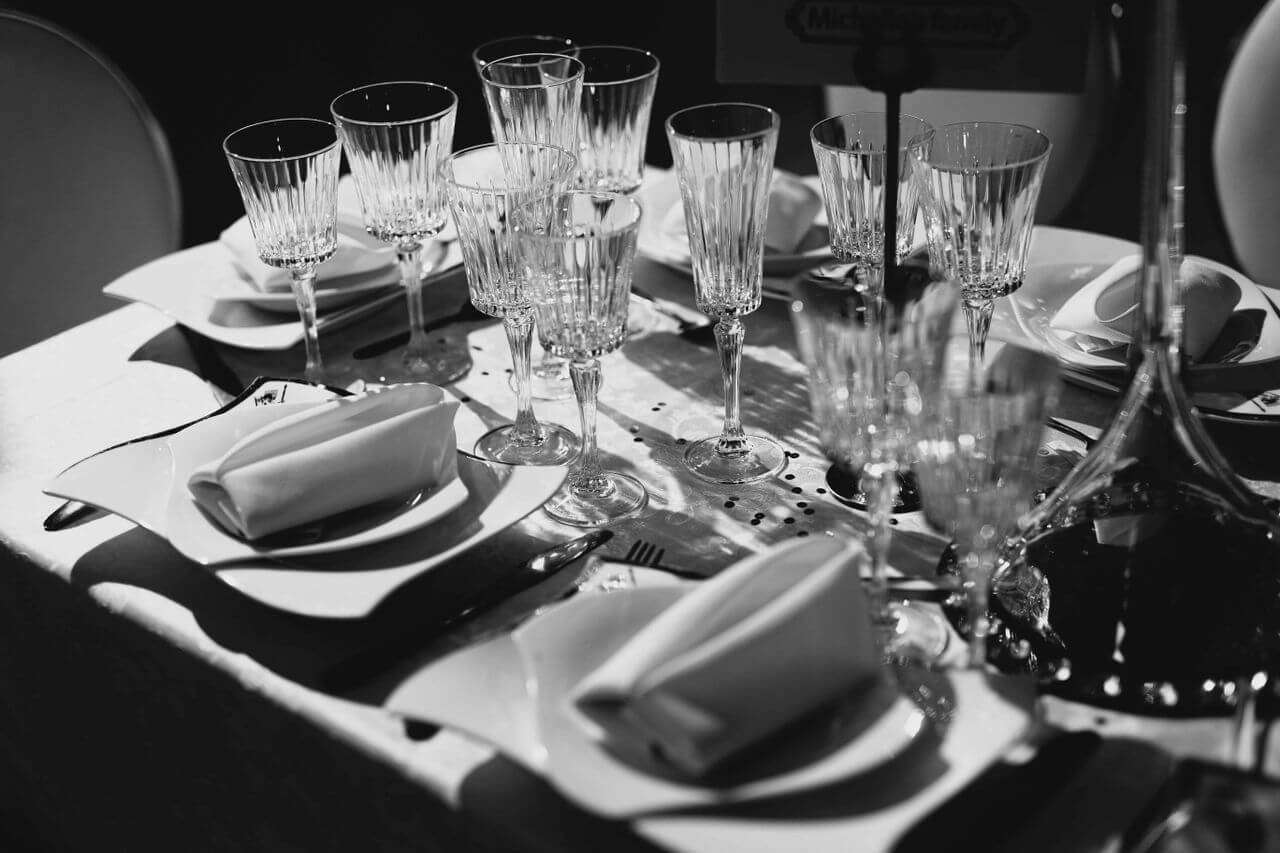
What Causes Hard Water Stains on Glassware?
Hard water stains are the mineral content of your water left behind after the water evaporates. Calcium and magnesium bicarbonate stay dissolved while the water is liquid, convert to insoluble carbonate as it dries, and bond to the glass in rings and milky patches that resist ordinary dish soap.
The mineral chemistry behind the white film
Hardness is the concentration of dissolved calcium and magnesium that water picks up moving through soil and rock, expressed as calcium carbonate equivalent. The U.S. Geological Survey classifies water from 0 to 60 mg/L as soft, 61 to 120 mg/L as moderately hard, 121 to 180 mg/L as hard, and above 180 mg/L as very hard.
| Water classification | Hardness as calcium carbonate | Behavior on glassware |
| Soft | 0 to 60 mg/L | Few spots, but higher etching risk in dishwashers |
| Moderately hard | 61 to 120 mg/L | Light spotting when air-dried |
| Hard | 121 to 180 mg/L | Visible rings within days |
| Very hard | above 180 mg/L | Heavy scale and white haze on rims and bases |
As a droplet shrinks, minerals concentrate at the waterline, which is why deposits form rings rather than an even coat. The crystals grow into microscopic surface irregularities, so the longer the film stays, the deeper it settles.
Mineral film or etched glass: how to tell them apart
| Feature | Mineral film | Etched glass |
| Appearance | Chalky white, uneven, often ringed | Uniform milky haze |
| Touch | Slightly rough | Smooth as the surrounding glass |
| Reaction to acid | Softens and wipes away | No change |
| Reversible | Yes | No |
Place a drop of vinegar on the cloudy area and wait two minutes. If the haze softens under a cloth, it is a deposit, and you can clean cloudy glassware at home with an acid and a soft cloth. If the drop dries without effect, the glass itself has been corroded.
Why some glassware stains faster than others
Narrow rims, heavy bases, pressed patterns, and bottle shoulders hold a film of water after rinsing, and those are where rings first appear. Soda-lime glass, which covers most tumblers and food jars, resists attack less well than borosilicate and both attracts deposits and etches sooner. A glass left to drain overnight collects more mineral than one wiped dry.
How to Remove Hard Water Stains from Glassware
The reliable method is a diluted acid soak, a clean-water rinse, and immediate drying. White vinegar at roughly five percent acidity dissolves calcium carbonate, and 30 minutes of full immersion handles all but the oldest deposits, which need a baking soda paste.
The vinegar soak, step by step
- Mix equal parts distilled white vinegar and warm water in a basin deep enough to submerge the pieces.
- Lay the glassware in completely, with no hollow sections above the liquid line, and leave it for 30 minutes.
- Lift one piece, rinse, and check the thickest deposit. If haze remains, return it for another 30 minutes.
- For scale built up over years, use cleaning vinegar at about 20 percent acidity and cut the soak to 15 minutes.
- Rinse in distilled, filtered, or softened water so no minerals remain.
- Dry at once with a microfiber cloth, buffing rims and bases where water collects.
The same ratio underpins any routine used to clean glassware with vinegar, whether you soak tumblers or spray and wipe large pieces; contact time matters more than concentration.
The baking soda paste for heavy buildup
Mix three parts baking soda with one part water into a thin paste and apply it with a soft brush in small circles. After ten minutes, spray undiluted vinegar over the paste. It foams as the acid neutralizes the carbonate, and that reaction loosens the deposit. Scrub once the foaming stops, rinse well, and dry. Keep the paste off printed decoration and gold rims, where abrasive particles dull the finish.
Rinsing and drying without new spots
Most descaling jobs fail at the last step. Tap water left to evaporate redeposits the minerals you just removed, so rinse mineral-free where possible. Dry immediately rather than air-drying, using a cloth that absorbs without shedding.
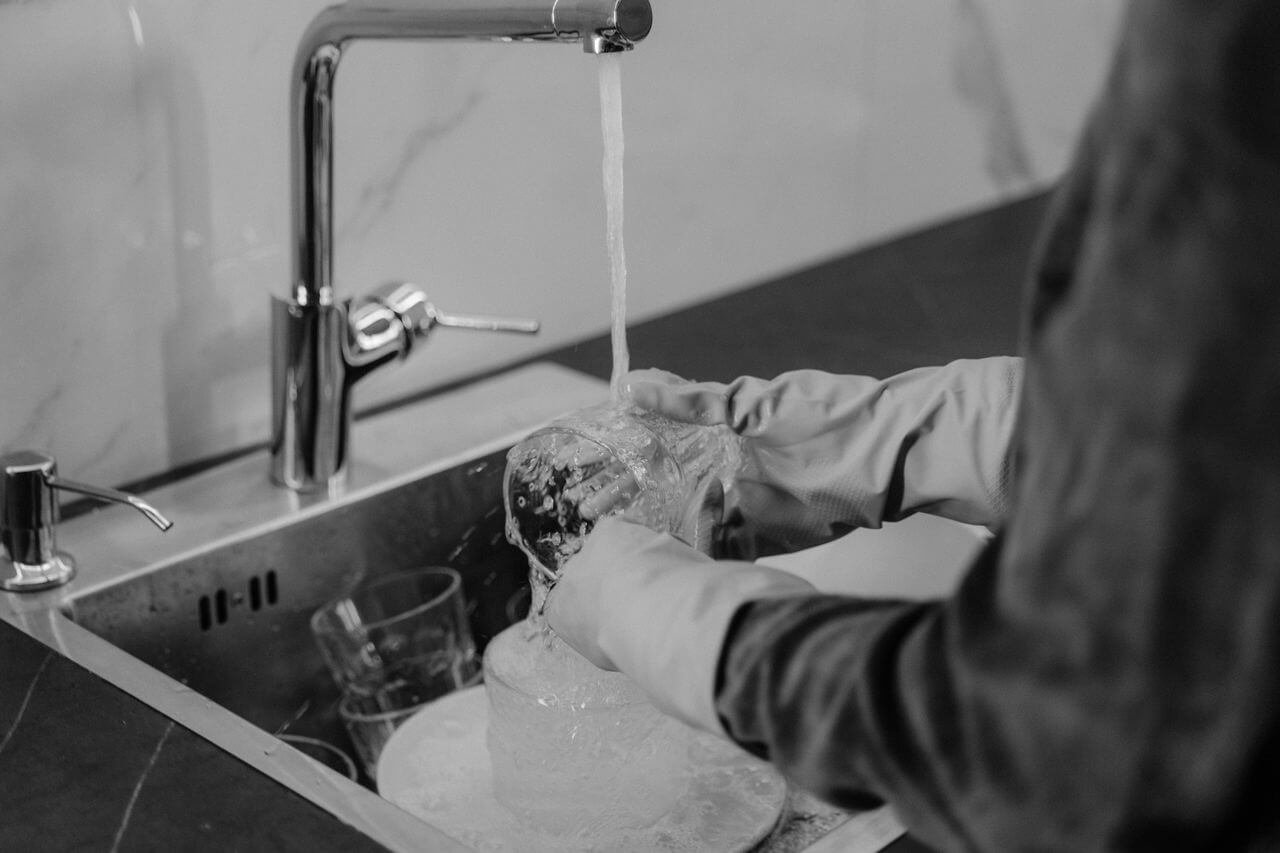
How to Clean Bottles, Jars, and Narrow-Neck Glassware
Narrow-neck items need liquid inside them, not just around them. Fill the vessel to the brim with the vinegar solution, stand it upright for 30 minutes, then invert it over the sink so the loosened deposit drains instead of settling back onto the base.
Fill, soak, and invert
A bottle standing in a basin only treats its exterior. Fill it completely, let it stand, then repeat if the interior still feels slick. For tall bottles, a second pass on its side reaches the shoulder, where evaporation rings form.
Brushes and gentle scouring media
A long-handled brush with soft nylon bristles handles most interior work. For a stubborn base, add a spoonful of coarse salt or crushed eggshell with a little water and swirl gently; the particles act as a mild abrasive that follows the curve of the glass. Never use steel wool, sandpaper, or melamine sponges inside a drinking vessel, since scratches give the next layer of scale somewhere to anchor.
Lids, gaskets, and metal closures
Closures carry more residue than the body because they trap water in threads and liners. On glass jars with lids, soak metal discs and rings separately for no more than ten minutes, dry immediately, and check for rust. Silicone gaskets need a short soak in warm soapy water and full air drying; wooden lids should be wiped, never submerged.
What Works, What Doesn’t, and What Damages Glass
Acids dissolve the deposit, mild alkalis lift grease and organic film, and abrasives remove what chemistry cannot reach, but each has a ceiling. Most failures in glass care come from mixing categories, overusing abrasives, or applying heat the glass cannot absorb evenly.
| Agent | Effect on mineral deposit | Safe on undecorated glass | Main caution |
| White vinegar, 5 percent | Dissolves carbonate slowly | Yes | Odor, long contact on decoration |
| Cleaning vinegar, 20 percent | Fast dissolution | Yes, short contact | Aggressive on prints and gold rims |
| Citric acid solution | Effective, low odor | Yes | Needs thorough rinsing |
| Baking soda paste | Mechanical plus mild alkaline | Yes | Can dull decoration |
| Washing soda | Strong alkaline cleaner | Short contact only | Attacks glass with repeated use |
| Chlorine bleach | No descaling action | Not recommended | Never combine with acid |
Acids that dissolve scale
Acetic and citric acids convert insoluble calcium carbonate into soluble salts that rinse away, which is why every credible descaling method smells faintly of vinegar or lemon. Concentration shortens the time, not the care: 20 percent vinegar can mark a decorated surface in minutes where household vinegar takes an hour.
Alkalis and abrasives
Baking soda is both a mild alkali and a very soft abrasive, a useful pair on greasy film with mineral mixed in, though it is not a descaler on its own. Washing soda and strong alkaline detergents cut grease well but attack the silica network when used repeatedly, the same mechanism behind dishwasher etching.
Combinations and surfaces to avoid
Never mix vinegar or any acid with chlorine bleach, since the reaction releases chlorine gas. Do not pour boiling water into a cold jar or set a hot piece on a cold surface; thermal shock cracks sound glass. Skip compounds sold as glass restorers, which remove glass rather than clean it. On crystal, gold rims, and enameled decoration, keep acid contact under ten minutes and test a hidden area first.
Can Hard Water Permanently Damage Glassware?
Yes. Once the surface has been etched, the damage is structural and cannot be reversed by cleaning. Etching is not a thicker layer of mineral film; it is glass chemically removed in microscopic patches, so the haze scatters light instead of transmitting it.
How etching actually happens
In a dishwasher, three conditions converge: water hot enough to accelerate reactions, detergent alkaline enough to attack silica, and water soft enough to be chemically aggressive. Sodium ions migrate out of the surface and are replaced by hydrogen ions while the alkaline solution dissolves the silica network layer by layer. Research from the Corning Museum of Glass describes this deterioration, and the practical lesson is that early surface changes can sometimes be washed away while advanced corrosion cannot. Soft water is not automatically safer: without calcium and magnesium to occupy the detergent, it attacks the glass instead.
What cannot be reversed
A uniform haze that ignores acid, feels smooth under a fingertip, and appears inside and outside equally is etched. Polishing pastes can reduce the effect on flat surfaces, but they remove material and rarely restore clarity on curved or patterned pieces. For drinking vessels and food jars, the honest answer is retirement from daily use.
Protecting the glass you already own
Use the minimum detergent that still cleans, skip the hottest cycle for everyday glass, keep rinse aid topped up, and hand-wash anything with decoration, a gold rim, or a thin stem.
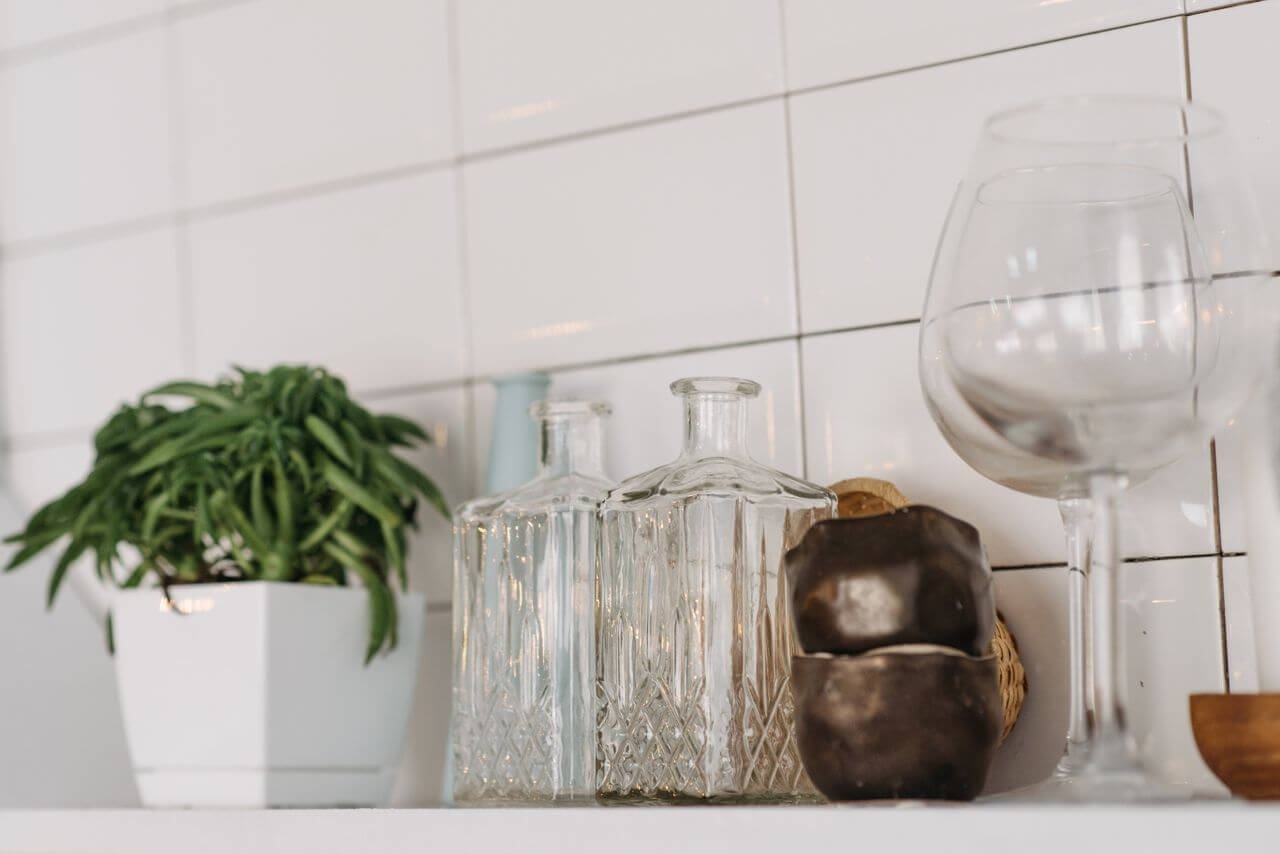
How to Prevent Hard Water Stains from Coming Back
Prevention is about the last drop of water, not the first scrub. If the water left on the glass contains no minerals, or is removed before it can evaporate, there is nothing left to form a deposit.
Rinse, dry, and store correctly
Dry glassware by hand while it is still warm, or run a full drying cycle. Follow the same rules when storing clean glasses: leave a finger-width between pieces and avoid stacking damp glasses mouth to mouth, which traps moisture and produces rings around the rim. A closed cabinet holds humidity, so let pieces cool and dry before the door is shut.
Dishwasher adjustments that matter
Rinse aid is the highest-return setting, because it changes how water sheets off instead of pooling. Detergent dose matters in both directions: too little leaves food soil that binds minerals, too much leaves alkaline residue that etches. If the machine has a hardness setting for its built-in softener, set it to the measured value. Confirm what the manufacturer permits as well, since a dishwasher-safe claim applies per product, not per jar shape.
Water-side fixes
Test your supply first; a hardness strip or a laboratory report tells you whether you are treating a real problem. A whole-house softener removes the calcium and magnesium that cause spotting, while a point-of-use filter feeding the final rinse achieves most of the benefit at a fraction of the cost. Neither replaces drying, but together they turn descaling into an occasional task.
Glassware Care in Food Service and Packaging Operations
In commercial settings, staining is a process control problem rather than a cleaning problem. Water quality, detergent concentration, and drying are three measurable parameters, and any one drifting out of range will produce complaints within a week.
A cleaning protocol that scales
Use a three-compartment sink or a validated machine cycle, and record wash temperature, rinse temperature, detergent concentration, and final rinse hardness. Test hardness at the tap weekly, because supply blends change seasonally. Train staff to inspect glass against a backlit panel rather than under ambient light, where film is easy to miss, and schedule descaling by evidence such as a rising reject rate instead of a fixed calendar.
Specifying glass that resists staining
When buying in volume, ask for the hydrolytic resistance class, the property that best predicts behavior across hundreds of wash cycles. Check annealing quality, because poorly annealed glass carries internal stress that accelerates surface breakdown. Mouth diameter and interior geometry matter too: wide mouths drain faster, and smooth interiors hold less residue. A simple incoming inspection, soaking a sample in dilute acid and comparing haze against a reference piece, catches specification drift early. Buyers sourcing custom glassware for hospitality, retail packaging, or food service should treat these characteristics as part of the specification, alongside capacity and finish.
FAQ
Can I use lemon juice or citric acid instead of vinegar?
Both work, and citric acid suits large volumes because it is odorless and easy to dose. Use one to two tablespoons per liter of warm water, or straight lemon juice on small spots. Rinse well, since residual sugars leave a sticky film.
How often should glassware be descaled?
In very hard water, a preventive soak every two to four weeks keeps film from hardening. In soft or moderately hard water, descale when you first notice a ring at the waterline, typically every two to three months. Needing it more often usually means the drying step or the rinse water needs attention, not the glass.
Is the white film from hard water harmful?
The film is calcium and magnesium carbonate, the same minerals that make water hard, and it is not considered a health risk at levels found on household glass. It does affect taste perception and appearance, and in commercial settings it reads as poor hygiene even when the glass is microbiologically clean.