A burnt-out candle leaves a jar still worth keeping: sound glass, a lid that fits, a shape that suits storage. Between the container and its second use sit a wax disc welded to the base, a metal wick tab set in adhesive, a film of fragrance oil and a ring of soot at the rim. One jar is a small annoyance; a tray of them is a line item.
The reliable way to remove candle wax from a glass jar is to change the wax’s physical state rather than fight its adhesion: chill the jar so the wax contracts and releases from the wall, lift out the bulk disc, melt or wipe away the rest while it is warm, then finish with a solvent wipe for the oily film. Freezing suits thin residue in a single jar, a warm water bath or a low oven suits thick wax and batches, and no water-based cleaner dissolves wax at any stage.
Three properties of the material explain every step below.
Why Candle Wax Bonds to Glass
Wax forms no chemical bond with glass. It grips by wetting the surface completely while molten, flowing into microscopic pits and polishing marks, and then freezing in place, so removal means breaking a mechanical contact rather than reversing a reaction.
Nothing has reacted, which is why soaking never loosens a disc from below. Anything that raises surface area also raises grip: a scratched interior, a frosted band, a heavy embossed base. A shoulder narrower than the body locks the wax in place even after the wall contact has failed.
The Chemistry Behind the Stick
Paraffin wax, the most common candle base, melts between about 48 and 66 degrees Celsius depending on grade and consists of solid hydrocarbons recovered from petroleum. Soy, palm, coconut and beeswax bases share that hydrocarbon character, which is why they behave alike under heat and cold. Being nonpolar, they have no affinity for water, detergent or acid.
Finished wax is not pure either. Fragrance oil, typically 6 to 12 percent by weight, plasticises it and lets it creep deeper into surface texture during the burn, so a heavily scented candle clings harder and leaves a thinner, more persistent film.
What Cold Does to the Bond
Cooling shrinks wax considerably more than glass. The jar barely moves, the wax pulls away, the contact area collapses, and near freezing most candle waxes turn brittle enough to fail cleanly instead of smearing. The limit is thickness: cold penetrates slowly, so in a half-full jar the centre stays soft while the outer millimetres contract. Narrow necks compound this, which is one reason refill programmes favour wide mouth glass jars, where the wax leaves as a cylinder instead of being dragged past a constriction.
The Best Way to Remove Old Candle Wax from a Glass Jar
There is no single best method. The right choice depends on how much wax remains, which wax it is and how many jars are in front of you. Freezing is cleanest for thin residue in one jar, a warm water bath is fastest for a partly burnt candle, a low oven is the only practical route for batches, and every heat-based method still leaves a film that needs a separate solvent step.
| Method | Best for | Typical time | Main risk |
| Freezer | Thin residue, single jars | 1 to 4 hours, hands off | Thick plugs stay gripped |
| Warm water bath | Partly burnt candle, any wax | 15 to 30 minutes | Thermal shock, burns |
| Low oven | Six or more jars at once | 15 to 25 minutes | Labels and decoration lift |
| Targeted heat | Patches near the rim | 5 to 10 minutes | Overheating one spot |
Wax type shifts the ranking: hard paraffin releases well from cold, soft container blends freeze brittle and lift out easily but leave more oil behind, and beeswax, the most adhesive of the common bases, responds better to a water bath.
The Freezer Method
Leave the jar upright in the freezer for one to four hours. The wax should contract enough that a plastic scraper inserted at the edge lifts the disc whole. If it resists, stop: resistance means the wax is too thick for cold to work through, not that more force is needed. Prying harder is how bases crack and how interior walls pick up scratches that will hold wax next time.
Wipe the inside with dry paper towel before the glass warms up, while the wax is still brittle enough to come away in flakes rather than smear. Then let the jar reach room temperature before washing it, because a cold jar and a hot tap are the classic route to a cracked base.
The Warm Water Bath
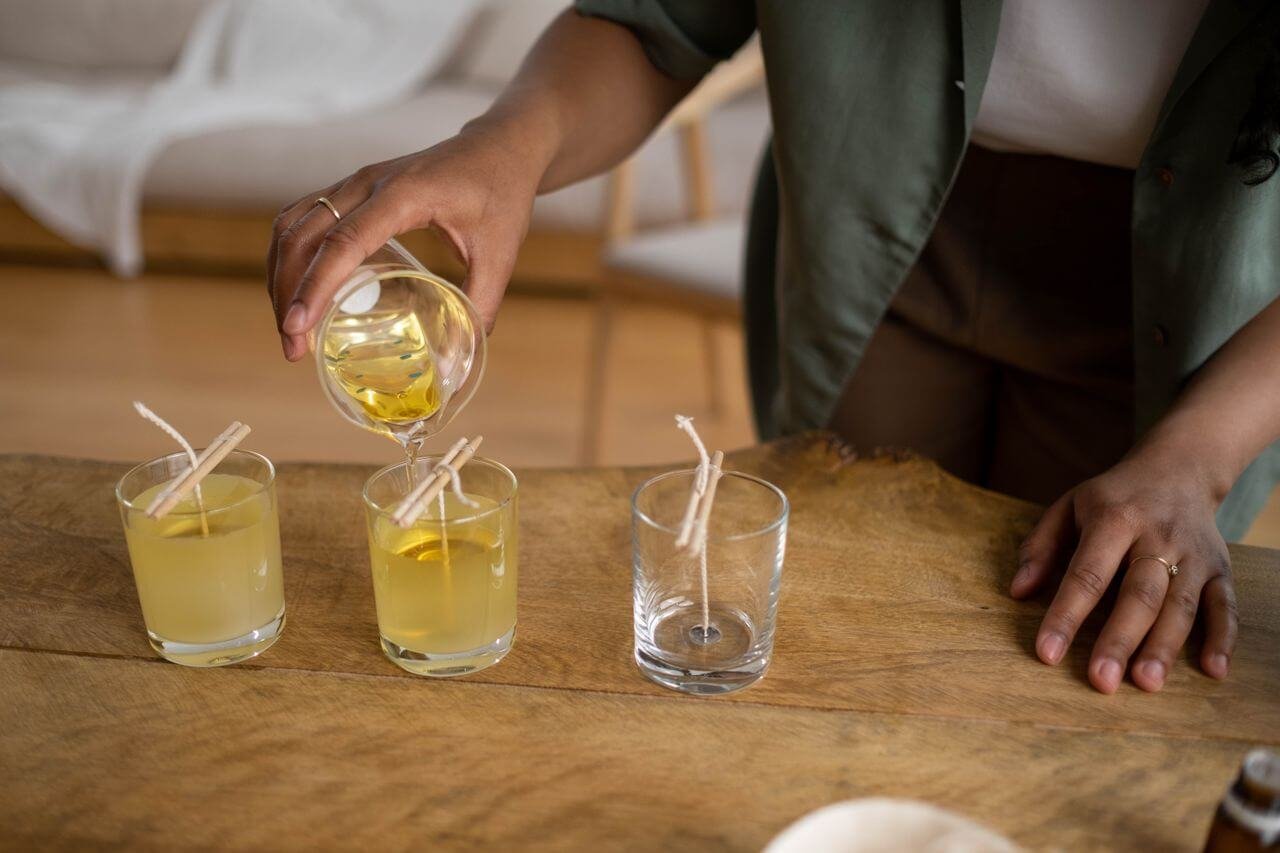
Do not pour boiling water into a cold jar. Stand the jar in a pan of water at 60 to 70 degrees Celsius, with the level below the rim, and leave it for 10 to 20 minutes. Heat reaches the wax through the glass, the wall contact softens from the outside in, and the block lifts out with tongs while still coherent.
The limit here is a material property, not a caution. Soda-lime glass, which accounts for most candle vessels, tolerates a sudden differential of only about 40 degrees Celsius, while borosilicate handles roughly 170, a gap that follows from the mechanics of thermal shock. A jar at room temperature meeting water at 95 degrees presents a 75 degree differential, well past the limit for ordinary glass. For a narrow jar, fill it with hot but not boiling water instead: the wax floats, re-sets as a disc and lifts off whole, which is slower but reaches shoulders a scraper cannot.
The Low Oven Method
Set the oven to about 80 degrees Celsius, line a tray with foil, and invert the jars on it so the wax runs out and pools. Fifteen to 25 minutes is enough. Wipe each jar with paper towel held in tongs while the glass is warm but no longer hot enough to burn.
The oven is the only method that scales, and it damages the most jars. Labels, foil stamps and painted bands lift or discolour at that temperature, and their adhesive migrates. Cold jars in a preheated oven are also a thermal shock in themselves, so the tray belongs in a cold oven that comes up with it. For residue near the rim, a hairdryer on medium held 10 to 15 centimetres away softens the wax without heating the whole vessel. Open flame is not a shortcut; wax vapour above a hot surface can ignite.
What Dissolves Wax on Glass
Only nonpolar or weakly polar solvents dissolve wax. Water, detergent solutions and acids do not, at any concentration or temperature. Isopropyl alcohol above 90 percent, mineral spirits, citrus terpenes and cooking oil all attack residue through the principle that like dissolves like, and each leaves its own clean-up problem, so solvent is a finishing step rather than a removal method.
Solvent carries away a film measured in microns. It cannot lift a two-centimetre disc, and treating it as though it could produces a larger, thinner mess.
Solvents That Work
| Solvent | Action on wax | Best use | Cautions |
| Isopropyl alcohol, 90 percent or higher | Lifts thin film, dries clean | Final wipe, soot removal | Flammable, fumes, can dull coatings |
| Mineral spirits | Dissolves thick smears | Workshop and batch work | Persistent odour, hazardous waste |
| Citrus terpene | Dissolves wax and adhesive | Labels and stubborn film | Attacks some plastics and inks |
| Cooking oil | Swells and loosens residue | Decorated jars | Leaves oil needing a detergent wash |
Apply solvent to the cloth rather than into the jar, so residue is lifted instead of spread, and work in order of increasing strength.
Does Vinegar Remove Wax from Glass?
No. White vinegar is a dilute solution of acetic acid in water, around 5 percent acid by volume, and both components are polar. Wax is a hydrocarbon, and the industry body confirms that all candle waxes are essentially hydrocarbons, so vinegar cannot dissolve, soften or break down paraffin, soy, coconut or beeswax, however long it soaks.
The claim survives because vinegar does three adjacent jobs well enough to look like wax removal. It dissolves the mineral film and hard-water haze that make a cleaned jar look cloudy. It neutralises smoke and soot odour, which is often what people notice after a candle has burnt out. And it evaporates without streaks, which makes the final polish convincing. It also shifts fragrance oil residue, because oil is not wax, but that is degreasing rather than dissolution.
Use vinegar at the end, once the wax is physically gone, as set out in this guide to cleaning glassware with vinegar. Keep it off foil labels and gold rims, where acid and time lift the finish.
How to Get the Last Bit of Wax Out of a Jar
The last of the wax is a film rather than a layer, and it comes away by softening, absorbing and dissolving in that order. Scraping harder only spreads it over more surface, and any scratch left behind becomes a place for the next pour to grip.
Lifting the Wick Tab
The metal disc at the base is held by a hot-melt adhesive that softens well below the temperature of the glass. Warm it with a hairdryer for 30 to 60 seconds, slide a plastic scraper underneath and lift; a drop of isopropyl alcohol left for a minute will also release it. Never lever with a knife tip, because a point load at the centre of a base is where a jar fails, and the failure is sudden.
Cutting the Film and the Smell
Wash in hot water with a few drops of dish detergent and a nylon brush; the surfactant bridges polar water and the nonpolar film, which is why plain hot water leaves the jar greasy. A paste of baking soda and water handles patches that survive, and an alcohol wipe takes off the last trace.
A jar can still smell of the candle long after it looks clean, because fragrance compounds migrate into the film and the lid liner and release slowly. A bicarbonate soak, one tablespoon per litre for 30 minutes, neutralises most of it. Air-dry inverted overnight rather than sealing the jar damp: trapped moisture turns sour and, before refilling, stops new wax adhering to the wall, which is the origin of the pale patches known as wet spots.
Cleaning, Drying and Inspecting the Jar
A jar is ready for reuse when the interior is wax-free, the rim is unbroken and the glass is dry. Skipping the inspection is the most common reason a refilled candle tunnels at one side or a storage jar fails to seal.
Dishwasher Cautions
No visible wax should go into a dishwasher. Residual wax melts at wash temperature and re-solidifies in the drain line, filter and pump housing, where it traps food particles until the machine blocks. Once the wax is off, a dishwasher is effective on plain glass but unkind to decorated jars, since alkaline detergent and repeated heat cycles dull gold rims and lift printed bands.
Drying and Rim Inspection
Dry the jar inverted on a rack, never with a towel pushed inside, which leaves lint that shows as specks in the next pour. Hold the rim against a light and look along it for chips and hairline cracks, since a chipped rim will not seal. Check the interior for scratches and the grey haze of etching, which no cleaning removes and which will hold wax again.
What Not to Do
- Never pour melted wax down a drain, where it sets as a waterproof plug no chemical cleaner will shift
- Never microwave a jar that still holds a metal wick tab
- Never move a hot jar onto a cold worktop or rinse hot glass under cold water
- Never scrape the interior with a razor blade, a serrated knife or steel wool
Choosing Jars That Release Wax Cleanly
Geometry decides how much of this work is necessary. Straight-sided vessels with a wide mouth, a flat base and no internal shoulder release wax in one piece, while jars with a narrow neck, a rounded shoulder or heavy embossing trap wax where no tool can reach.
| Jar feature | Effect on wax release | Practical consequence |
| Straight side wall | Disc slides out as a cylinder | Lowest cleaning labour |
| Rounded shoulder | Wax locks above the neck | Requires melting, not prying |
| Wide mouth | Tool access, even freezing | Faster cleaning per jar |
| Heavy embossing | Larger bonded surface | Brush and warm water needed |
| Thick base | Slower, uneven contraction | Longer freeze or bath time |
The interior diameter of the neck should sit close to that of the body; a difference beyond about 10 percent turns the wax disc into a mechanical lock. Vertical walls also let heat or cold reach the full contact area at once, so the wax releases evenly rather than in patches.
Glass Type and Thermal Limits
Most candle vessels are soda-lime glass, chosen for clarity, cost and the ability to take a thick base. It is not a heat-resistant material, and its tolerance of sudden temperature change is around 40 degrees Celsius, against roughly 170 for borosilicate. Neither should go from a freezer into hot water, and neither should be heated while sealed. Buyers specifying glass jars with lids wholesale fix vessel and closure as a matched set for the same reason: a lid that will not seat on a damaged rim cannot be corrected later by cleaning.
Cleaning Candle Jars at Production Scale
At production scale the constraint shifts from technique to throughput and waste handling. A rack oven or heated tunnel at 70 to 85 degrees Celsius drains wax from inverted jars into a collecting tray, the jars cool on the line, and a solvent or alkaline wash removes the film. The bottleneck is rarely labour; it is wax recovery and drain protection.
Racks and Wax Recovery
Load jars inverted at a slight angle so the melt runs to one edge instead of pooling in the base, and allow 15 to 25 minutes depending on wall thickness. Recovered wax can be filtered through cloth and reused for samples, but keep heavily fragranced stock separate, since carryover will contaminate a clean batch. Cool the jars gradually; quenching warm glass is the fastest way to lose a tray to thermal shock.
Volume changes the economics of the jar itself. A vessel that releases wax cleanly saves minutes per unit on the cleaning line, and at scale those minutes decide whether a refill programme pays for itself, which is why wholesale glass jars for candle work are specified against cleaning performance and not only appearance.
Drains and Waste Handling
Wax and water are a bad combination in any drainage system, and the problem worsens as the water cools. A grease interceptor sized for the wash line, skimmed regularly, keeps congealed wax out of the plumbing, and the solids leave as solid waste under local rules. Running the wash hot enough to keep wax liquid only moves the blockage downstream, into a larger pipe that is harder to open.
Frequently Asked Questions
Can removed candle wax be reused?
Yes, for non-food purposes. Melt it slowly in a double boiler, strain it through cloth to remove wick fragments and soot, and pour it into a smaller container with a fresh wick. Expect a weaker scent and a shorter burn than the original, and do not blend unrelated wax types without testing, because melt points and shrinkage differ enough to cause sinking and cracking.
How do you clean wax out of a textured or painted jar?
For textured glass, soften the wax with warm air rather than hot water, then work a soft toothbrush into the pattern with dish detergent, because texture holds residue that is only wiped. For painted, foiled or coated jars, skip the oven, the dishwasher and every solvent, and rely on the freezer plus a plastic pick, testing any product on the base first.
Is a cleaned candle jar safe for food contact?
Cleanliness is not the deciding factor; the vessel is. Candle containers are not always made from food-contact rated glass and may carry interior treatments, and they are often designed around a lid that seals against wax rather than moisture. Use a repurposed jar for dry goods in a liner, or confirm the rating with the supplier before storing anything moist or acidic in it.