Glass rarely breaks because a box fell off a truck. It breaks because two pieces touched each other for four hundred miles, or because a rim carried weight it wasn’t meant to carry. Road vibration, braking, a hand truck over a door sill: each load is harmless alone, but together they find the weakest point of a glass. Whether you’re clearing a kitchen cabinet or moving a commercial inventory of custom glassware, the failure points are the same.
The short answer: wrap every piece on its own, keep glass from touching glass, fill the box until nothing moves, and pad the rim, stem and handle more than you think you need. Every method below applies those four habits.
Why glassware breaks in transit
Glass is far stronger when squeezed than when pulled, and almost all breakage starts with tension. The American Ceramic Society puts it plainly: glass is strong in compression and weak in tension, so a small surface flaw opens into a crack once the material around it stretches.
That explains where pieces fail. Thin sections under load go first, so rims, jar shoulders, bottle necks and wine glass stems break before the body does. Washing scratches act as starting points, and a handle or a corner concentrates stress in one spot.
Temperature matters too: glass conducts heat poorly, so one side warming faster than the other builds stress.
Choose a box, dividers and a weight limit
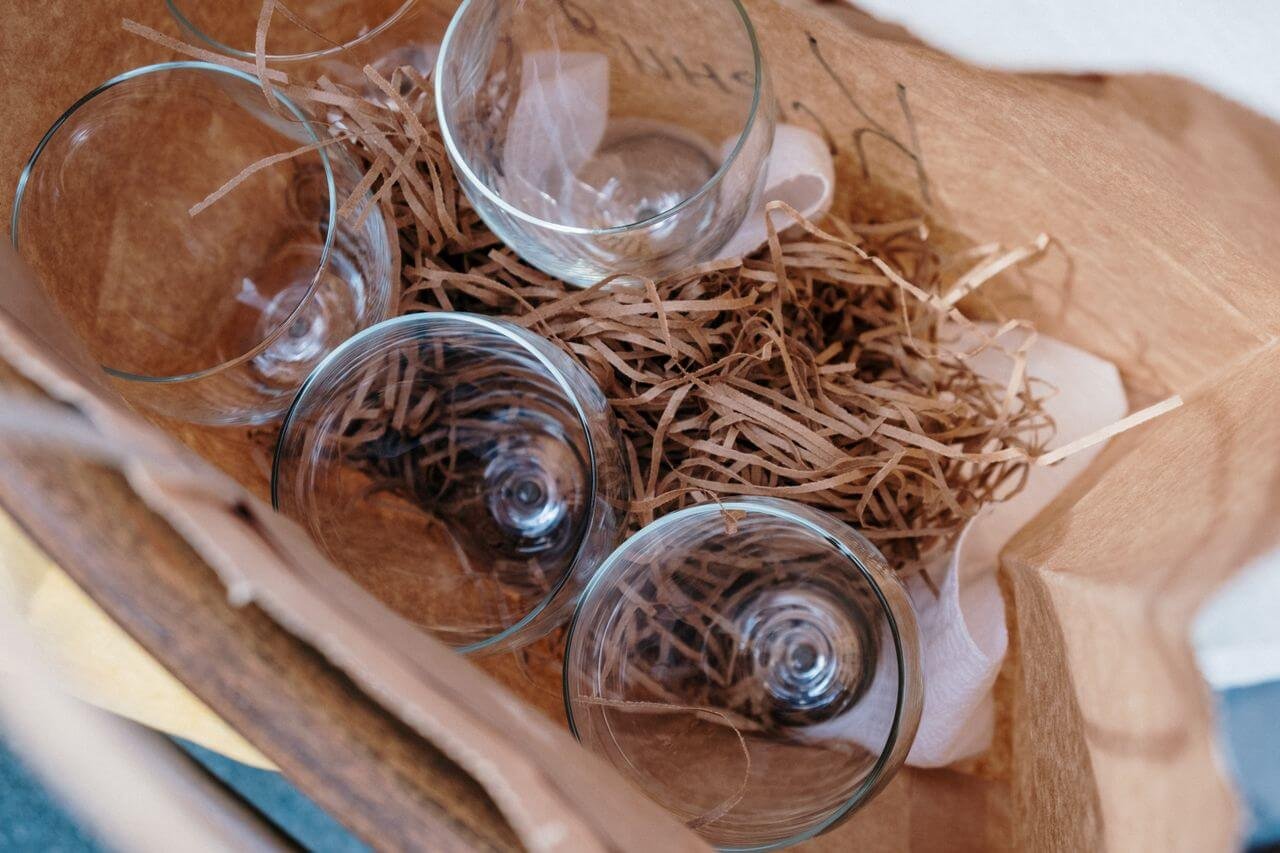
A rigid double-wall box with dividers protects glass better than perfect wrapping inside a flimsy box. If the walls flex, the load above pushes through the board and onto the contents.
Single-wall cartons are made for storage, not for stacking in a truck, and a used box is only worth keeping if its corners are still square. Dividers do more than separate pieces: they stop lateral movement, so a glass can’t slide into its neighbor on a turn. Purpose-made cell kits are easiest, but thick cardboard cut into a grid works, and small boxes packed one layer deep are a fair substitute.
Keep each box under about 15 kg. Past that point the bottom layer carries everything above it. Tape the bottom seam and the two lower corners in a cross pattern too, since that’s where boxes fail when they’re lifted by the flaps.
Packing paper or bubble wrap: which one protects glassware better
For everyday tumblers and plates, packing paper is enough and takes far less space; for crystal, thin stemware and anything you can’t replace, wrap in paper first and add bubble wrap outside.
Paper protects by conforming to the shape and putting a clean layer between surfaces. Bubble wrap protects by trapping air, which absorbs impact and spreads it wider. Paper is compact and cheap. Bubble wrap is bulky and better against a real hit.
| Material | How it protects | Space it takes | Best for |
|---|---|---|---|
| Acid-free packing paper | Conforms to shape, cushions when crumpled | Low | Everyday glass, plates, bowls, void fill |
| Bubble wrap | Air pockets absorb impact | High | Stemware, crystal, thin-walled pieces |
| Foam sheets | Thin, even cushioning between flat surfaces | Low | Stacked plates, layered boxes |
| Towels and cloth | Thick cushioning, reusable | High | Last-minute packing, void fill |
| Newspaper | Fills space, cheap | Medium | Void fill only, never against glass |
Layer order matters more than material choice. Paper goes against the glass so nothing presses on a coated surface, bubble wrap goes outside it when a piece needs shock protection, and crumpled paper fills the rest.
Newspaper is the one material to handle carefully. Ink transfers to glass and hands, and it’s hard to remove from etched or frosted surfaces. Use it to fill gaps, never as a first layer.
Matching the material to the piece
A tumbler needs two or three sheets of paper. A wine glass needs paper plus bubble wrap over the bowl and stem. A thick-walled bowl is fine in paper, two bowls to a stack. Anything printed or gilded gets paper only against the surface, since bubble wrap can leave pressure marks.
How to wrap each type of glassware
Wrap one piece at a time, fill the inside of anything hollow, and never put tape directly on glass. Residue is hard to remove, and on coated pieces it can pull the finish off.
Tumblers, cups and mugs
Crumple a sheet into a loose ball and push it into the cup. That stops the walls collapsing inward if something presses the rim. Lay the cup on two or three sheets at a diagonal, fold the near corner over the base, roll, then twist and tuck the ends. For mugs, run an extra strip around the handle and tape that strip to itself.
Pack mugs upright with every handle facing the same way, so the next layer sits flat instead of resting on a handle.
Wine glasses and stemware
Start at the bowl and work down. Wrap the bowl in two sheets, then spiral a third around the stem and base so the stem is supported along its length rather than at one point. One glass per wrap, always. Wrapping two together saves paper and breaks glasses.
Pack stemware upright and stack nothing on top. If the box is tall enough that glasses can shift upward, fill the gap above the rims with paper. Laying stemware at a slight angle in a cell box also works, as long as nothing rests on the stem.
Plates, bowls and serving pieces
Pack plates on edge, like records in a crate, never flat in a stack. Flat plates take the weight of everything above them and crack through the middle. Stand each wrapped plate vertically with paper between them.
Bowls go in pairs, nested with paper between, and no more than two to a stack. Pitchers, handled bowls and anything with a spout should travel alone with extra padding around the protrusion, since a handle takes the whole impact if the box tips.
Jars, bottles and glassware storage containers
Take the lid off and wrap it separately. The thread on the jar neck and the rim of the lid are both thin, and a lid screwed on tight concentrates pressure on exactly those edges. Gaskets and sealing rings go in a small bag taped to the lid, not loose in the box.
Small jars can nest inside larger ones, but only with padding between the walls. If the inner jar moves at all, pack it separately.
Packing glassware without packing paper
Clean towels, napkins, T-shirts and socks all work as wrapping; the cost is box space, roughly double. If you’re packing at short notice, this is the fastest option, because the materials are already in the house.
Use two towels per plate, one folded under and one over, and roll rather than fold glassware so the fabric stays tight. A clean sock makes a snug sleeve for a tumbler. Avoid anything with zips, buttons or heavy seams, and shake out lint first.
The trade-off isn’t only volume. Those towels are unavailable for the first week in the new place, and a kitchen packed entirely in cloth can need twice as many boxes. On a move priced by volume, buying paper is cheaper than using what you own.
Load the box so nothing can shift
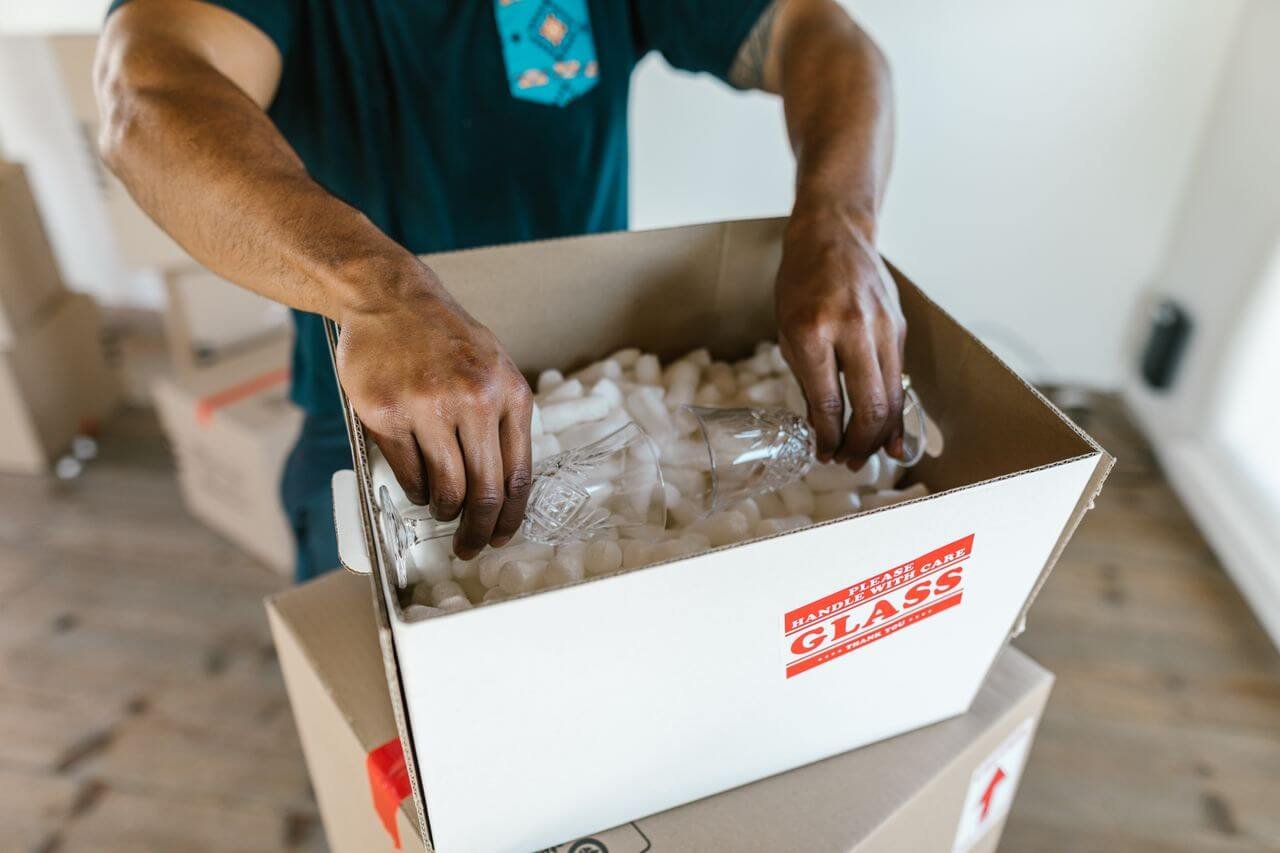
If a gently shaken box rattles, it isn’t packed yet. Movement inside the box is what turns a padded piece into a broken one.
- Add a 5 cm cushion of crumpled paper or bubble wrap to the bottom.
- Place the heaviest pieces first, upright, with dividers between them.
- Fill every gap as you go, not at the end. Small voids collapse under vibration.
- Put a sheet of cardboard between layers if you’re packing two tiers.
- Finish with a cushion above the top layer, then close the flaps and seal with two strips along the center seam and one across each end.
- Label at least two sides with contents, room and a number, and write “fragile” on the top.
Number the boxes. On a large move, forty similar cartons get loaded out of order, and a list on your phone tells you which to open first.
Loading, transit and short-term storage
Where the box sits in the truck matters as much as how it was packed. A well-packed box under a stack of furniture still fails.
Keep glass boxes out of the last row against the tailgate, where doors open and loads shift. Don’t put them on the floor under heavy items, and don’t stack more than two glass boxes high. Standing upright isn’t optional: a box on its side puts the load onto rims and stems instead of onto dividers.
Plan the route around temperature. A closed van in direct sun gets hot enough to stress cold glass, and a freezing garage followed by a warm kitchen is the same problem in reverse. Let boxes from an unheated space sit indoors first.
Short-term glassware storage adds one more handling cycle, so pack for it deliberately. Put boxes on pallets rather than a concrete floor, keep the unit dry and evenly heated, and don’t restack to reach something at the back; repeated restacking causes more breakage than the drive does. If the unit smells damp, unpack before the paper holds moisture.
Unpacking and setting up the glassware cabinet
Open boxes from the top, check rims and stems before washing, and don’t put anything away wet.
Cut the tape, take out one layer at a time, and set each piece on something padded rather than a countertop edge. Look at the rim first, then the foot, then the stem. Small chips are easy to miss when you’re tired.
Wash in warm water with a little mild soap, rinse, and dry completely before anything goes into a cabinet. Paper dust on a wet surface turns into a film. Warm water also protects cold glass: don’t run hot water onto a piece that has just come in from a cold truck.
Line the shelves before anything goes back. A non-slip mat stops glasses sliding when the door closes and cushions each base. Heavy items go on the lower shelf, stemware is where nothing is stacked above it, and a gap at the back keeps rims off the cabinet wall. For a fuller method of arranging shelves so glasses stay clean between uses, this guide on how to store clean glasses and cups covers the layout in detail.
Moving a commercial glassware inventory
Commercial moves fail on counting, not on cushioning. Household packing protects the piece; commercial packing also has to protect the count.
Rental fleets and event inventory
Glassware rentals live and die by the count. Every box should hold one specification, labeled with the quantity inside, so a return check can be done box by box instead of piece by piece. Mixing sizes saves space during the move and costs hours in the warehouse, because someone has to sort it back into sets.
If you use speed racks, wrap the rack rather than the glasses and tape a written count to the outside. Photograph the loaded racks before the truck closes.
Studio and workshop pieces
Glassware studios usually move pieces that can’t be replaced: one-off shapes, test glazes, unfinished work. The priority flips from density to isolation, so each piece gets its own compartment, decorated surfaces get paper contact only, and nothing is stacked. Custom crates are worth the cost for anything that took weeks to make.
Bars, restaurants and retail sets
Glassware sets have to travel as sets. A matched set that arrives with one broken piece is an inventory loss, not a partial delivery, so keep each set in one box and note the code on the label. Sample pieces should travel in a separate marked box, or they end up in service and vanish from the showroom.
FAQ
How long can packed glassware stay in storage?
There’s no fixed limit, but three things decide how long is safe: moisture, weight and how often the boxes get moved. In a dry, evenly heated space, boxes on pallets can sit for months. Damp air is the real risk, since paper holds moisture against glass and leaves marks. Check the boxes every few weeks and unpack anything that feels soft.
Should you wash glassware before packing?
Yes, and dry it completely. Cleaning first lets you see chips and hairline cracks you’d otherwise pack and discover later. Drying matters more than washing: a drop of water trapped under paper for a month leaves a mineral ring that’s hard to polish out.
Is household packing enough for a long-distance or international move?
Usually not on its own. Longer transit means more handling, more humidity swings and, on international shipments, at least one inspection where boxes are opened and repacked by someone else. Use double-wall boxes, add foam to the corners, and consider professional packing for anything irreplaceable. For high-value pieces, a custom crate costs less than the replacement.