Most crystal in a family cabinet was bought between 1960 and 1990, usually as a wedding gift, and much of it has not left the shelf since. When the cabinet is cleared, the question arrives with it: is any of this worth money, or is it just heavy glass? Settling crystal vs. glass comes first, because it decides whether a piece belongs in the resale market at all.
A single piece of ordinary crystal glassware usually sells for $2 to $35, a set of eight to twelve stems for $120 to $400, signed art glass for $100 to $1,500, and rare antique cut glass can reach five figures. Most households own the low end, because the market is full of the same patterns.
The numbers below break that down by type, explain which part of the market still moves, and show what a seller keeps after fees.
What crystal glassware is worth in 2026
Resale value in 2026 turns on type, condition, and completeness more than age. Everyday stemware trades for a few dollars a glass, complete sets in the low hundreds, and signed or antique pieces in the hundreds to thousands.
Three prices get confused here. Resale is what a buyer pays this month. Insurance replacement value is what a retailer charges for the same piece, often several times higher once a pattern is discontinued. Original retail price has almost no bearing on either. Figures below are resale and auction results through October 2026.
| Type | Typical resale, per piece | Typical set or lot | What moves the number |
|---|---|---|---|
| Everyday lead-free stemware, current production | $2 to $8 | $30 to $90 for six | Low replacement cost, endless supply |
| Mass-market lead crystal stems, 1960s to 1990s | $5 to $35 | $120 to $400 for eight to twelve | Pattern demand, chips, clouding |
| Unsigned cut decanters and bowls | $15 to $60 | $40 to $150 for small lots | Cut depth, size, condition |
| Crystal barware | $10 to $40 | $60 to $140 for four | Usable shapes, holiday demand |
| Signed art glass vases and figures | $100 to $1,500 | Rarely sold as sets | Maker, colour, era, box |
| Antique hand-cut pieces, 1876 to 1917 | $50 to $500 | $300 to $2,000 | Signature, pattern rarity, damage |
Stemware, tumblers, and serving pieces
Stemware is the weakest and most common category. Millions of stems were made in the same handful of patterns, so a buyer has thousands to choose from and no reason to pay much. Barware holds up better because people use it. Cut depth separates prices more than size does.
Sets versus single pieces
A complete set beats the sum of its parts, but only while it stays complete. Eight matching stems in a discontinued pattern price at $120 to $400. The same eight across four patterns become a mixed lot near the bottom of the range. Single goblets are hardest to sell, because the only people who want one are replacing a break.
Signed pieces and antique cut glass
An etched or engraved mark lets a buyer date a piece, confirm the pattern, and compare recorded sales. Signed pieces from documented patterns can bring several times what an unsigned piece of the same quality sells for. American hand-cut glass from roughly 1876 to 1917 is its own market: a signed punch bowl brought $33,600 at auction in 2023, and a signed centrepiece bowl in sterling mounts passed $130,000 in 2024.
Is crystal glassware still valuable?
Yes, but only in parts of the market. Signed art glass, rare patterns, complete boxed sets, and usable barware still find buyers. Ordinary clear stemware made in large numbers has stopped being an investment.
The market split in two over the last two decades, and the halves no longer move together. Replacement services buy only what customers ask for, so common patterns get declined while the warehouse is already overstocked. The middle has no natural buyer left.
What lost value, and why
Supply is the main cause. The same patterns were produced in huge numbers for decades, and almost every set survived. Fewer households set a formal table, the ones that do prefer glass that goes through a dishwasher, and shipping a box of stemware can cost as much as the glasses.
What still sells
Demand concentrates where supply is thin: signed pieces, unusual colours, rare patterns, and forms people still use. Flutes and decanters sell from November into the new year, boxed sets sell as gifts into mid-December, and spring weddings are the second window. Sets in original packaging outperform, because the box answers the question about chips before a buyer asks it.
Where studio glass fits
Work from glassware studios sits in a different market. Pieces are signed, often numbered, and made in small runs, so the oversupply problem does not apply. Small studio vases commonly bring £120 to £400 at auction, and work by artists with international exhibition histories reaches thousands. Bubbles and a pontil mark are evidence of hand work, not defects.
How to tell if crystal glass is valuable
Sound, weight, and sparkle tell you whether a piece is crystal. They do not tell you whether it is worth much. Value comes from the maker, the pattern, the condition, and how many other people are selling the same thing.
Run the checks in order: material, then maker, then condition. Most sellers stop at the ring test, hear a clear tone, and assume the piece is valuable.
Material checks
Lead crystal is heavier for its size, throws small rainbow flashes, and rings longer than soda-lime glass. Sound alone is not conclusive, since modern lead-free crystal also rings. Under Council Directive 69/493/EEC, glass needs at least 24% lead oxide to be sold as lead crystal and 30% for full lead crystal, with minimum density and refractive index to match. Labelling in the United States is looser.
Marks and signatures
Acid-etched marks look frosted and sit flush; laser marks are finer and brighter; moulded marks belong to mass production rather than to a workshop. Look on the base, under the foot, and along the lower body under strong light. A missing mark settles nothing, since several of the most collected workshops never signed their production.
Cut versus pressed
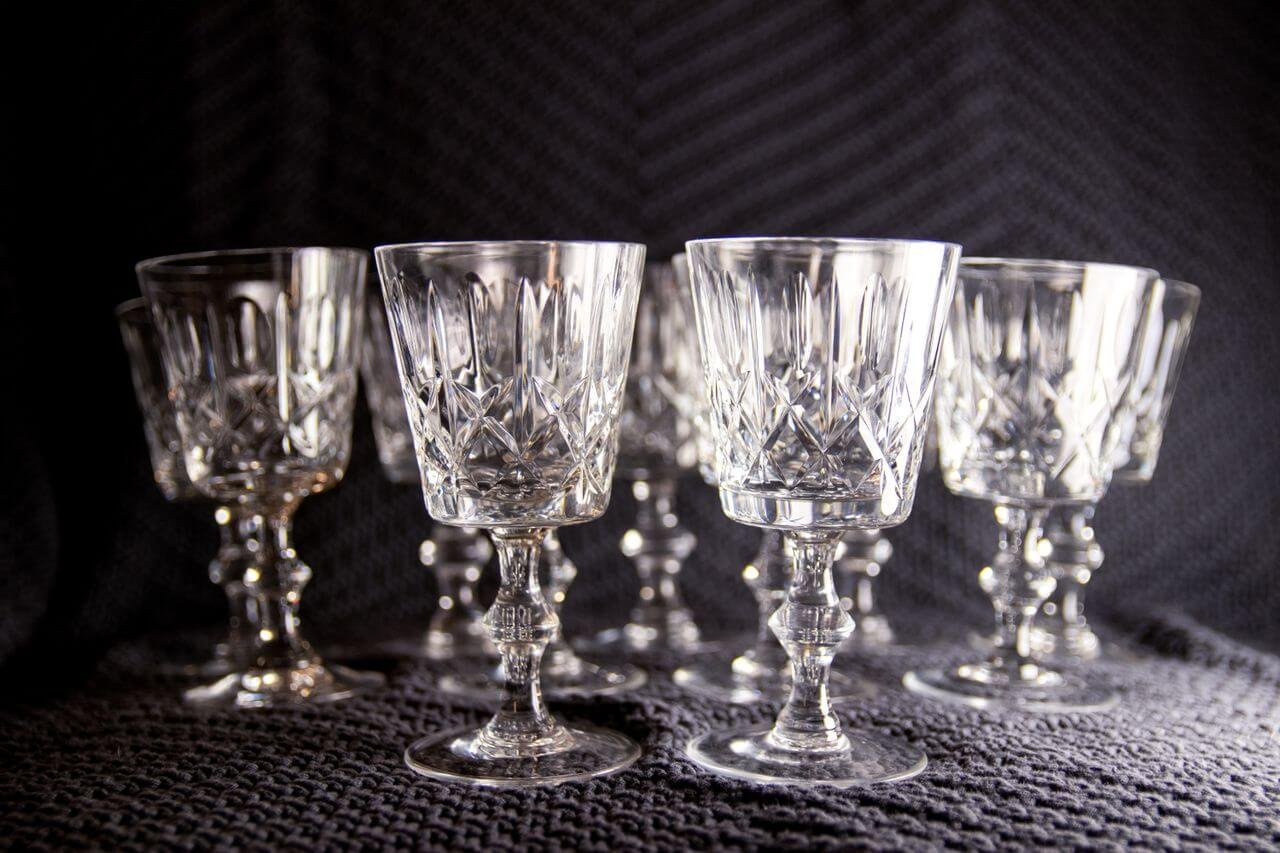
Run a fingertip across the decoration. Hand-cut crystal has crisp edges where facets meet and slight variation in depth. Pressed glass has rounded edges, uniform depth, and often a seam where the mould halves joined.
Damage that kills value
A chip on the rim or foot can halve a piece’s value, and a crack removes it from the market. Clouding, the milky haze that will not wash off, is etched glass from dishwasher detergent or hard water. A decanter without its stopper is worth a fraction of a complete one.
What makes one piece worth more than another
Maker, pattern rarity, condition, completeness, colour, and provenance, roughly in that order. Two pieces of the same size and age can differ tenfold on those six points alone.
| Factor | Effect on price | Why buyers pay for it |
|---|---|---|
| Maker or signature | Several times an unsigned equivalent | Attribution, documented pattern |
| Pattern rarity | Large, especially discontinued lines | Completing a set nobody else can complete |
| Condition | A chip can halve it; clouding ends it | No repair path at reasonable cost |
| Completeness | Premium for full sets in original boxes | Immediate use, no searching |
| Colour | Premium for cut-to-clear and period colours | Scarcity and display appeal |
| Provenance | Modest to substantial, with documentation | Receipts and boxes reduce risk |
Condition is a storage problem
Condition is the only factor a seller can still influence, and most damage happens in the cabinet. Stacked glasses chip under their own weight.
A glassware cabinet works best when nothing touches: a finger’s width between stems, glasses upright rather than inverted, heaviest pieces low. For longer glassware storage, wrap each piece in acid-free tissue inside divided boxes, and use glassware storage containers with individual compartments so rims never meet.
How much can you sell crystal glassware for?
Most sellers receive a third to a half of retail replacement value, and often less for common patterns. A buyout service pays wholesale, an auction pays the hammer price minus commission, and a private sale keeps the most but takes the longest.
| Channel | Typical cost to seller | Speed | Best for |
|---|---|---|---|
| Replacement-matching service | None; the price is a wholesale offer | Days | Common patterns still in demand |
| Specialist auction house | Roughly 10% to 20% seller commission | Two to six weeks | Signed, rare, high-value pieces |
| Online marketplace | Roughly 12% to 15% in fees | Days to months | Mid-range pieces |
| Consignment shop | Roughly 30% to 50% commission | Unpredictable | Local buyers, hands-off sellers |
| Direct sale to a dealer | Roughly 30% to 50% of retail | Immediate | Quick exits, low-value lots |
Replacement-matching services
These services fill gaps in discontinued patterns, so offers depend on what they hold. A piece they need brings a wholesale price within a day or two; a common pattern they are overstocked on gets declined regardless of condition. There is no commission and no shipping, but the offer is not negotiable.
Auction houses
Auction works when bidding can push a piece past book value, which means signed art glass, rare patterns, and large serving pieces. Commissions commonly run 10% to 20%. A specialist decorative arts sale usually outperforms a general sale for the same piece.
Marketplaces and consignment
Selling directly keeps the highest share and carries every risk: packing that has to survive a courier, returns on a chipped glass, and competition with thousands of near-identical listings. Consignment shops take 30% to 50% in exchange for local display and no shipping.
Does anybody buy crystal glassware?
Yes, in four groups. Replacement buyers need one specific glass. Decor resellers buy bowls, vases, and coloured pieces. Event suppliers maintain glassware rental fleets and buy glassware rentals stock in durable, uniform, replaceable shapes rather than delicate stems. Collectors and dealers buy signed or rare pieces.
What does not sell is bulk clear stemware with no pattern demand, mixed lots, and anything cloudy or chipped. Most of it is donated.
Why new crystal glassware costs what it does
In a new piece the glass itself is a small part of the price. Forming method, cutting time, breakage rates, packaging, and freight make up most of it, which is why two glasses of the same size can differ fivefold at retail.
The stack is predictable. Batch and melting come first, then forming, where machine pressing is fast and hand blowing needs a skilled team. Cutting and polishing follow, and deep hand work can take longer than every other step combined. Quality control adds a breakage allowance, and export packaging, freight, and margin finish the number. New six-piece sets therefore retail from about $40 to $300, and single stems from $8 to $60.
That breakdown is a buying tool. A restaurant replacing glass monthly should not pay for hand-cutting; it will lose within a year. A hotel specifying glassware sets needs uniform capacity and replaceable shapes more than a rare pattern. Decide the use case first, then the forming method, then the decoration, and price the packaging last. Suppliers who quote this way can offer custom glassware sets that match the job instead of a catalogue default.
FAQ
Is lead crystal safe to drink from?
Occasional use is not the concern; storage is. Lead can migrate into acidic liquids such as wine, citrus juice, and vinegar, and the amount rises with contact time. A glass used for an hour at dinner is a different exposure from a decanter holding port for months. Use lead crystal for serving and display.
Can cloudy crystal be restored?
Only by removing the damaged surface. Clouding is etched glass, so restoration means polishing away a thin layer, by hand or through a professional service. The piece comes back clearer and slightly thinner, and the cost usually exceeds the value of anything below the signed tier.
How should sold crystal be packed?
Individually and upright. Wrap each piece in acid-free tissue or bubble wrap, stand it in a divided box, and fill any gap so nothing shifts. Double-box the outer carton with padding between the layers, mark it fragile, and photograph the packed box before sealing. Damage in transit is the most common reason a sale falls apart.