Ask five suppliers how many ounces a cocktail glass holds and you will get five answers. The name covers a stemmed cone, a shallow coupe, and a short tumbler, and each ships in several sizes. Buyers sourcing custom glassware for a hotel bar or a retail line meet the same gap: the label says 6 ounces, the recipe calls for 3, and the invoice does not say which one you were charged for.
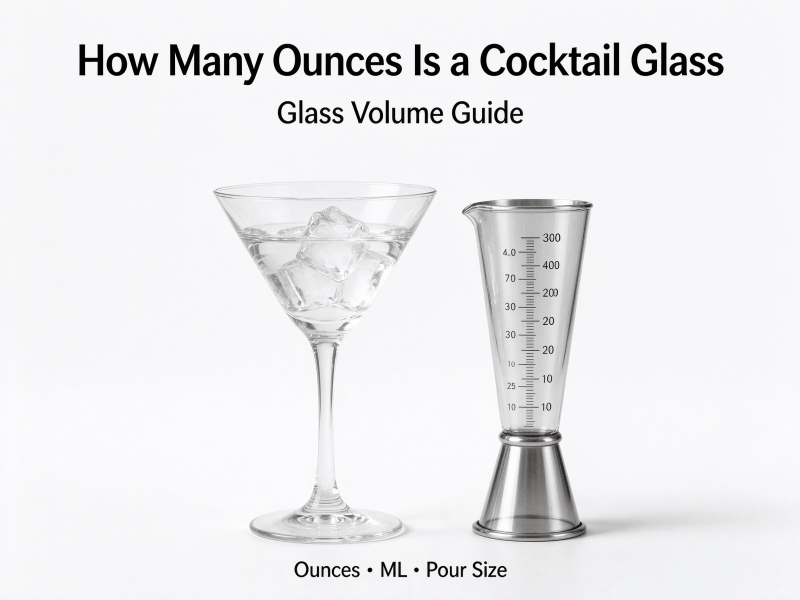
A classic stemmed cocktail glass, the V-shaped one most people picture, holds 4 to 6 ounces, or 120 to 180 millilitres. Oversized versions run 8 to 10. Capacity is not pour: a 6-ounce glass usually receives 3 ounces, and the rest of the space is there for aroma, foam, and the movement of a drink carried across a room.
The table below pairs each shape with both numbers, which is the pairing a buyer orders against.
How many ounces a cocktail glass holds, by shape
Most cocktail glasses sit between 4 and 6 ounces. The wider family runs from 1.5 ounces at a shot glass to 20 at a hurricane, and the useful figure for ordering is the typical pour, not the maximum the glass can hold.
Catalogues disagree with each other. One supplier lists a 5-ounce cocktail glass, another a 9-ounce glass under the same name, and both are describing a stemmed V. The capacities below are typical commercial sizes rather than regulated definitions.
| Shape | Capacity (oz) | Capacity (ml) | Typical pour | Drinks built for it |
|---|---|---|---|---|
| Cocktail glass, classic V | 4 to 6 | 120 to 180 | 2.5 to 3.5 oz | Dry martini, gimlet |
| Cocktail glass, oversized | 8 to 10 | 240 to 300 | 3 to 4 oz | Espresso martini, bar martini |
| Coupe | 6 to 8 | 180 to 240 | 3 to 4 oz | Daiquiri, sidecar |
| Nick and Nora | 4 to 5 | 120 to 150 | 2.5 to 3 oz | Manhattan, vesper |
| Rocks or old fashioned | 6 to 10 | 180 to 300 | 2 to 3 oz plus ice | Old fashioned, negroni |
| Highball | 8 to 12 | 240 to 360 | 1.5 to 2 oz plus mixer | Gin and tonic, whisky soda |
| Collins | 10 to 14 | 300 to 420 | 2 oz plus mixer | Tom Collins, mojito |
| Margarita | 8 to 12 | 240 to 360 | 4 to 6 oz | Margarita, frozen blends |
| Hurricane | 14 to 20 | 400 to 600 | 5 to 7 oz | Tropical and layered drinks |
| Shot | 1.5 to 2 | 45 to 60 | 1.5 oz | Straight spirits |
One US fluid ounce is 29.5735 ml, so 4 ounces is 118 ml and 10 ounces is 296 ml. A stated 6 oz can mean 177 or 180 ml depending on who wrote the catalogue.
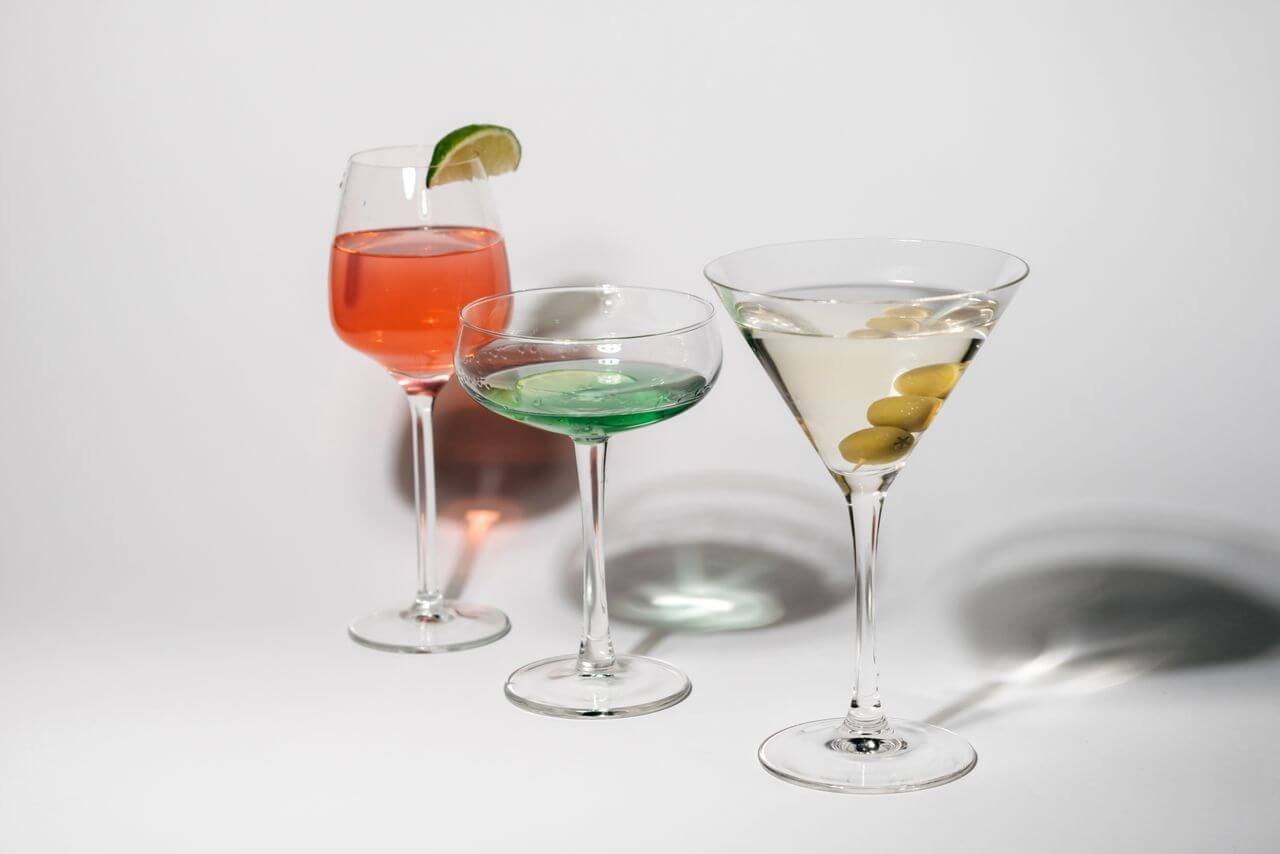
Stemmed cocktail and martini glasses
This is the glass the name originally described. The wide, shallow cone puts a large surface of liquid in contact with air, which pushes aroma up before the first sip, and the same surface is why a cold drink in one loses its chill within minutes.
The 8 to 10 ounce versions exist mostly for presentation. A large bowl leaves room for a garnish and photographs well. The trade-off is real: a 3-ounce drink in a 10-ounce cone sits low, spreads thin, and warms faster than the same drink in a 5-ounce glass.
Coupes, Nick and Nora, and the tumblers
A coupe at 6 to 8 ounces has a rounder bowl and a wider opening than the classic cone. The Nick and Nora at 4 to 5 ounces is deeper and narrower, so a 2.5-ounce stirred drink fills more of the glass. Less air above the liquid means slower warming and less sloshing on a tray.
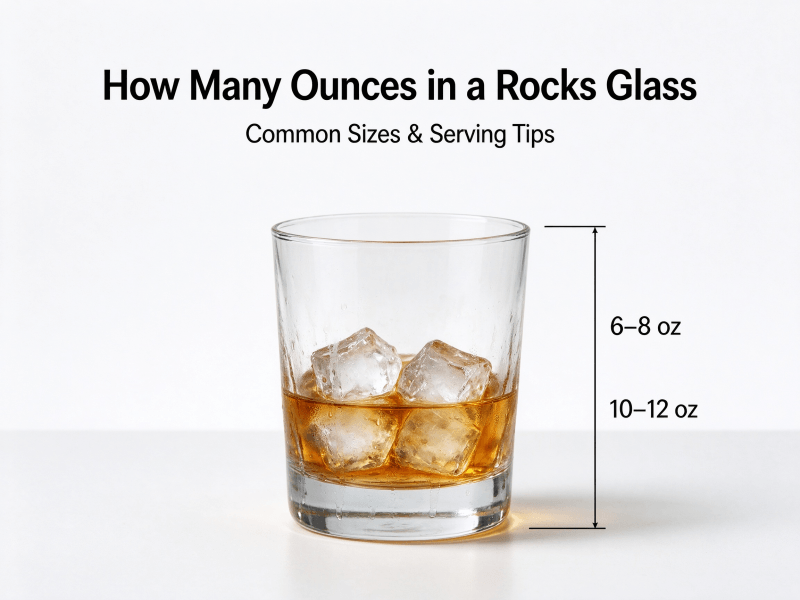
The tumblers work the same logic in reverse. A rocks glass at 6 to 10 ounces has to take a large ice cube plus 2 to 3 ounces of spirit without crowding the rim. A highball at 8 to 12 ounces is tall and narrow, which keeps the ice column intact and holds carbonation. The Collins is taller again, with more room for mixer.
What is the standard size of a cocktail glass?
Nothing fixes it. No metrology or food-service rule sets the capacity of a cocktail glass, and a supplier can put almost any stemmed glass under that name.
The 4 to 6 ounce convention is arithmetic rather than regulation. A classic recipe builds 2.5 to 3.5 ounces of liquid. Add the 1 to 2 ounces of headroom service requires and the answer lands in the middle of that range. Where menus state a volume, the figure refers to the pour, not the glass.
Capacity, pour, and headroom: three numbers, not one
A 6-ounce glass is expected to hold a 3 to 4 ounce drink, and the unused ounce or two is not waste. Headroom absorbs foam, a garnish, the displacement of ice, and the tilt of a full glass being carried through a busy room.
Getting this wrong is the commonest specification error in a bar project. Order a 5-ounce glass for a drink that builds to 4.5 ounces and every serve spills at the pass. Order a 12-ounce glass for the same drink and the cocktail warms before it is half finished. The rule of thumb is to leave 1 to 2 ounces between the drink volume and the capacity: the lower end for spirit-forward drinks served up, the upper end for anything shaken with egg white or built over ice.
Ice, dilution, and alcohol
Ice takes up volume before it adds any. A highball filled with ice can lose 3 to 4 ounces of usable space to the cubes alone, which is why a 2-ounce pour plus 4 ounces of tonic needs an 8-ounce glass and will overflow a 6-ounce one.
Meltwater moves the numbers the other way. A martini built at 70 ml is strained into the glass at closer to 90 ml, because stirring over ice adds water. The recipe volume is what the bartender measures; the served volume is what the glass has to hold.
Alcohol is a third measurement. In the United States a standard drink contains about 0.6 fluid ounces of pure alcohol, the amount in a 1.5-ounce measure of 40 percent spirits, as the National Institute on Alcohol Abuse and Alcoholism defines it. A 3-ounce pour of 45 percent gin carries the alcohol of roughly two and a quarter standard drinks, whatever the box says.
Reading capacity on a spec sheet
Three details decide whether two glasses with the same stated capacity behave the same way in service.
Where capacity is measured to comes first. Brim capacity runs to the very top of the rim, fill capacity to a line below it, and suppliers do not always say which one they mean. A glass sold as 10 ounces on a brim measurement often holds 8 comfortably.
Rim diameter comes second, since two 6-ounce glasses can differ by 20 mm across the opening and the wider one spills sooner. Wall thickness comes third: a thick-walled 6-ounce tumbler holds less usable liquid than a thin-walled one, which is what catches buyers working from drawings instead of samples.
Is a martini 2 or 3 oz?
Nearly every published dry martini recipe lands on the same ratio: 60 ml of gin to 10 ml of dry vermouth, about 2.4 ounces before dilution. Stirred and strained, it arrives at roughly 3 ounces, so both figures are right depending on what is being measured.
The confusion comes from mixing three quantities: what goes into the mixing glass, what lands in the serving glass, and what the glass can hold. Only the middle one is what a guest drinks.
Recipe volume versus served volume
At 70 ml before dilution, a dry martini is a small drink. Stirring it for the 20 to 30 seconds a proper chill takes pulls water out of the ice, and the strainer leaves that water in the drink. The serve arrives at about 85 to 95 ml, at a lower strength than the recipe suggests. That is why a 5-ounce cocktail glass suits it: three ounces of liquid leaves two ounces of headroom.
Why bar pours drifted upward
The oversized cone changed expectations. Once a martini arrives in a 10-ounce glass, a 3-ounce pour looks thin, so the pour grows to 4 or 5 ounces and the drink becomes something other than the one on the recipe card. Fix the pour independently of the glass instead: work out the drink, add the headroom, then choose the shape.
What is considered a cocktail glass?
Strictly, a cocktail glass has a stem, a bowl, and no ice, and it holds drinks that were shaken or stirred and then strained. In catalogues the term is looser, and any glass a cocktail is served in can appear under it.
Both definitions are in circulation, and the difference causes ordering problems when buyer and supplier work from different ones.
The narrow definition
A stem keeps the hand off the bowl so the drink stays cold. A bowl wide enough to release aroma and shallow enough that the drink is not buried. No ice, because the drink was chilled and diluted in the mixing glass. By that definition the family is small: the V-shaped glass, the coupe, and the Nick and Nora. A rocks glass is a rocks glass even when it holds a negroni.
The catalogue definition
Commercial catalogues group by end use rather than geometry. Under a cocktail glass heading you will find cones, coupes, tumblers, highballs, and margarita glasses, which tells a buyer nothing about capacity or shape. Order by shape and volume instead: “stemmed, 6 ounces, 90 mm rim” gets what you wanted.
Choosing cocktail glassware for a venue or a product line
Fix the pour first, choose the shape second, then pick a capacity with 1 to 2 ounces of headroom above it. Finish, thickness, and packing follow from those three decisions.
The sequence matters because drink specs are cheaper to revise than a glass mould.
Glassware sets versus open stock
Packaged glassware sets solve consistency. Six glasses from one mould, one thickness, one capacity, delivered together, is the simplest route for a small bar or a retail range. The limit is replacement: sets come in fixed quantities, and once a set is discontinued the remaining pieces are hard to match.
Open stock is bought by the case in whatever quantity the venue needs, which suits operations running several hundred covers a night. Capacities have to be verified case by case, because two shipments of the same nominal size can come off different moulds.
Glassware rental, studios, and custom runs
Rental fleets hold glasses from more than one production run, and small differences between runs show up as uneven pours at events where staff are working fast. A fill line on the glass, or a jigger at the station, removes the reliance on the glass being exactly what the label says.
Glassware studios developing a new shape run into the same variable: the sample. Wall thickness changes internal volume without changing the outer profile, so a design that measures 6 ounces on a drawing can come out at 5.6 or 6.4 in production. Fill the first sample with water, measure what it holds to the intended fill line, and adjust the drink spec or the mould from there.
Storing cocktail glassware without chipping the rims
Rims chip when they carry weight or touch each other. Store stemmed glasses upright or hanging by the foot, leave a finger’s width between pieces, and never stack one inside another.
The rim is the thinnest part of a drinking glass and the part a guest notices first. A chip costs the glass, and in a bar it also costs the drink already poured.
Shelf height is the limiting factor in a glassware cabinet. Stemmed glasses need clearance above the rim, either standing on the foot with enough headroom for the bowl or hanging from a rack by the base. Tumblers can stand but should not be stacked more than two high, because the base of the upper glass lands on the rim of the lower one. Where pieces travel rather than sit, glassware storage containers with individual dividers do the work that distance does on a shelf. The principles for how to store clean glasses and cups hold at home as well as behind a bar: dry thoroughly, keep the cabinet closed, and never leave a glass in the sink long enough for the rim to meet the bottom.
FAQ
How do you measure cocktail ounces without a jigger?
A tablespoon is half a fluid ounce, so six tablespoons is 3 ounces and three tablespoons is a 1.5-ounce measure. A kitchen scale works too if you know the density of what you are pouring, which rules out most syrups. For repeat service, a marked fill line on the glass beats any improvised measure.
How many cocktails does a 750 ml bottle make?
About 16 at a 1.5-ounce measure, and about 10 at the 2.5 to 3 ounce pours common in a stemmed glass. That gap is why bottle costing has to start from the pour on the menu rather than from the glass size.
Can you serve a small pour in a large cocktail glass?
You can, and bars do, but the drink warms faster and the aroma spreads thin across the empty bowl. Chill the glass before service if the bowl is much larger than the pour. A glass one size down usually serves the drink better than a large one filled a third of the way.