Glass has a way of looking more capable than it is. A tumbler, a storage jar and a casserole dish can share the same clarity and the same shelf in the cupboard, yet only one of them is built to survive an oven. Most broken glassware in home kitchens, and a good share of the returns handled by anyone who sells glass, traces back to that gap between appearance and specification.
Yes, you can put glassware in the oven, but only the specific pieces that were manufactured and rated for it. Oven safety is a property of the material and the production process, not of thickness, clarity, price or how sturdy a piece feels. Borosilicate bakeware and tempered soda-lime cookware are engineered for oven heat. Drinking glasses, storage jars, decorative pieces and thin tableware are not, even when they look substantial.
The rest of this guide sorts that distinction item by item, because can you bake glassware safely depends far more on which piece you are holding than on the temperature you set.
Which Glassware in Your Kitchen Is Oven Safe
Only cookware sold as oven-safe glassware is oven safe. The category is defined by how a piece was designed and rated, not by what it is made of in general terms, so the same material can appear in an oven-rated dish and in a decorative bowl that must never see heat.
The reliable way to sort a cupboard is by intended use rather than by look.
Baking Dishes, Casserole Pans and Roasting Trays
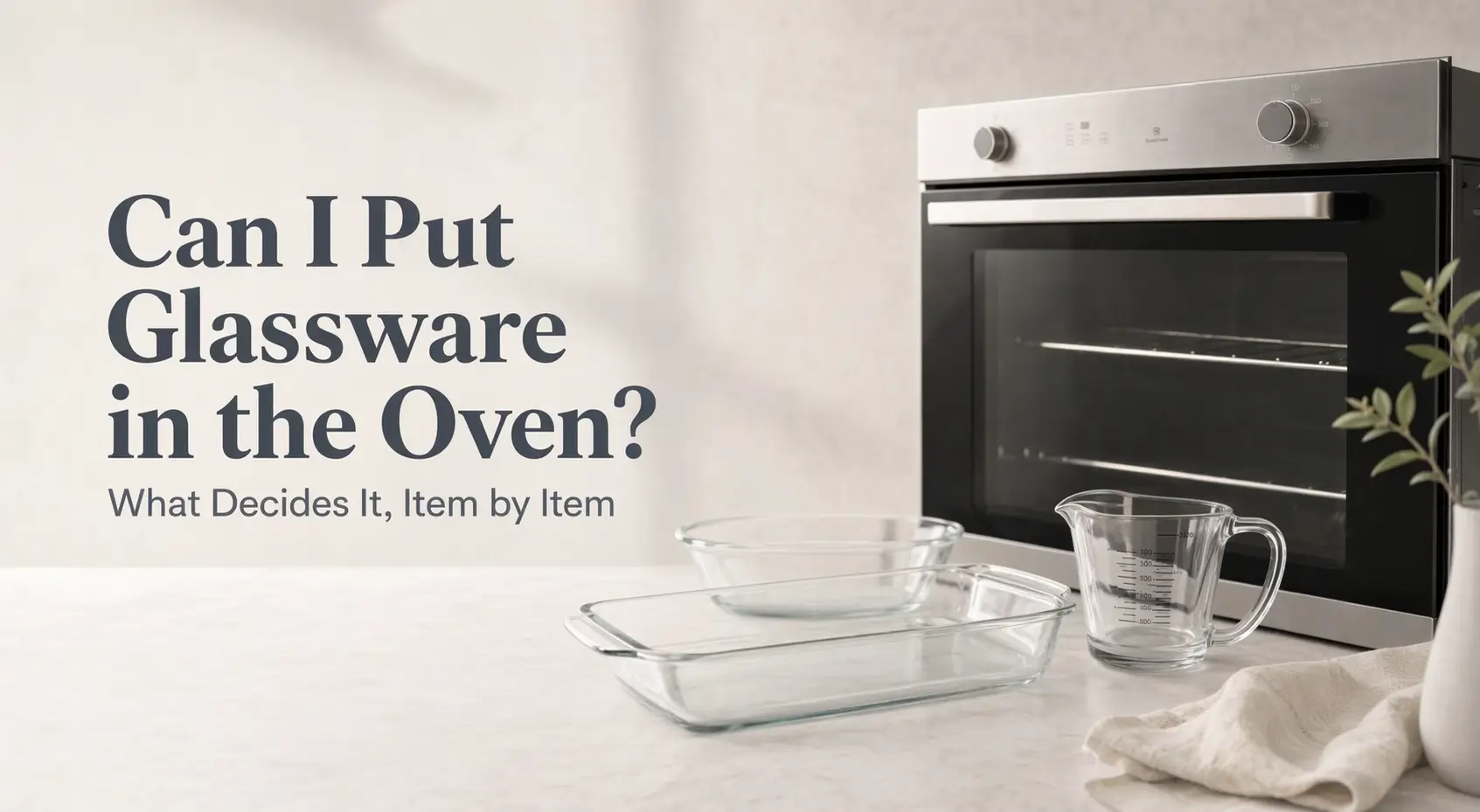
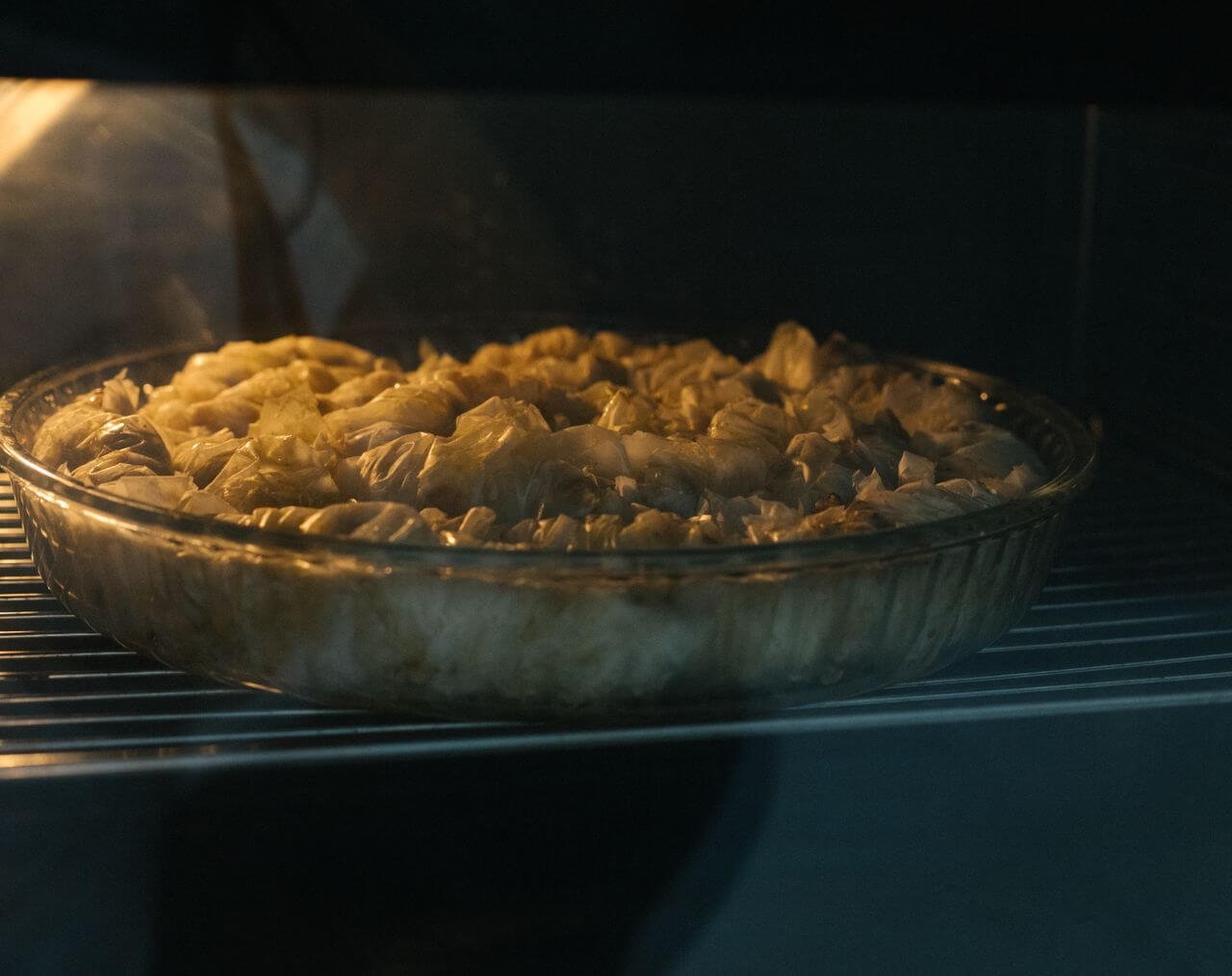
These are the pieces built for the job. A rectangular baker, an oval gratin dish or a round casserole with an oven rating is formulated or tempered for the thermal gradient an oven creates. Applied handles are a common crack origin, because they heat and cool at a different rate from the body they are bonded to.
Drinking Glasses, Tumblers and Mugs
This is the highest-risk group in most kitchens and the one most often used by mistake. Thin walls change temperature almost instantly, the rim is a sharp edge with little material to spread load, and a thick base holds heat while the wall above it does not.
Mason Jars and Storage Jars
Jars sit in an ambiguous middle. Many are rated for water-bath processing or pressure canning, a wet-heat process with its own ceiling, which is not the same as a dry oven rating. Whether mason jars are oven safe depends on the individual specification, and the answer is often no. Metal lids and rubber seals have limits far below the glass itself, so a jar that tolerates dry heat may still fail as an assembly.
Measuring Cups and Mixing Bowls
Measuring cups are frequently made from low-expansion glass and handle oven temperatures well, which leads people to assume they can also sit on a stovetop. They cannot. Mixing bowls are thinner and wider than bakeware, with a large open rim that cools fastest, so the rim cracks first.
Decorative, Colored and Vintage Pieces
These carry the least certainty of all. Coloring oxides and decorative coatings are not formulated with food-heat performance in mind, and vintage formulations changed substantially across the twentieth century, so the same silhouette from the 1950s and from the 1990s may be different materials.
| Item in the cupboard | Typical verdict | Reason |
| Rectangular baker, gratin dish, casserole | Oven safe if marked | Designed and rated for dry oven heat |
| Glass lid matched to a baker | Usually safe to the dish rating | Check the rating, not the fit |
| Drinking glass, tumbler, mug | Not oven safe | Thin wall, sharp rim, no rating |
| Storage jar, mason jar | Only if marked oven safe | Canning ratings are not oven ratings |
| Measuring cup | Often heat resistant | Still not for stovetop or direct flame |
| Mixing bowl | Rarely rated | Thin wall and large rim |
| Decorative, colored, vintage | Treat as not oven safe | Unknown composition |
How to Tell If Glass Is Oven Safe
The answer is printed on the piece or on its original packaging, and nowhere else. Not the clarity, not the ring when tapped, not the weight, not the price. Manufacturers mould, etch or print the rating where a buyer can read it before the first use.
Turn the piece over. The base is flat, survives handling and is the surface a buyer naturally inspects.
The Markings That Matter
Molded lettering is pressed in during forming and is the most durable. Etched marking can wear smooth after years of scouring, and printed enamel is the least permanent, so a piece whose marking has rubbed away should be treated as unrated. When a temperature is stated, read it as a ceiling rather than a target.
Reading the Symbols Correctly
The most common error is treating any heat-related pictogram as an oven rating.
| Marking | Meaning |
| The words oven safe or oven proof | Rated for oven use, subject to any stated limit |
| A small oven pictogram | The same statement in symbol form |
| A number in degrees | The rated ceiling, not a target temperature |
| A microwave pictogram alone | Safe for microwave energy, says nothing about oven heat |
| A dishwasher pictogram alone | Withstands washing cycles, says nothing about heat |
| A fork and glass pictogram | Food-contact safety, not thermal performance |
| No marking at all | Storage and serving ware until proven otherwise |
What to Do When There Is No Marking
Absence of a marking is common on imported, unbranded and gift items. Work backward from how the piece was sold. A dish that arrived as part of a bakeware set, with a glass lid and a care leaflet, is very likely rated. A jar sold as a pantry container, a glass sold as drinkware, or a bowl sold as a serving piece almost certainly is not, however solid it feels.
Is Borosilicate Glass Oven Safe
Yes. Borosilicate glass is the family most closely associated with oven and laboratory use, and it tolerates heat better than ordinary household glass. The caveat is that borosilicate describes a composition, not a promise. A thin borosilicate vessel with no rating is still a thin vessel with no rating.
Everything comes down to expansion. Every glass expands as it warms, and what matters in an oven is not how much a piece expands but how unevenly it does so across its own wall.
Why Low Expansion Matters
Borosilicate substitutes boron trioxide for part of the soda and lime in a conventional recipe, and that substitution suppresses expansion sharply. Its coefficient of linear thermal expansion sits near 3.3 x 10^-6 per kelvin, against roughly 9 x 10^-6 per kelvin for soda-lime glass, so a wall under the same temperature difference develops roughly a third of the stress.
The distinction is formalized rather than folkloric. ASTM E438 separates low-expansion borosilicate glass as Type I from soda-lime glass as Type II, and sets the linear expansion of Type I in the region of 32 to 33 x 10^-7 per degree Celsius against 90 to 93 x 10^-7 for Type II. The same standard puts the softening point of borosilicate near 815°C and soda-lime near 700°C, both far above any domestic oven: glass in an oven does not melt, it cracks from stress. For the composition itself see borosilicate glass, and for how such claims are verified in production see understanding heat-resistant glass.
Tempered Soda-Lime Is Not a Downgrade
Tempered soda-lime takes the opposite route to the same destination. The glass is reheated and then chilled rapidly with controlled air, locking the surface into compression while the core stays in tension. That stored stress gives several times the impact resistance of annealed glass, and provides headroom when oven heat adds new stress on top.
What tempering cannot do is change the expansion coefficient. The material still moves as it warms, it simply has more reserve before it fails, and the failure mode differs. Borosilicate tends to develop a crack that starts at an edge and propagates. Tempered soda-lime holds until its reserve is exhausted and then releases suddenly, which is why a dish that has survived years of use can appear to break without warning.
| Property | Borosilicate | Tempered soda-lime |
| Linear expansion | About 3.3 x 10^-6 per K | About 9 x 10^-6 per K |
| Thermal shock tolerance | High | Moderate, improved by tempering |
| Impact resistance | Good | High, from surface compression |
| Typical failure | Gradual crack from an edge | Sudden release into fragments |
The Same Shape, Two Different Materials
A product line can also change composition without changing its name or silhouette, so bakeware sold in one market may be borosilicate while the visually identical item sold in another is tempered soda-lime. Product names and photographs are useless as material evidence.
Oven Temperature in Practice: 180°C, 350°F and 400°F
Ordinary baking temperatures are almost never the reason glass fails. A rated dish handles 180°C or 350°F comfortably for the length of a normal recipe. What damages glass is the difference in temperature between one part of a piece and another, and that difference is created by how the piece is handled, not by the number on the dial.
Can You Put Glass in the Oven at 180°C (356°F)
Yes, for any piece rated for oven use. Failures at this setting are nearly always failures of handling: a dish taken from a cold garage or a chilled refrigerator and placed in a preheated oven, or a piece resting against an element. Fan modes do not exceed the set air temperature, but they move heat more aggressively, so the glass surface reaches oven temperature faster.
Can You Put Glass in the Oven at 350°F (177°C)
350°F and 180°C describe almost the same oven, so the guidance does not change. Preheat fully before the dish goes in, or place a room-temperature dish in a cold oven and let both come up together. The risky middle path is sliding a cold dish into a partly heated oven where the element is still cycling hard.
Can You Put Glass in the Oven at 400°F (204°F)
This is where margin starts to matter. Oven-rated glass bakeware is commonly specified somewhere between 400°F and 450°F, so this setting sits close to the ceiling on many pieces. Confirm the rating on the base, avoid heating the dish empty, and keep food or liquid in contact with the base so heat spreads rather than concentrating. A dial setting is also not the delivered temperature, since thermostats cycle and older ovens can overshoot by 15 to 25 degrees.
| Setting | Condition | Practical risk |
| 180°C / 356°F | Rated dish at room temperature | Very low unless chilled or touching an element |
| 350°F / 177°C | Rated dish, oven fully preheated | Low; avoid partly heated ovens |
| 400°F / 204°F | Rated dish, food covering the base | Moderate; near the ceiling on many pieces |
| Broiler or grill | Any glass | High; direct radiant heat creates hot spots |
| Empty dish | Any glass | High; concentrated heat with nothing to spread it |
Why Rated Glassware Still Breaks
Nearly every failure blamed on bad glass is thermal shock. Glass conducts heat poorly, so when one face of a wall changes temperature much faster than the other, the two regions expand or contract by different amounts and pull against each other. Push that mismatch far enough and the glass fails, sometimes as a hairline crack and sometimes all at once.
How Thermal Shock Builds
Stress concentrates where geometry is least forgiving: the junction where a base meets a side, an internal corner, a drilled hole, the edge of a rim. A thermal shock event is a temperature difference large enough that the resulting stress exceeds what the material can absorb at those points. Because failure starts at a stress concentrator, an existing chip or scratch is not cosmetic. It is a crack that has already begun.
The Temperature Jumps That Cause Most Failures
- A chilled or frozen dish going straight into a hot oven
- A hot dish set down on a stone counter, a metal trivet or a damp cloth
- Cold liquid poured into a hot dish, including stock or a cold sauce
- Cold water run over glass that has just left the oven
- An empty dish preheating with nothing to distribute heat
- A chipped, cracked or heavily scratched piece kept in service
A Handling Sequence That Works
- Inspect the base for a rating and the rim for chips before the dish is filled.
- Bring chilled pieces toward room temperature, or add cooking time and start in a cold oven.
- Put a thin layer of oil, water or sauce in the base so heat has somewhere to go.
- Place the dish on a rack in the middle of the cavity, clear of elements and walls.
- Remove lids, seals and any non-glass accessory before the door closes.
- Set the hot dish on a dry wooden board or a dry folded towel.
- Let it cool before it meets water, and never plunge it into a sink.
What Should Never Go in the Oven
A few uses fall outside what oven glassware is designed to do, and none of them are rescued by a rating on the base. These limits concern the type of heat rather than the temperature, so a piece rated for a 450°F cavity is still unsuitable for them.
Glass should not go under a broiler, on a stovetop burner, on an induction or ceramic surface, or over an open flame, unless it is explicitly sold as flameproof. It should not be heated empty, used once chipped or deeply scratched, or kept in service after years of dishwasher clouding have eroded the surface. A matched glass lid usually follows the rating of its dish, while plastic lids and rubber-sealed covers are storage components that will warp or trap pressure.
What This Means for Buyers and Private-Label Programs
Heat performance is a specification decision made during development, not a property that can be confirmed after a container has been produced. For anyone sourcing glassware, the rating belongs in the technical brief alongside dimensions and decoration, because the cost of getting it wrong shows up as returns and reviews rather than as a line item.
A specification that holds up states five things: the glass family and its expansion range, the maximum continuous service temperature, the heat sources the piece is rated for, separate limits for lids and seals, and the marking that will appear on the base. The fifth is the one most often skipped, and it is the only one the end user can see. Consistency between what is engineered, what is printed and what is packed is what allows a range of custom glassware to be sold on heat performance at all.
FAQ
Can glassware go straight from the freezer to the oven?
Only if the piece is specifically rated for both, and even then the transition should be gentle. Most oven-rated dishes are not freezer-rated, and most freezer-rated containers are not oven-rated, so the combination has to be confirmed on the base rather than inferred. Move the dish to the refrigerator first, then the counter, then into a cold oven that comes up with the food inside.
Does food brown differently in glass than in metal?
Yes. Glass is a poor conductor and releases stored heat slowly, so the base runs hotter than the air around it and the underside of the food browns faster and darker. Many bakers compensate by lowering the setting by about 25°F, or by checking the base five to ten minutes earlier than the recipe suggests. Metal gives up heat to the food quickly, which is why the same recipe can produce a paler crust in a metal pan.
Can I bake with a glass lid on the dish?
Yes, when the lid is glass and the dish is rated for oven use, since a matched lid normally shares the same rating. The lid is also where most people go wrong. A plastic lid, a rubber-sealed cover or a knob made from a different material is a storage component and should come off before the oven. If the aim is to keep moisture in, parchment or foil over the dish does the same job without the risk.