Most people searching this question want a year. What they get instead is a spread of dates that disagree, because glass and glassware are not the same invention. Glass arrived first as ornament. Vessels came later, and a cup you could drink from came later still, after someone worked out how to blow a bubble of molten glass on the end of a tube.
Glassware in the sense of a hollow vessel dates to roughly 1500 BC, when craftsmen in Egypt and Mesopotamia wrapped molten glass around a removable core. Glass itself is older. The first man-made glass objects, beads and small cast pieces, go back to about 3500 BC in the same region, and natural glass was in use long before that.
What follows is the working timeline, the dating disputes most summaries skip, and why any of it still matters when you order, rent, or store glassware.
The short answer in dates
Glassware was invented in stages between about 3500 BC and the 1st century BC. Small cast objects came first, hollow vessels arrived around 1500 BC, and the blowpipe turned glassware from a royal luxury into something an ordinary household could eventually afford.
| Date | What happened | Where |
|---|---|---|
| c. 3500 BC | First man-made glass: beads, amulets, inlays | Mesopotamia, Egypt |
| c. 1500 BC | First hollow vessels, made by core forming | Egypt, Mesopotamia |
| 3rd century BC | Mosaic glass assembled from cut canes | Hellenistic Mediterranean |
| 1st century BC | Glassblowing with a hollow pipe | Syria and the Levant |
| 1291 | Glassmaking consolidated on Murano | Venice |
| 15th century | Cristallo, a near-colorless glass | Murano |
| 1670s | Lead crystal developed in England | London and Bristol |
| 1745 | Glass taxed by weight in Britain | England |
| 1820s | Pressed glass in metal molds | United States |
| 1880s and 1890s | Borosilicate glass | Germany |
| 1962 | Studio glass workshops | Toledo, Ohio |
What people used before glass existed
Before glass containers, people stored and served food in pottery, gourds, hollowed wood, animal skins, horn, and metal. Natural glass came first, though: obsidian was knapped into blades and arrowheads thousands of years before anyone melted sand on purpose.
Obsidian takes an edge sharper than steel, and Neolithic toolmakers worked it between 5,000 and 10,000 years ago. As the Corning Museum of Glass puts it, glass has always been found in nature, but the first glass deliberately created by humans dates to about 4,000 years ago, when craftsmen in Mesopotamia worked out that sand, soda, and lime would fuse.
Pottery carried the load in the meantime, because clay was everywhere and took heat. What it could not do was show you the contents, and glass does not react with what it holds.
The oldest glass objects ever found
The oldest surviving man-made glass is not a cup. It is a lump of raw blue glass found at Eridu in modern Iraq, dated before 2050 BC. The earliest glass object with a firm date is a portrait head of the pharaoh Amenhotep II, made between 1426 and 1400 BC.
Raw glass traveled as an ingredient before it traveled as a product, which is why glass chunks turn up in shipwrecks and palace storerooms. Early glassware went to people who could afford to lose it: core-formed flasks of scented oil, cast pendants, inlays for furniture.
Why the dates don’t agree
Method is one reason. Glass can be dated by the layer it came from, by style, or by chemical composition, and those three do not always land in the same century. Definition is the other. Some accounts count faience, a glazed ceramic with a glassy surface, as early glass, while others count only fully vitrified material. Seeing “5,000 years” and “4,000 years” side by side is not an error.
How glassware was made, century by century
Four techniques shaped nearly every piece of glassware made before the industrial era: casting, core forming, mosaic assembly, and blowing. Each lowered the cost of a vessel and changed who could own one.
Casting and core forming
Casting is the simpler idea. Heat glass until it softens, press it into an open mold, let it cool, and you have a bead or an inlay. Core forming solved the hollow problem: a craftsman shaped a mud core around a metal rod, wound molten glass over it, then scraped the core out through the neck. The method was slow enough to keep glassware a luxury good.
Mosaic glass in the Hellenistic world
From the 3rd century BC, glassworkers assembled vessels from cut pieces of colored cane, bundling thin rods into a pattern, slicing the bundle into cross sections, then fusing the slices in a mold. The pattern ran through the material instead of sitting on the surface, which is why so much Roman glass imitates stone.
The blowpipe changes the math
Around the 1st century BC, somewhere in Syria or the Levant, a glassworker gathered molten glass on the end of a hollow iron pipe and blew into it. This is the most consequential moment in the history of glassware.
Before the pipe, shaping glass meant casting or winding. After it, one person could form a vessel in minutes rather than hours, and the vessel was thinner, lighter, and cheaper. The Romans adopted the technique quickly and carried it across their provinces, and glass became a household material within a few generations.
Murano, cristallo and the secret-keeping era
By 1291, Venice had moved its furnaces to the island of Murano, officially to cut fire risk and in practice to keep technique inside a closed guild. In the 15th century its makers produced cristallo, a nearly colorless glass made from very pure silica pebbles and purified soda ash. It was the first glassware that could pass for rock crystal, and it set the standard for European tableware, even though glass of that quality was fragile and hard to make in large pieces.
Did glass exist in the 1700s?
Yes, and the 1700s were the century glassware became normal. Windows, bottles, drinking glasses, and decanters were in daily use across Europe. England had pulled ahead of Venice after developing lead crystal in the 1670s, and by mid-century a British tax on glass by weight was reshaping how drinking glasses were designed.
Lead crystal and the heavier table
George Ravenscroft’s experiments with crushed flint and lead oxide in the 1670s produced a glass denser, brighter, and easier to work in thick sections than anything Venice made. Lead crystal had three properties a buyer could check without a laboratory: weight, a refractive index high enough to make cut edges sparkle, and a clear ring when struck.
The 1745 tax that made glasses thinner
The Glass Excise Act of 1745 taxed glass by weight. Lead glass is heavier than soda glass, so the tax fell hardest on exactly the quality production England was known for. Glassmakers responded rationally. They made lighter vessels: drawn stems instead of thick knops, thinner walls, fewer folded feet. Decoration moved inside the stem as trapped air twists, which added interest without adding weight. Collectors now call that output excise glass. Ireland was exempt until 1825, which is why Cork, Dublin, and Belfast built a deep-cut crystal trade in the same century English makers were pushed toward thin, plain forms.
Where the glassware lived: cabinets and cupboards
Once a household owned more than three or four glasses, storage became a design problem. The corner cupboard solved it and did three jobs at once: display, dust protection, and collision protection. That is the ancestor of the modern glassware cabinet, and the logic has not changed. Glasses stacked rim to foot chip. Glass kept against metal picks up marks. The furniture changed. The constraints did not, and glassware storage in a restaurant or a home still runs on those same three rules.
When glassware became something ordinary households owned
Glassware became a mass product in the 1820s, when American glasshouses began pressing molten glass into metal molds. A pattern that once needed a skilled cutter could be reproduced by the thousand, and glassware sets were sold as matched groups for the first time.
Pressed glass and the first affordable sets
Press molding formed the vessel and its surface pattern in one operation. The giveaway on an early pressed piece is a mold seam and slightly rounded pattern edges, where cut glass has sharp edges and fine wheel marks. A family that could not afford one cut decanter could now buy six matching tumblers in the same pattern. Most glassware sets on a shelf today still follow a pattern family rather than a single shape.
Sealed jars and the storage problem
Dry goods needed something a pressed tumbler could not provide: a seal. In 1858 an American inventor patented a threaded glass jar with a matching screw band. Flour, coffee, sugar, and preserves all moved into glass. That shift created the category sold today as glassware storage containers, and the requirements come straight out of the 19th century: a rim that holds a vacuum, a mouth wide enough to fill and empty, and walls that survive a cool pantry and a warm kitchen.
Heat-resistant glass changes the kitchen
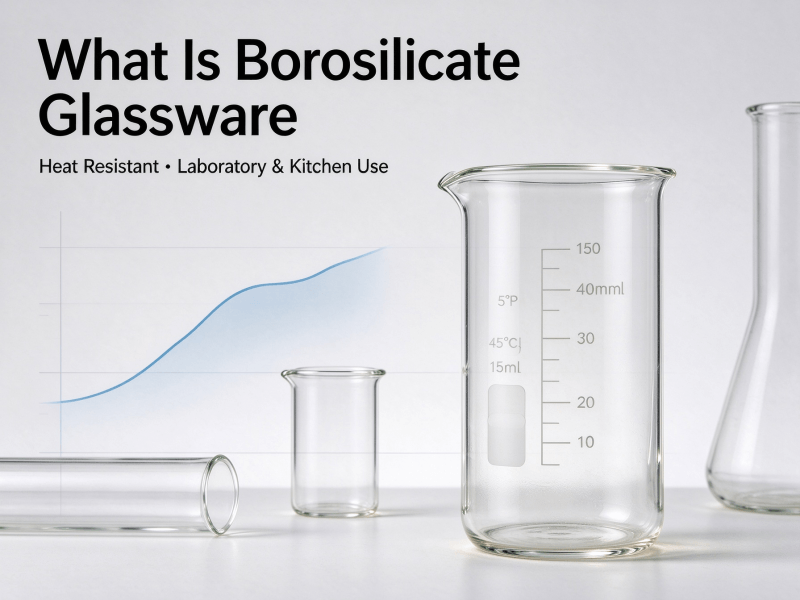
In the 1880s and 1890s, borosilicate glass solved the thermal shock problem. Its low expansion coefficient means a hot dish can meet a cool surface without shattering, which is why borosilicate ended up in measuring cups and baking dishes. The four families a buyer chooses between now, soda-lime, lead crystal, borosilicate, and tempered glass, all existed before the First World War.
From factory to studio: the 1962 workshop
In 1962, Harvey Littleton and Dominick Labino ran two workshops at the Toledo Museum of Art with a small furnace and a low-melting glass batch. They proved that one person could blow glass outside a factory, and the studio glass movement grew from that proof.
The barrier was never talent. It was infrastructure. Factory furnaces ran continuously, cost a fortune to fire, and needed a team to work one gather. Littleton and Labino shrank the furnace and reformulated the batch so it melted at a temperature a small workshop could reach. That unlocked the glassware studios that exist now: short runs, one-off shapes, custom color work a large plant cannot economically schedule. Studios handle design and small volume. Factories handle consistency and the dimensional accuracy a retail program needs.
What the timeline means if you buy, rent or store glassware today
Three things from this history still decide whether a piece survives normal use: how well it was annealed, whether the seams and rims were finished, and what is in the batch. Those three questions also drive the cost of buying, renting, and storing glassware at volume.
| What to check | Where it comes from | How to test it now |
|---|---|---|
| Annealing | Cooling too fast leaves locked-in stress, a risk since core forming | Ask for the annealing curve, or inspect under polarized light |
| Seams and rims | Pressing and mold blowing leave seams; fire polishing removes them | Run a fingernail along the seam and rim; a rough rim chips first |
| Batch chemistry | Lead crystal, soda-lime, and borosilicate behave differently under heat | Ask for the expansion coefficient, not just the material name |
Buying: what seams and shine tell you
A seam that has been fire polished tells you someone paid for finishing. A heavy base on a cheap tumbler often hides a thick, poorly annealed section that fails at the rim rather than the foot. If you are sourcing custom glassware, ask for the annealing curve, the rim finish, and whether your approved sample comes off the production line.
Renting: why rental stock looks the way it does
Event and hospitality glassware rental is a business built on breakage rates. That is why rental stock tends to be pressed or fully tempered, stackable, and plain. If you are comparing glassware rentals for a venue or a caterer, ask how many wash cycles the pattern is rated for.
Storing: racks, headspace and dust
Storage is where most breakage happens, and the rules are old. Stand glasses upside down so dust settles on the foot. Leave a finger’s width between rims. Do not stack unless the design has stacking feet. Keep lead crystal away from long contact with acidic liquids.
For the household version, this guide on how to store clean glasses and cups covers shelf order, cabinet lining, and the mistakes that cause cloudiness. At commercial volume the same logic scales: glassware is safe when it is counted, spaced, and kept off metal.
FAQ
Why does old glass look green or cloudy?
Green comes from iron oxide in the sand, which most historical batch recipes could not remove. Cloudiness usually comes from moisture trapped between stacked pieces, or from crizzling, where an unstable batch absorbs water and develops fine surface cracks.
Can you tell antique glassware from a modern copy?
Imperfection is the best clue. Genuine old glass carries small bubbles called seeds, faint internal streaks, and uneven thickness, especially in the foot. Modern reproductions are cleaner.
Was glass invented in one place, or several?
The evidence points to one origin region, Mesopotamia and Egypt, then a long diffusion. Mosaic glass developed in the Hellenistic world, and glassblowing emerged in Syria before the Romans carried it across Europe.