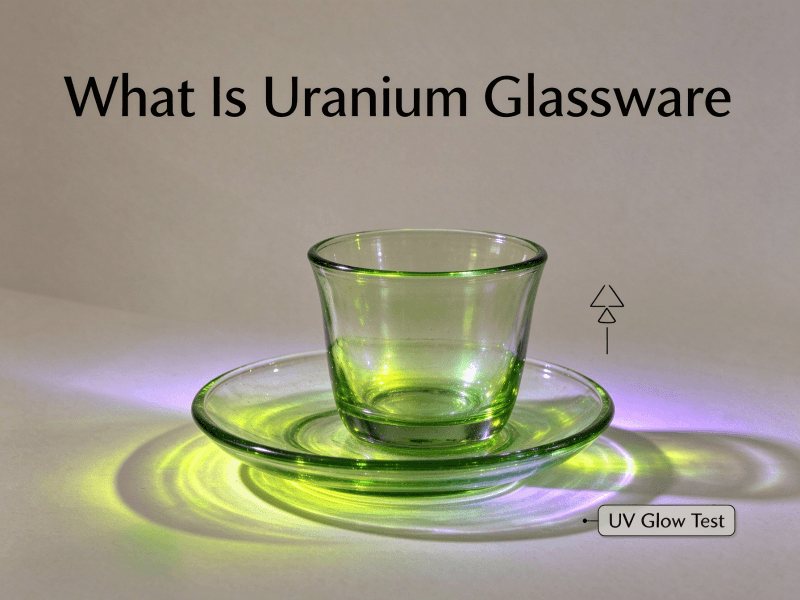
Green glass that turns electric green under a blacklight has moved from flea-market curiosity to a category collectors hunt by name. Auction listings, estate sales and social media groups now trade uranium glassware beside depression glass and mid-century barware. The material is also a useful case study for anyone buying or selling glass, because it sits where color chemistry, old production methods and safety rules meet. Modern custom glassware gets its tints from other metal oxides, so a bright green glow under UV is almost always a sign of age.
Uranium glassware is glass made with a small amount of uranium oxide added to the batch before melting, which gives it a yellow-green body color and makes it fluoresce bright green under ultraviolet light. Most pieces date from roughly 1830 to 1945, contain well under 2 percent uranium by weight, and are legal to own and trade in the United States. The radiation is low enough that museums display the glass on open shelves, but it should not be used for food or drink.
What follows covers what the material is, how to spot it, what it sells for, and how to store it safely.
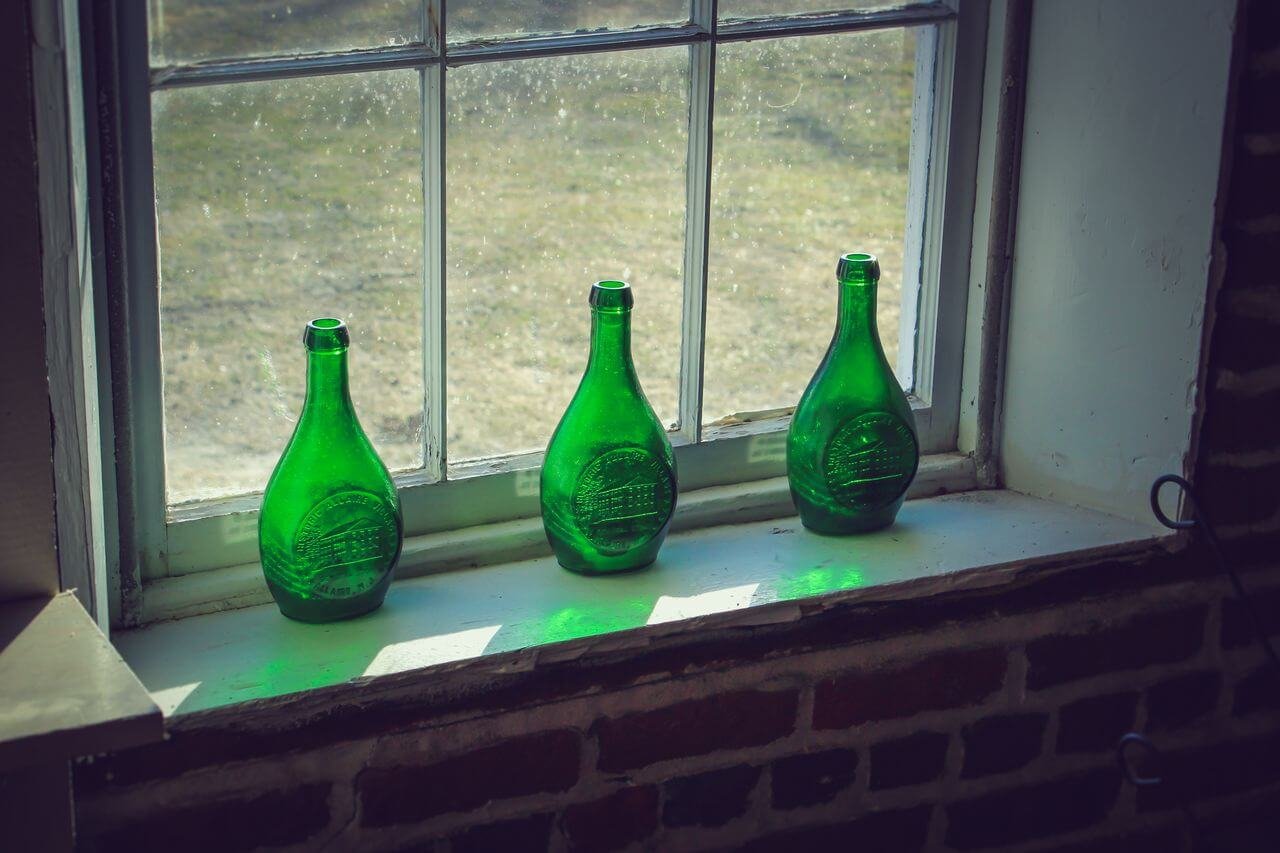
What uranium glassware is made of
Uranium glass is ordinary soda-lime or lead glass with uranium added as a colorant, not a coating. The uranium is melted into the batch, so it runs through the whole body of the piece and cannot be washed or worn off.
Glassmakers blended a uranium compound with silica sand, soda ash and limestone before firing. In the finished glass the uranium sits as uranium oxide inside the silicate network, which is why a chip or a ground pontil mark shows the same color underneath.
Why it glows green under a UV light
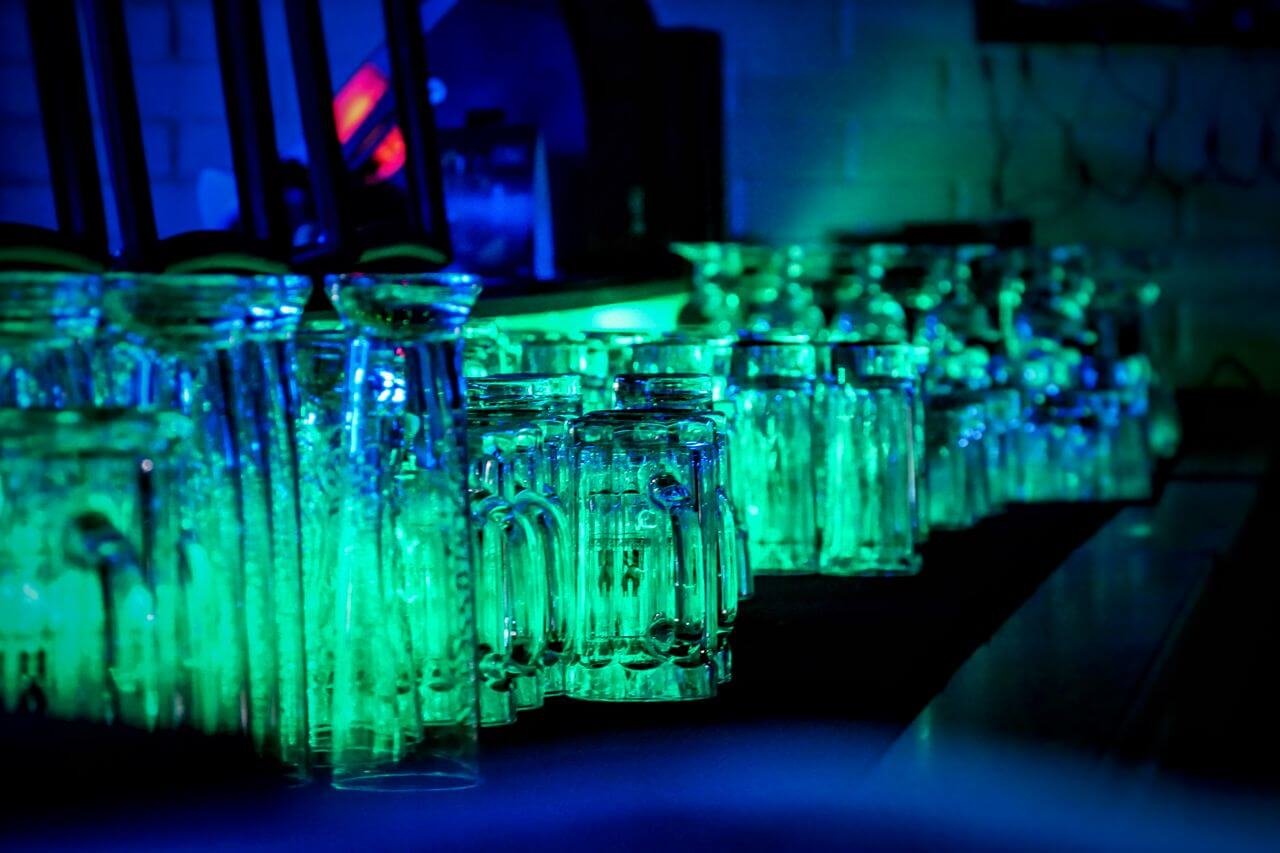
Fluorescence is an immediate response to ultraviolet light, not stored energy. Take the torch away and the glow stops within a fraction of a second; a piece will not glow in a dark room on its own. The color shifts with uranium content and recipe, from yellow-green at low concentrations to a sharper green, and sometimes toward orange. Wavelength matters too: a 365 nm torch gives a cleaner reaction than the cheaper 395 nm units, whose violet wash can mask a weak glow.
How much uranium is actually in it
The US Nuclear Regulatory Commission’s assessment of exempt products puts glassware at 0.26 to 10 percent uranium by weight and notes that lower contents are more common. Typical vintage table pieces sit in the trace-to-2-percent range.
| What is being measured | Typical figure | Note |
|---|---|---|
| Uranium content, exempt glassware | 0.26 to 10 percent by weight | Lower end far more common |
| Common vintage tableware | Trace to about 2 percent | Enough to fluoresce clearly |
| Form in the finished glass | Uranium oxide | Dispersed through the body |
When uranium glassware was made
The material appeared in the 1830s, reached mass-market production in the 1880s, and stayed in production in some form until the early 1940s. Nearly everything collectors find today falls inside that 110-year window.
Bohemian glassmakers are credited with the formula in the 1830s; the two original shades were reportedly named after the glassmaker’s wife, Anna, one word for yellow and one for green. It started as a luxury material made in small decorative runs, spread through European factories in the 1840s, and by the 1880s was being turned out in volume for household goods. The interwar years were the peak for quantity, when pressed-glass lines produced tumblers, plates and bowls in enormous numbers. Complete glassware sets from that period are scarcer than single pieces, because sets get broken up and the pieces sell easily one at a time.
Why production stopped
Uranium glass did not fade out over a health scare. It stopped because the uranium was needed for weapons research during the Second World War and the supply to glassmakers closed.
From the early 1940s the US government took control of uranium stocks for its nuclear weapons program, and European production was disrupted by the war at the same time. The gap lasted roughly fifteen years, and several producers never restarted. Some who did switched to depleted uranium, which is less radioactive but colors glass similarly; others moved to unrelated colorants, which is why most mid-century green glass contains no uranium. A few glassware studios still make uranium-bearing pieces in small batches for collectors.
How to tell uranium glassware from ordinary glass
Ultraviolet light is the only dependable field test. Color, weight and surface texture all mislead, because plenty of green glass contains no uranium and plenty of uranium glass is not obviously green in daylight.
Work in a dark room or cup your hands around the piece, and sweep a 365 nm torch across a flat section rather than an edge. Uranium glass glows across the whole body. If only the edges light up, you are seeing reflected torch light or residue in a moulded seam.
Lookalikes that fool buyers
- Manganese-decolorized glass. Manganese was used to cancel the green tint from iron impurities. It fluoresces weak and greyish, nothing like bright uranium green, and it is everywhere in Victorian glass.
- Lead crystal. Brilliant on a shelf, but generally does not fluoresce. Brightness is not glow.
- Irradiated glass. Gamma treatment can tint clear glass green or brown without creating uranium fluorescence.
What a Geiger counter adds
A reading above background confirms something radioactive is present, which helps on a high-value purchase. It is a weak test alone: low-content pieces can be ambiguous, and a meter cannot tell uranium from another radioactive colorant. Use it to confirm a positive UV result.
Vaseline glass, canary glass, custard glass: sorting out the names
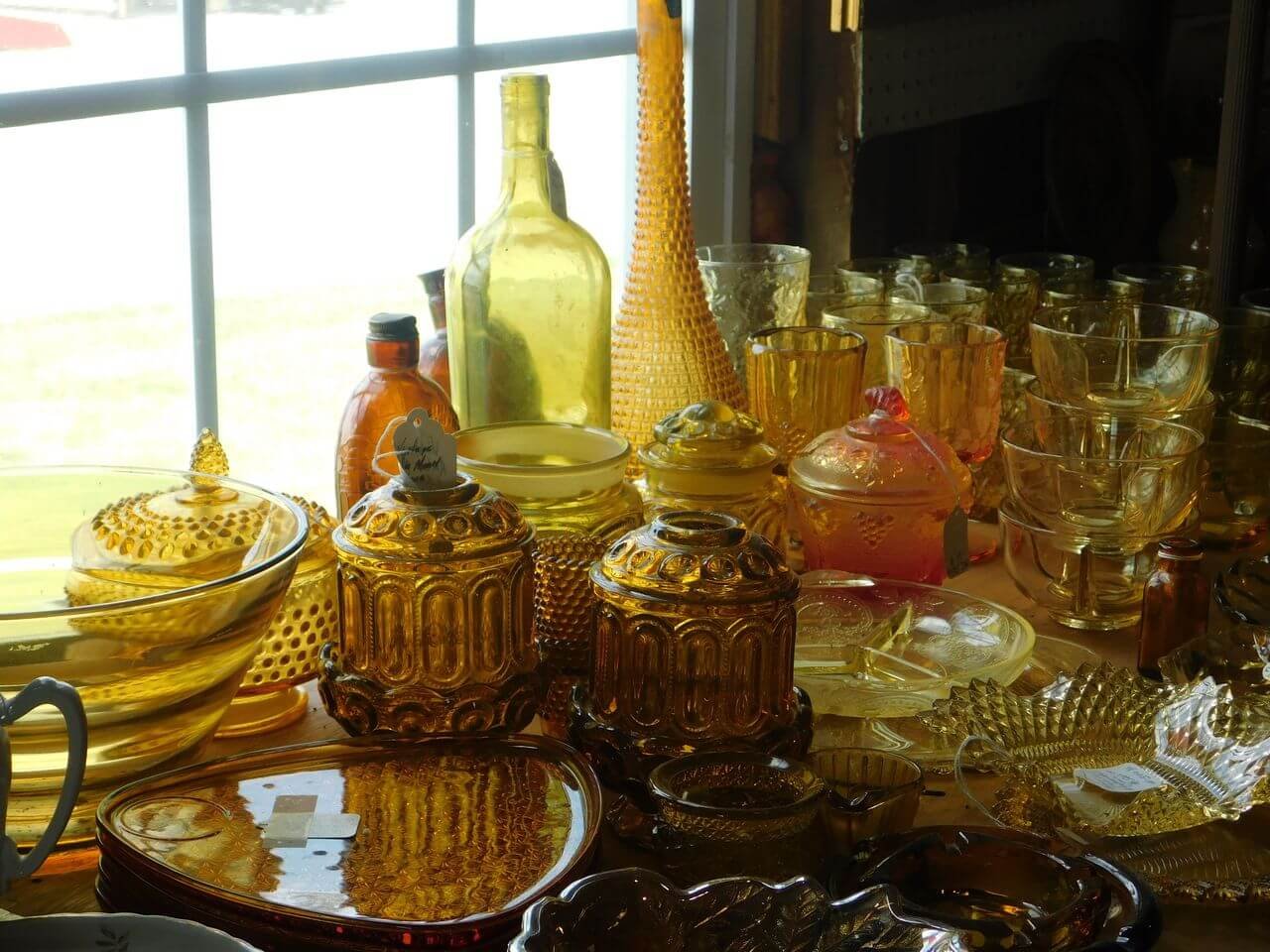
These are trade names for appearances, not a measure of what is in the glass. A piece can be called vaseline glass and contain uranium, or be called vaseline glass and contain none.
| Term | What it describes | What to keep in mind |
|---|---|---|
| Uranium glass | Any glass colored with uranium | The broadest and most accurate term |
| Vaseline glass | Translucent yellow-green, like petroleum jelly | The common US trade name for the transparent type |
| Canary glass | Bright yellow | Often used for the same pieces in older catalogs |
| Custard glass | Opaque cream to pale yellow | Opaque rather than transparent |
| Burmese glass | Opaque, shading pink to yellow | A related heat-sensitive type |
Sellers use the terms interchangeably, which is why the naming confuses buyers. The name tells you nothing about content; the torch answers it.
How unhealthy is uranium glassware
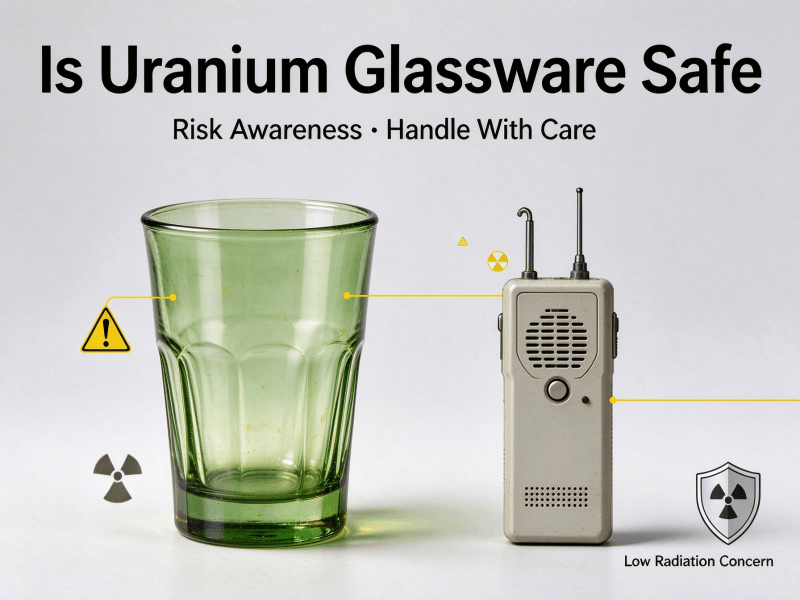
Handling and displaying uranium glassware carries a very small dose, low enough that major museums keep it on open shelving. The risk that matters is ingestion, which is why the standard advice is to look at it and not eat or drink from it.
Alpha particles, the main emission from uranium decay, cannot pass through the glass, let alone skin or paper. Beta and gamma escape, but at low intensity. A conservator at a major Australian museum measured most pieces in its collection at under 10 microsieverts per hour at close range and confirmed they are safe to be near and to handle.
A US government radiological assessment reached the same place from the other direction. Following the whole supply chain, it found the highest estimated dose went to workers handling glassware in transit, and their maximum exposure came to 1 to 2 percent of the average American’s annual radiation dose.
The real concern is what you put in it
Uranium in a glass matrix is stable, but acidic liquids in prolonged contact can dissolve tiny amounts. A US Geological Survey study leached 33 uranium-bearing glass items in water, dilute acetic acid and strong nitric acid. The highest concentration from the glass came out at about 30 micrograms per litre, roughly level with the World Health Organization’s guideline for uranium in drinking water. Uranium-glazed ceramics in the same study released up to around 300,000 micrograms per litre, which is why vintage red-orange dinnerware gets handled more cautiously than green glass.
There is a toxicity point that gets lost in the radiation discussion. Uranium is a heavy metal and the kidney is its target organ. For natural and depleted uranium, chemical toxicity matters more than radiological dose.
So do not serve from uranium tumblers, pitchers or bowls, and do not store vinegar, citrus juice or wine in them. If you run events, keep uranium pieces out of glassware rental stock, since you cannot control how guests handle them.
Pieces that should leave your shelf
- Anything chipped, cracked or flaking, because damaged edges shed particles
- Jewelry worn against the skin daily
- Anything you planned to grind or polish, which also takes the piece outside the exemption below
Is it illegal to own uranium glassware
No. In the United States, glassware within the uranium content limit is exempt from licensing, so you can own, buy and sell it without a radioactive materials licence. The rules target the material content, not the collector.
Under 10 CFR 40.13, glassware containing no more than 2 percent source material by weight is exempt; pieces made before 27 August 2013 get a 10 percent ceiling, which covers most genuine antiques. Glass brick, pane glass and ceramic tile are excluded, and the exemption covers the finished product rather than processing, which is why grinding or polishing changes the piece’s status.
Selling domestically is straightforward. Shipping is where friction shows up: carriers set their own rules on radioactive goods, and a parcel crossing a border can be treated as a regulated shipment regardless of the US exemption. Import rules vary, and several countries restrict or require declaration for radioactive consumer products.
What uranium glassware is worth
Most of it is not worth much. Common bowls, tumblers and plates trade near other decorative glass of the period, while rare patterns, large pieces and documented makers reach the hundreds or low thousands.
Dealer and museum price guidance puts common items at roughly $10 to $50, and large vases, intricate figures or well-documented pieces at several hundred to a few thousand dollars.
| Category | Typical range (USD) | What drives it |
|---|---|---|
| Common bowls, tumblers, small plates | $10 to $50 | Abundant supply, plain patterns |
| Mid-size serving pieces | $50 to $200 | Condition, pattern demand |
| Large vases and centerpieces | Several hundred upward | Size, intactness, color intensity |
| Intricate figures and rare patterns | Several hundred to a few thousand | Rarity, documented maker, provenance |
Rarity does most of the work. After that, buyers weigh condition, craftsmanship, size, depth of color and how strongly the piece fluoresces. Documentation helps: a piece matched to a catalog page outsells an identical one with no history, and complete sets hold a premium over the sum of their parts.
How to display and store a uranium glass collection
The goal is to cut handling, avoid stacking pressure and keep dust off the surface. A closed cabinet does all three and makes a UV display easier to set up.
A glassware cabinet with doors keeps dust off pieces you are not touching, prevents accidents, and lets you mount a UV strip inside so the glow shows without moving anything.
- Keep uranium pieces as their own group, away from everyday tableware
- Line shelves with a soft mat and do not stack pieces on each other
- Skip containers that seal tight and trap moisture
- Run the UV light only while showing the collection
- Keep the cabinet out of direct sun
The usual rules of glassware storage apply: wash and dry each piece fully before it goes back, and never shelve anything damp. Handle by the body rather than the rim, and clean with warm water, mild detergent and a soft cloth. No abrasives, no dishwasher, no hot-to-cold rinses.
Buying uranium glassware today
Most of it comes from antique shops, estate sales, house clearances and online marketplaces. The best finds are still pieces priced as ordinary green glass.
Bring a 365 nm torch and use it before you discuss price. Dealers who know the material label it, and the ones who do not will sometimes let a good piece go cheap. Online, ask for a short video under UV in a dim room rather than a still, since photos can be adjusted. Ask about chips, hairlines, whether the lid is original, and whether the piece has been repaired. A repaired piece can look fine in daylight and read wrong under UV, because the fill does not fluoresce the same way.
FAQ
Does uranium glass glow in the dark without a UV light?
No. The effect is fluorescence, which needs an active ultraviolet source. In a fully dark room the glass does nothing. Some sellers shoot long exposures with a blacklight and present the result as glowing in the dark, which is misleading but common.
Can a chipped piece be polished and used again?
Polishing removes material and creates fine dust, the exposure pathway worth avoiding here. It also takes the piece outside the licensing exemption, which covers finished glassware rather than glass being reworked. Retire damaged pieces to display only.
Is all green depression glass uranium glass?
No, and this is the most common mix-up in the category. Depression-era factories used several green colorants, and only some contained uranium. Two bowls in the same shade can sit side by side on a dealer’s table with only one fluorescing. Test every piece.