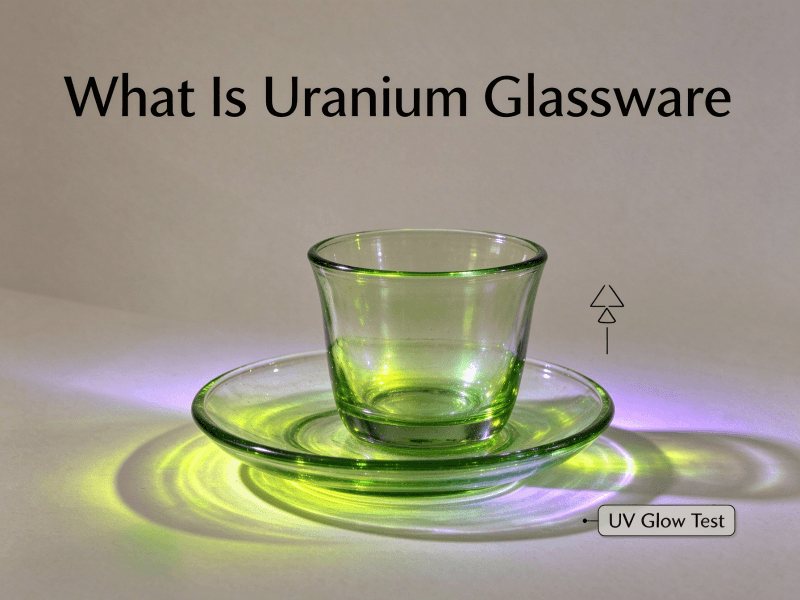
A yellow-green plate that turns neon under a black light is hard to walk past. Estate sales lean on it and antique malls stack it near the register. Then comes the question that follows the sale: is this safe to keep in the house?
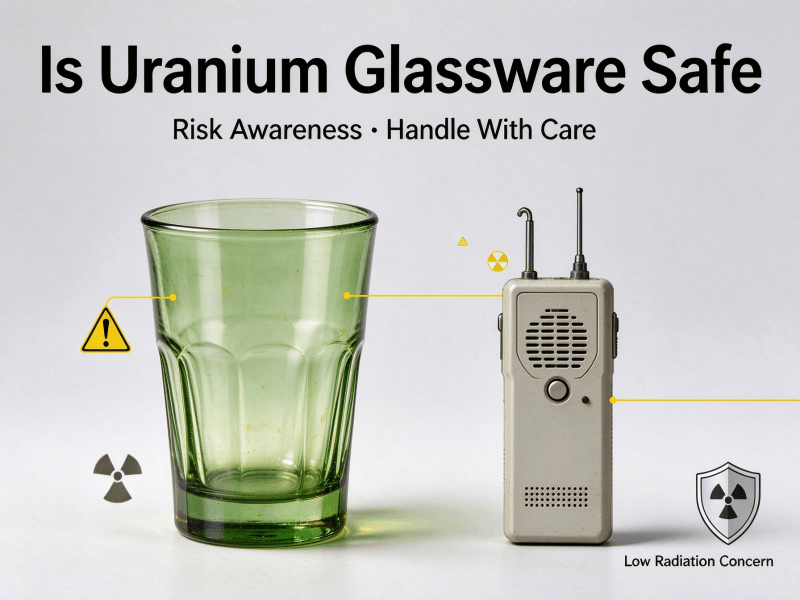
For normal ownership, yes. A piece in a cabinet delivers a dose well below the natural background you already live with, and dry-handed handling carries no meaningful risk. Two situations need care: food contact, and anything that turns the glass into dust, such as cutting or grinding. Those are the only places where the exposure pathway becomes real rather than theoretical.
Here is what the glass actually is, what instruments measure when you point them at it, and why most trade buyers now order modern glassware sets instead of chasing an antique.
What uranium glassware is, and why it glows
Uranium glass is ordinary soda-lime or lead glass with a uranium compound added to the batch. The uranium colours it yellow or yellow-green and makes it fluoresce under ultraviolet light. Both effects come from that one additive, which is also why the material is mildly radioactive.
Glassmakers melted uranium salts such as sodium diuranate with sand, soda ash and limestone. The uranium ends up dispersed through the glass as oxide, locked into the network rather than sitting on the surface. Content varies more than buyers expect: US regulators describe a range of 0.26% to 10% by weight, with the low end far more common in surviving tableware.
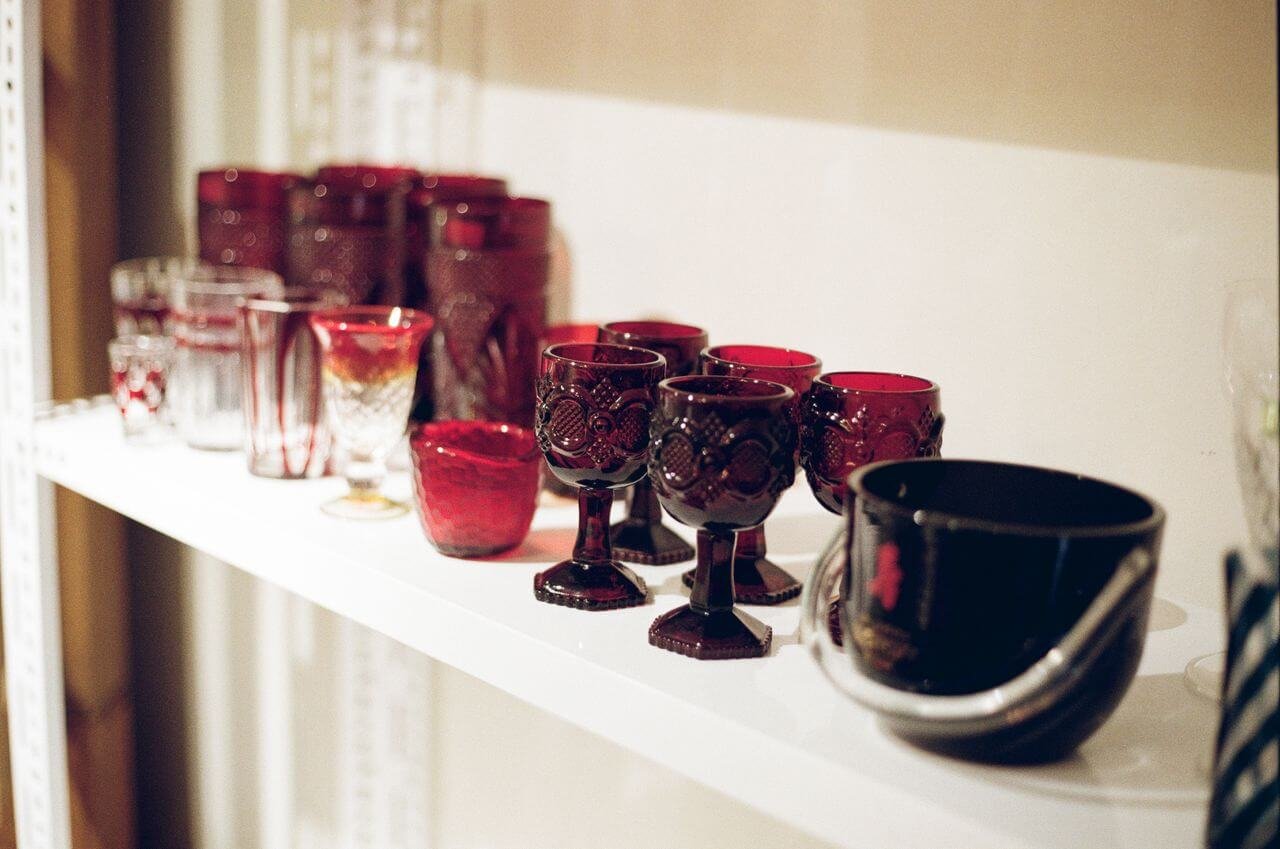
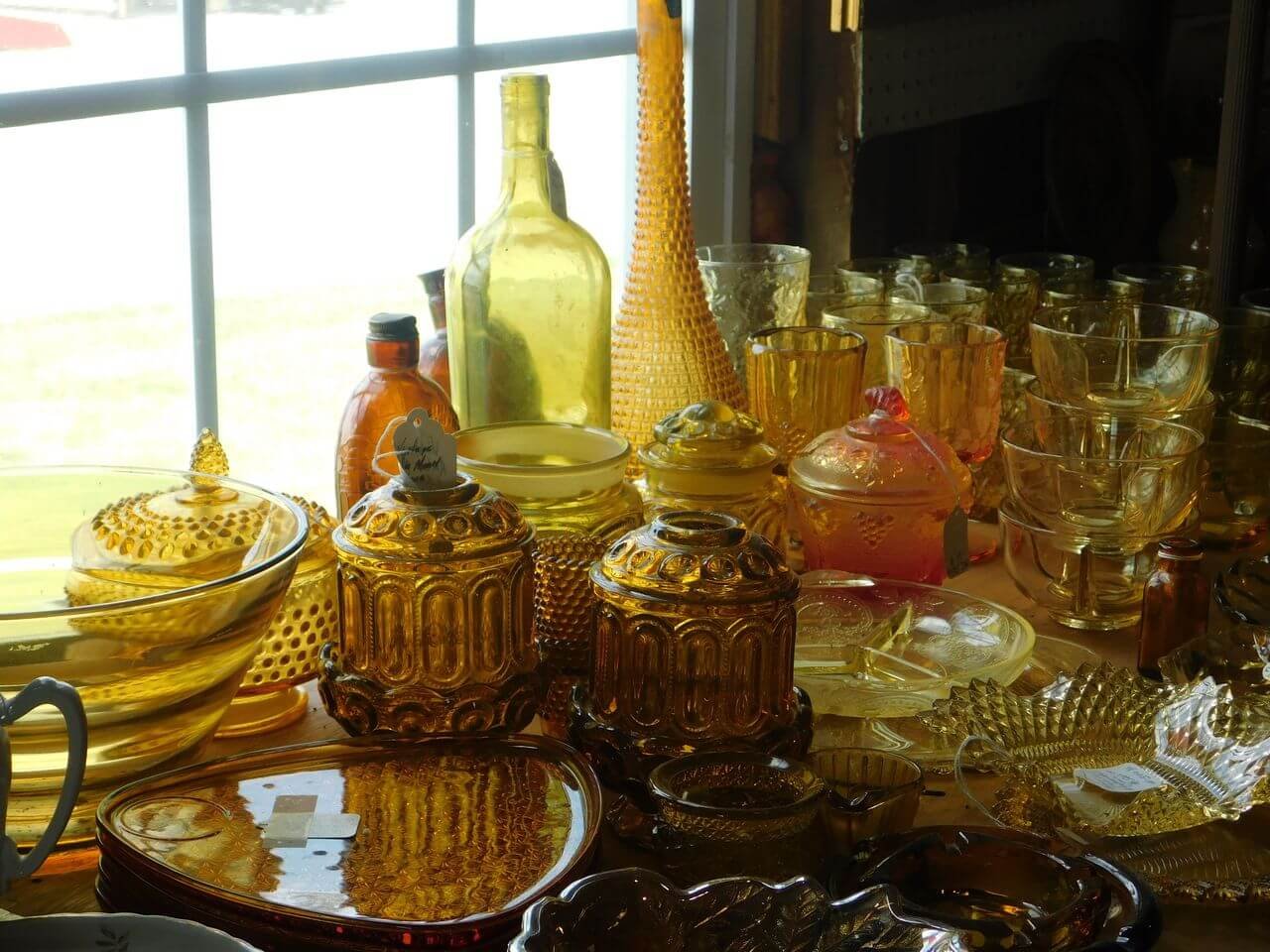
Colour tracks composition, from pale yellow to green, and to orange and deep red when lead is in the mix. Production began in Bohemian glasshouses in the 1830s, and the American peak came in the 1920s and 1930s, when pale green moulded dinnerware filled ordinary kitchens.
Why it glows under a UV torch
The uranyl ion absorbs long-wave ultraviolet light and re-emits it around 520 nanometres. A 365 nm black light is the fastest field test you can run. One counterintuitive detail matters when buying: the glow weakens as uranium content rises, because the glass absorbs its own emission. A weak glow is no proof a piece contains no uranium, and a strong one is no proof it contains a lot.
How much radiation a piece actually gives off
Less than the room around it at normal distance. A 10% uranium piece reads about 0.001 mrem/hr one foot away, while natural background gamma runs near 0.01 mrem/hr. You would need to hold it against your skin and stay there a long time to register anything above the noise.
These figures come from the US dose assessment for exempt products, as summarised by the Oak Ridge Associated Universities health physics museum.
| Distance | Drinking glass, 10% uranium | Decorative piece, 10% uranium |
|---|---|---|
| 1 foot | 0.0009 mrem/hr | 0.0018 mrem/hr |
| 3 feet | 0.0001 mrem/hr | 0.0002 mrem/hr |
| 6 feet | 0.000025 mrem/hr | 0.00005 mrem/hr |
| Background, for comparison | 0.01 mrem/hr | 0.01 mrem/hr |
Beta particles are what people notice, because a Geiger counter complains loudly at contact. The same assessment put skin dose at 27 mrad/hr for a plate held in the hand, while the effective dose equivalent rate was 0.0027 mrem/hr. Beta stops in a few millimetres of air or clothing, so the reading collapses when you lift the piece off the table. The highest dose in the whole assessment went to people loading crates onto trucks: 4 mrem a year at most, about 1% to 2% of average annual exposure.
Is it safe to keep uranium glassware in the house?
Yes. Alpha particles never leave the glass, beta stops within millimetres, and the gamma component is too weak to matter at arm’s length. A cabinet gives you less dose than the difference in background between two floors of the same building.
Condition and use are what change the picture. A chipped piece shedding dust near food is a different object from a plate on a shelf. Volume barely matters: a hundred pieces in a closed cabinet add up to very little, and the cabinet blocks most of the beta. Households with toddlers should put heavy pieces high, not because of radiation but because old pressed glass breaks into sharp pieces. Pregnancy adds no extra rule: don’t eat off it.
Where the real risks sit
Dust from cutting, acid from food, heat from a microwave. Radiation on a shelf is not the problem; the problem is what happens when the material is disturbed or used the way it was meant to be used a century ago.
Cutting, grinding and polishing
Lapidary work is the one activity with a documented exposure route. Dry grinding and sawing release fine glass dust carrying uranium and, in most old formulas, lead. Inhaled particles are the concern, because an alpha emitter inside the lung delivers dose where no glove helps. Cut wet, add local exhaust, wear a respirator, keep food off the bench, and change out of work clothes before you pick up a child. Saw sludge goes to hazardous waste, not the garden. With no meter and no wet setup, leave the piece on the shelf.
Food and drink contact
Leaching is measurable, and the numbers are small. A 1992 study in Health Physics soaked uranium glassware for 24 hours and found average uranium concentrations of 0.052 µg/L in water and 5.9 µg/L in dilute acetic acid, which stands in for vinegar and acidic drinks. The highest single reading in acid was 30.1 µg/L, against a US drinking water limit of 30 µg/L. Repeat the soak and less comes out, because the leachable fraction sits close to the surface.
| Use | Recommendation |
|---|---|
| Display, dry storage, occasional handling | Fine |
| Dry bread, wrapped sweets, brief contact | Acceptable on an intact piece |
| Daily coffee, citrus juice, wine, vinegar dressings | Don’t |
| Microwave or oven use | Don’t |
Uranium is only half of it. Most 1930s formulas carried lead oxide for brightness, and acid pulls lead as readily as uranium. That double exposure is why collectors keep uranium glass off the table.
Heat and thermal shock
Old pressed glass is soda-lime or lead glass, not borosilicate. It tolerates a modest temperature difference and no fast one. A hot piece in cold water, a cold piece under a hot tap, a microwave, an oven: each is a crack waiting to happen, and a cracked piece is a dust source. Dishwasher detergent is the slower problem, etching the surface over repeated cycles and dulling the finish along with the fluorescence.
Handling, cleaning and storing a collection
Treat it as old glass, not as hazardous material. Two hands, dry palms, no stacking, and a shelf that does not get knocked. Nothing about the radiation changes that routine.
Do you need to wash your hands after touching it
No, not for radiation. Nothing transferable radiates off an intact piece, and handling leaves nothing on your skin. Wash after a dusty attic find or anything chipped, because that dust carries lead and uranium as particles rather than rays, and wash before eating as you would after handling any antique. Gloves are optional and mostly protect the glass from your hands, not the other way around.
Cleaning, storage and display
Hand wash in lukewarm water with a drop of mild washing-up liquid, no soaking, then dry with a towel rather than leaving pieces to air dry. Mineral scale comes off with diluted white vinegar applied briefly and rinsed well. Skip abrasive powders and cream cleansers, which scratch the surface and leave it cloudy for good.
A glassware cabinet with doors beats open shelving: it keeps dust off, cuts the chance of a knock, and blocks the beta component. Stand pieces upright, never stack bowls rim to rim, put platters low, acid-free felt between plates if you must stack at all. Keep the cabinet out of direct sun, since repeated heat cycling fades some colours.
For a large collection, padded boxes with soft dividers beat the glassware storage containers sold for kitchen staples, and label them on the outside. Write decorative, not for food on the lid of any box that leaves the house, and keep those boxes away from the kitchen so nothing gets mixed up at a dinner party. Event and rental work needs the same discipline at higher volume: fixed crate layouts, a printed inventory, and a glassware storage routine that survives being loaded and unloaded ten times a season.
Why the world stopped making it
War took the uranium and cheaper colourants took the market. American production stopped in 1943 and never returned to its earlier scale.
- 1830s: Bohemian glasshouses begin making uranium colours for luxury tableware.
- 1880s to 1920s: the material spreads through pressed glass, lamps, beads and decorative ware.
- 1943: the US government requisitions uranium stocks for the Manhattan Project, and civilian production winds down.
- Late 1950s: American makers restart in small volumes using depleted uranium, less radioactive than the pre-war material.
- Today: a few glassware studios produce it in batches, almost never as dinnerware.
Selenium and other colourants give a similar yellow-green for less money and none of the paperwork, so the incentive to go back never arrived. Pre-war pieces used natural uranium, post-1950s pieces used the depleted form, and that gap is why older stock is scarcer.
Is it illegal to make uranium glassware now?
In the United States, owning, displaying and reselling old pieces is legal and needs no licence. Manufacturing new uranium glassware for sale is a licensed activity, which is why almost nobody does it at commercial scale.
The exemption sits in 10 CFR 40.13(c)(2)(iii): glassware containing no more than 2% uranium by weight is exempt from licensing, and glassware made before 27 August 2013 gets a 10% ceiling. Two neighbouring paragraphs close the loophole. Paragraph (c)(9) says the exemption does not authorise manufacture, and (c)(10) requires a licence for the first transfer of such products for sale or distribution. Elsewhere, most regulators treat uranium glass as a low-dose consumer product and regulate the workplace rather than the shelf. Import rules are the friction point, since carriers and customs apply their own thresholds.
Checking a piece before you buy, rent or resell
Ultraviolet light first, a radiation meter second, condition third. Those three checks answer almost every question a buyer has, and two of them cost less than lunch.
A 365 nm torch shows the character of the glow in a second. A Geiger counter at the surface tells you whether a piece is ordinary or unusually active. Then run a bright light along the rim and the foot.
| Check | What you want to see | Walk away if |
|---|---|---|
| UV response | Distinct yellow-green glow | No glow while the price assumes uranium |
| Meter reading at surface | A multiple of background, not a spike | A reading far above background |
| Rim and foot | Smooth edges | Chips on a drinking edge |
| Cracks | None under bright light | Hairline cracks or crazing |
| Surface | Clear, not etched | Cloudy patches from dishwasher damage |
Businesses running glassware rentals, event stylists and set dressers meet this material constantly, because the colour photographs well under warm light. For a one-off shoot it is a look. For anything that repeats weekly, breakage and replacement costs make antique stock a poor business decision.
What trade buyers do instead
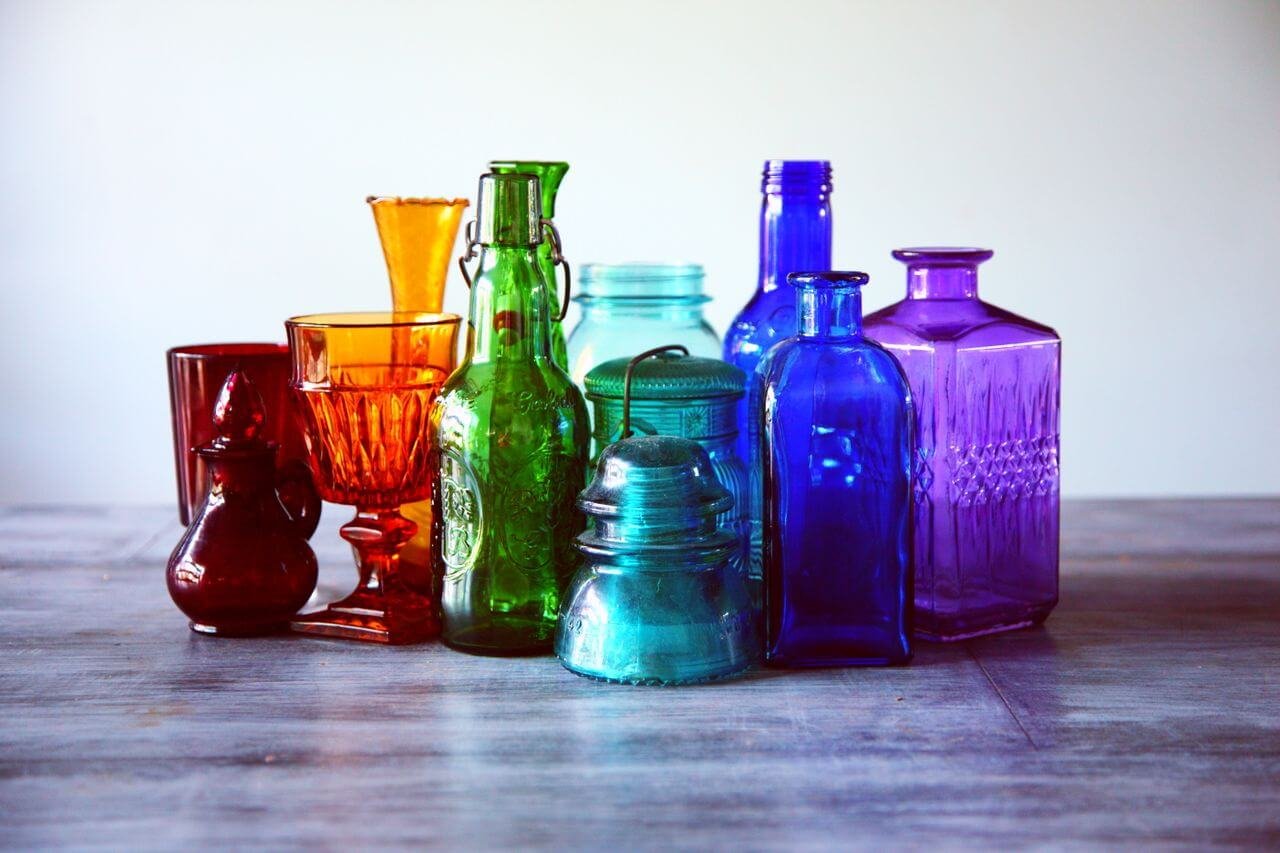
When the goal is the colour rather than the isotope, modern production solves the problem. Colourants now reproduce the yellow-green tone without uranium, and the glass can be specified for lead content, thermal shock resistance and dishwasher cycles. Anyone ordering for a restaurant, hotel or rental fleet should ask for those figures in writing, plus a colour standard for batch matching, because tone drifts between runs and a mismatched replacement reads as a mistake on a shelf. Matching cups and plates keep sizes consistent and units replaceable.
Frequently asked questions
Will uranium glassware set off a scanner at an airport or in the post?
Almost never. Portal monitors are tuned for sources far stronger than a plate reading a fraction of background at a metre. Paperwork is the real obstacle: some carriers exclude radioactive material by policy regardless of activity, and customs rules differ by country.
Can a chipped piece stay on display?
Yes, with conditions. A small chip on a foot or rim can stay in a cabinet if the piece is out of reach of children and never used for food. Cracks, crazing and cloudy etched surfaces are different: they shed particles, they cannot be cleaned properly, and they fail without warning. Retire those to a box, or take them to household hazardous waste.
Do modern reproductions glow the same?
If they contain uranium, yes, though the 2% ceiling on new glassware in the US keeps the colour paler than some pre-war pieces. Many uranium-free lookalikes copy the daylight colour and show weak or different fluorescence, so test before paying an antique premium. A dull glow under 365 nm deserves a second look, since heavy uranium content can suppress the effect.