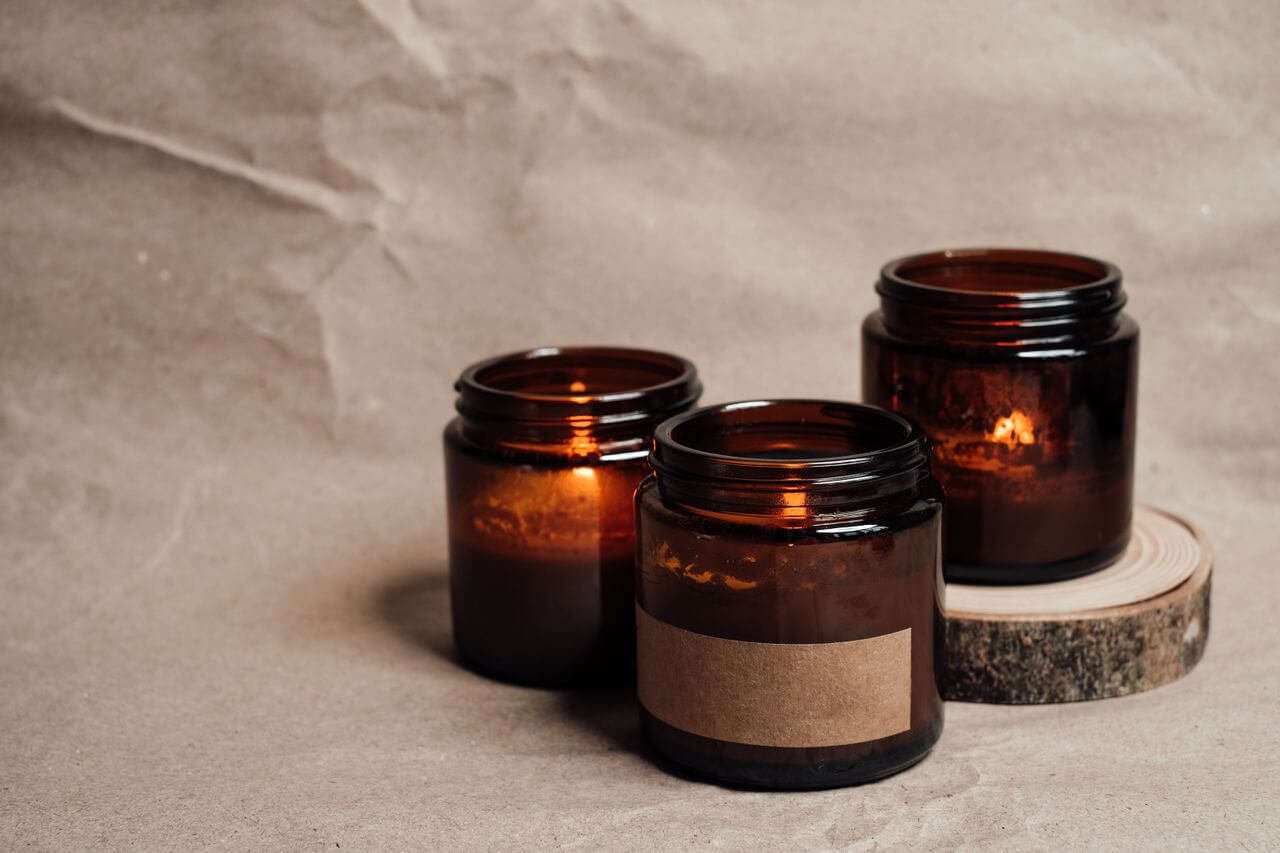
A jar candle rarely fails all at once. It tunnels down the middle, drowns its wick, and leaves a thick collar of wax fused to the glass, at which point most people either attack it with a knife or throw the jar away. Both are avoidable.
You can melt a candle in a glass jar safely as long as you heat the glass slowly, indirectly, and below the point where the container is stressed. A water bath at 150 to 180°F is the most reliable route to a full melt, a 150 to 170°F oven handles several jars at once, a candle warmer lifts small residuals, and a microwave works only on a rated jar with every metal part removed. Direct flame and cold glass dropped into hot water are the two ways jars break.
What follows is the order of operations that protects both the wax and the glass, starting with the question most guides skip: whether your jar should be heated at all.
Two Different Jobs Behind the Same Question
The phrase covers two tasks with different temperature ceilings. Softening wax in place to rescue a tunneling candle needs warmth under 150°F at the glass. Liquefying wax for pouring needs a full melt of 150 to 185°F, and that second job is where glass fails.
Confusing the two is the usual cause of a cracked jar. Someone reads that a warmer is safe, then applies the same logic to a block of solid wax on a hot plate.
Melting Wax In Place
This is the repair job. A candle with a channel burned down its center, or a wick toppled into the wax, often recovers by warming the top inch until it re-levels into a flat pool. Heat travels a short distance, so a warmer or a low oven is enough.
Melting Wax to Remove It
Removal requires either a complete melt or none at all. A full melt holds the whole wall at 150 to 185°F for ten minutes or more, which is where wall thickness and heating rate start to matter.
Is It Safe to Burn and Melt a Candle in a Glass Jar?
Burning a candle in a glass jar is safe when the jar was made for it, and the exterior typically runs between 100 and 140°F during a normal burn, well inside what annealed container glass tolerates. Melting is the harder half of the question, because it pushes that glass to 150 to 185°F, often from a cold start. The jar is rarely the weak point. The rate of change is.
What Thermal Shock Does to Glass
Glass expands when heated and contracts when cooled, and because it moves heat slowly, it does so unevenly. When one region of a jar is far hotter than another, the hot section tries to expand against a cooler one that will not yield, and strain concentrates at the boundary. Once that strain exceeds the tensile strength of the glass, a crack starts and runs. This is thermal shock, and it explains why a jar can sit an hour at a steady 170°F, then split within seconds on a cold surface.
How to Tell Whether a Jar Can Take the Heat
| Jar type | Verdict | Notes |
| Purpose-made candle jar | Good | 3 mm base or thicker |
| New wide-mouth canning jar | Fair to good | Avoid dry oven heat above 200°F |
| Thin jam or sauce jar | Poor | Thin bases crack first |
| Jar with paint or foil trim | Poor | Coating creates hot spots |
| Chipped or starred rim | Never | The failure point already exists |
| Vintage or crystal glassware | Never | Old glass behaves unpredictably |
Hold the jar to a window and look for a star or hairline at the rim, run a thumbnail around the lip, and check that the base is flat and thick. Those criteria are the practical version of what this guide calls heat-resistant glass.
Four rules cover the rest. Start at room temperature. Raise and lower heat gradually. Set hot jars on wood or cork, never stone. Never heat a nearly empty jar, because wax is the thermal buffer.
What Is the Fastest Way to Melt a Candle?
A microwave melts wax fastest, often in under three minutes, and a water bath is second at roughly eight to fifteen minutes for a partially burned jar. Neither is automatically correct. The microwave concentrates energy in the center of the wax and turns dangerous the moment a metal wick tab is still inside, while a bath cannot exceed 212°F and therefore cannot scorch the wax. For most people the bath is the fastest method that is also the safest.
Method Comparison at a Glance
| Method | Typical time | Control | Glass risk | Best for |
| Warm water bath | 8 to 20 min | High, capped at 212°F | Low | A full melt in one or two jars |
| Oven | 10 to 20 min | High and steady | Low if the jar is sound | Several jars at once |
| Candle warmer | 30 to 60 min | Very high | Very low | Softening the top layer |
| Microwave | 2 to 4 min | Low | Moderate to high | Small amounts in rated jars |
| Freezer, no melting | 1 to 3 hours | Not applicable | Very low | Releasing a residual slab |
Method 1: Warm Water Bath
A water bath is the default method because water cannot exceed 212°F, which is above every common wax melt point and below the temperature at which most container glass becomes stressed. It is slow, forgiving, and needs nothing beyond a pot and a towel.
- Set the jar in a pot deep enough that the water line sits two to three inches below the rim.
- Add warm water to two thirds of the jar height, with a folded towel under the jar so it cannot float and tip.
- Bring the water to a gentle simmer. Small bubbles on the pot wall are the target, not a rolling boil.
- Leave the wax undisturbed for five minutes, then stir with a wooden skewer to distribute heat.
- Lift the jar with tongs once the wax is clear, with no opaque islands at the base.
Both failure modes involve water rather than heat: too high a water line splashes into the wax, and a floating jar tilts and can crack.
Method 2: Oven
An oven set between 150 and 170°F melts a jar in ten to twenty minutes without exceeding temperatures the glass already handles in service. Anything above 200°F adds risk without shortening the melt, because glass transfers heat so slowly that oven air is not the limiting factor.
Preheat fully, since a jar placed in a heating oven faces a rising gradient. Strip labels, stand the jar on a foil-lined tray, and use the middle rack. Check at ten minutes and pull the tray rather than the jar. The oven suits four or five jars at once and is the worst choice for a single one, where preheat outlasts a bath.
Method 3: Candle Warmer or Heat Lamp
A warmer melts wax from the bottom up at a controlled, low temperature with no open flame, making it the safest powered option and the slowest. It suits softening a top layer or releasing fragrance, and is impractical for melting a whole jar to the point of pouring.
A heated plate warms the base and heat rises by conduction, so the wall stays close to the wax temperature. A full 8-ounce jar can take an hour. Heat lamps work from above, so keep twelve inches of clearance or the rim becomes the hot spot a warmer is built to avoid.
Method 4: Microwave
You can melt a candle in a glass jar in a microwave only when the jar carries an explicit microwave-safe marking and every metal component has been removed, including the wick tab, foil label residue, and metallic trim. If either condition fails, use a water bath. There is no workaround for a metal wick clip.
Most jar candles are neither rated nor metal free, which is why many guides simply say no. Where the conditions are met, work in bursts: break solid wax into smaller pieces, heat in 20 to 30 second intervals at medium power, stir between every interval, and stop the moment the wax is liquid. Never let it smoke.
Why Most Candle Jars Fail This Test
Three failures converge. The metal wick tab arcs immediately and can crack the base from inside. There is no thermal buffer, so the wax heats volumetrically while the glass heats only by contact, and the center can hit 200°F while the wall sits at 90°F. Uneven energy distribution then pushes a small region toward its flash point while the rest is still solid.
Can You Melt a Candle and Pour It Into a Different Jar?
Yes, and it is the most common reason to melt a candle at all, but the receiving jar must be prepared before any wax arrives. The new wick needs anchoring at the center of the base, the empty jar needs warming to 100 to 120°F, and the pour must fall within the range specified for that wax. Skipping the preheat is the usual cause of cracked jars and of wax pulling away from the glass.
- Clean and dry the jar, since a drop of water flashes to steam under hot wax.
- Fix the wick at the base, then hold it upright with two skewers across the rim.
- Warm the jar at 150°F for five minutes, which reduces pour shock and improves adhesion.
- Pour slowly down the side, stop half an inch below the rim, and cool for twelve to twenty-four hours.
Choose a straight-sided or slightly flared vessel rather than one that tapers inward at the base. Most wide mouth glass jars share those traits, which is why the format dominates container candle production.
Wax Temperature Reference
| Wax type | Melt point | Pour temp | Flash point | Notes |
| Soy and blends | 120 to 180°F | 130 to 150°F | 300 to 350°F | Contracts, may need a top-up |
| Paraffin | 120 to 150°F | 150 to 175°F | 300 to 400°F | Hotter pour, demands sound glass |
| Beeswax | 144 to 147°F | 145 to 165°F | Above 400°F | High adhesion, scorches easily |
| Coconut wax | 76 to 80°F | 120 to 135°F | 300 to 400°F | Lowest pour, most forgiving |
Treat these as working ranges and defer to the supplier’s datasheet. Never combine different wax families in one pour, because they cool at different rates and separate.
How to Melt Old Candles in Glass Jars
Old candles and thrifted jars follow the same procedure with one addition: sort them by wax type first. Soy, paraffin, beeswax, and coconut wax cool at different rates, and a mixed batch produces a sunken center, poor adhesion, and an unreliable burn.
Wipe soot from the surface, since it settles into the melt, and pull out wick fragments with tweezers. Melt in a water bath, the most tolerant option for unknown wax and glass, then strain through a fine mesh to catch carbon. For nearly empty jars, the cold approach in this guide on how to remove old candle wax uses no heat at all.
When You Should Not Melt at All
Freezing exploits the fact that wax shrinks more than glass when chilled. Leave the jar in the freezer for one to three hours, press the surface with a thumb, and a residual slab usually pops free in one piece. It suits thin residuals and fails on thick candles that bond too firmly. Afterwards, wipe out cooled wax with a paper towel before it meets water, then wash with hot water and dish soap.
When Something Goes Wrong
Most failures announce themselves before they become dangerous. A sharp ping from the pot, a wisp of smoke off the wax, or a sudden paraffin smell means the batch is past its safe range, and the right response is to remove the heat and let everything cool in place rather than intervene physically.
| Symptom | Likely cause | What to do |
| Ping or ticking from the jar | Thermal shock starting at the base | Cut the heat, leave the jar where it is |
| Hairline or star crack | Glass already compromised | Discard the jar, keep the wax |
| Wax smoking or yellowing | Localized overheating | Remove from heat, cover loosely, no water |
| Wax across the counter | Overflow during pour | Cool fully, then lift with a plastic scraper |
| Wick leaning off center | Turbulence during pour | Straighten while the wax is still soft |
Never throw water on burning wax, because it flashes to steam and sprays burning wax outward. The National Candle Association recommends trimming the wick to a quarter inch before each burn and stopping use when half an inch of wax remains.
Choosing Jars That Survive Repeated Heat Cycles
A jar that will be melted more than once needs a base of at least three millimeters, straight or slightly flared sides, a wide opening, and no metallic decoration. Those four traits predict heat performance far better than shape or finish.
Thin, wide, shallow jars crack most often, because a shallow pool concentrates heat across a large flat base with little glass mass to spread it. Narrow-neck jars fail differently: the pool cannot reach the walls, the wick struggles for air, and the candle tunnels however carefully it was poured. That is why most wholesale glass jars made for candles share a similar wall profile. In the end, melting a candle in a glass jar is not a test of technique. It is a test of whether the glass warms slowly enough for the material to keep up.
FAQ
Can a glass candle jar be remelted again and again?
Not indefinitely. Every heat cycle leaves the glass slightly more stressed, and the effect shows up as a dull ring when tapped, faint cloudiness near the base, or a web of fine surface lines. A thick purpose-made jar may tolerate dozens of gentle baths; a thin food jar may fail on the third.
How do you melt candle wax with no stove, oven, or microwave?
Seal the jar loosely and leave it on a sunny windowsill or in a parked car for a few hours, where interior temperatures routinely exceed 140°F. Alternatively, stand the jar in a bowl of the hottest tap water and refresh it as it cools.
What should you do if wax catches fire inside the jar?
Cut the heat source first, then smother. A metal lid, a baking sheet, or a pour of baking soda starves the flame, and the jar should be left alone until completely cool. Water must never go near it, because it vaporizes instantly and sprays burning wax.