Glass bottles are everywhere, but most people have no idea how they get made. If you have searched for how to make bottle glass, you probably started by picturing sand turning into something clear and solid. The basic idea goes back about 3,000 years to Syrian glassworkers who figured out that heating sand, plant ash, and lime together produced a material you could melt and shape. Today the industry runs at a pace that is hard to imagine. A single line can spit out more than 500 bottles a minute, holding tolerances tighter than a human hair.
Bottle glass is made by melting silica sand, soda ash, and limestone at around 1,500 degrees Celsius, then shaping the molten glass using blow-and-blow or press-and-blow methods inside automated forming machines called IS machines. The bottles go through a long, slow cooling process in a temperature-controlled lehr to relieve internal stress before anyone inspects or packages them.
The ingredient list is short. The machinery and timing that make it work are lacking.
What raw materials go into bottle glass
Silica sand constitutes about 70% of the batch, soda ash about 13%, and limestone roughly 10%. Tremaining 4% consists of is alumina, colorants, and fining agents.
Silica sand forms the glass structure. It has to be at least 98.5% pure silicon dioxide. Iron content stays below 0.04% in clear bottle glass because any more than that gives it a green tint. Soda ash brings the melting point down from over 1,700 degrees Celsius to about 1,500. Without soda ash, melting sand at industrial volumes would cost too much. Limestone stops the bottle glass from slowly dissolving when it touches water or anything acidic.
Recycled cullet in the batch
Most bottle glass made today is 30% to 60% recycled material, or cullet. Cullet melts faster than raw batch, so adding it cuts the energy bill. It also reduces CO2 output. Every 10% bump in cullet use drops energy consumption by about 2.5%. Many custom glassware plants now run cullet ratios above 70% to meet sustainability goals.
Colorants and additives
Amber bottles owe their color to iron sulfide and carbon. Chromium oxide makes green glass. As little as 0.01% cobalt oxide produces deep blue. A few extra grams per ton shifts the final color, so these get weighed with serious precision. Fining agents like sodium sulfate pull trapped gas bubbles out of the melt.

How glass bottles are manufactured step by step
The process runs through five stages: batch mixing, melting, forming, annealing, and inspection.
Batch mixing and furnace charging
Raw materials show up by truck or rail and sit in silos until needed. Computer-controlled scales weigh each ingredient to within 0.1% of the formula. The dry mix and cullet continuously feed into the furnace through an opening at the back called a doghouse charger. Getting the mix wrong by half a percent can wreck an entire shift of bottles.
Melting and refining
The furnace runs 24/7, 365 days a year. Once you fire it up, it stays on for 10 to 15 years until the brick lining inside wears out. Temperatures hit about 1,550 degrees Celsius in the melting section. The bottle glass then moves into a refining zone around 1,450 degrees, where gas bubbles rise and escape. By the time it reaches the forehearth, the bottle glass has cooled to roughly 1,100 degrees, which is the right thickness for forming.
Forming with IS machines
The Individual Section machine is responsible for most of the forming work in a bottle plant. Each section runs on its own, so you can fix one while the others keep going.
The blow-and-blow method handles narrow-neck bottles like wine and beer containers. A gob of molten glass drops into a blank mold. Compressed air blows it into a rough shape called a parison. The parison moves to a finish mold, where another shot of air shapes it into the final bottle.
Press-and-blow works for wide-mouth containers. Instead of blowing the parison, a plunger presses the glass against the mold wall. You get better control over wall thickness this way, which is relevant for jars and tubs.
Annealing
Glass does not cool evenly. The outside skin hardens first while the inside is still hot, and that mismatch creates stress that can crack the bottle later. The annealing lehr fixes these issues. It reheats bottles to around 565 degrees Celsius, then cools them slowly over 30 to 60 minutes. After that, the glass is stable enough to handle, fill, and ship.
Surface treatment and inspection
Bottles get a hot-end coat of tin oxide and a cold-end coat of polyethylene wax. Without these, bottles scratch each other on high-speed conveyors, and scratches turn into break points under pressure. Automated cameras check every bottle for size, wall thickness, bubbles, stones, and cracks. Bad ones go right back into the furnace as cullet.

Types of glass used for bottles
Soda-lime-silica glass handles most bottle production, but borosilicate and lead crystal show up in specialty uses.
Soda-lime glass
Soda-lime glass production covers beer, wine, spirits, and food bottles. It is cheap, chemically stable, and recyclable. The downside: it handles heat poorly. Pour boiling water into a room-temperature soda-lime bottle and it will crack. If you need something that can take temperature swings, heat-resistant glass materials like borosilicate are worth looking at.
Borosilicate glass
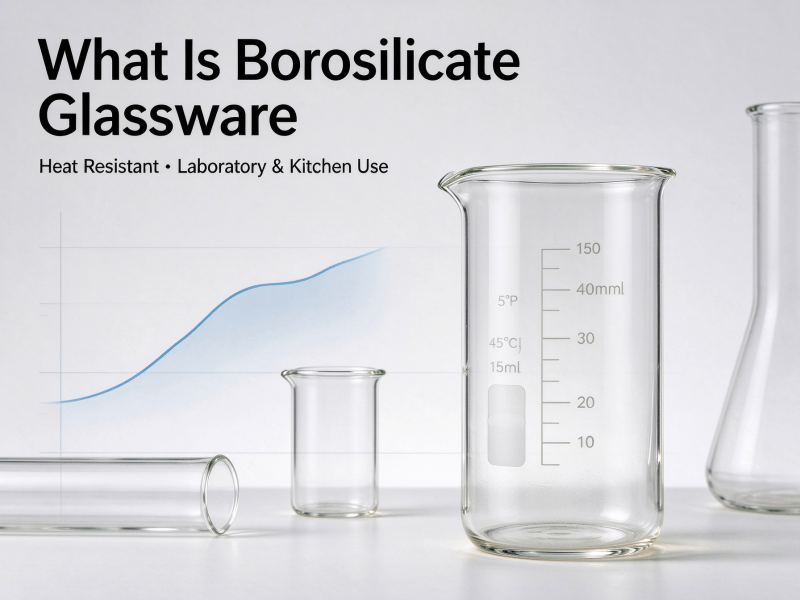
Borosilicate glass is made with about 13% boron trioxide. That knocks its thermal expansion down to about a third of what soda-lime glass does. Lab glass and some reusable water bottles use it because it handles quick temperature changes. It costs more to make and you do not see it in single-use packaging.
The difference between glass and crystal
People mix up glass and crystal all the time. It is relevant for premium spirits bottles and anything decorative. Standard glass vs. crystal formulas differ in one key way: crystal has lead oxide or barium oxide, which gives it more weight and a higher refractive index. Traditional lead crystal runs at least 24% lead oxide, though newer safety rules have pushed most production toward lead-free versions using barium, zinc, or potassium oxides.
How to make bottle into glass: upcycling at home
Turning old bottles into drinking glasses, vases, and decorative pieces is common in the DIY world. There are a few different ways to cut and polish them.
This is separate from factory production, but it is what a lot of people mean when they search for “how to make a bottle into glass.” Taking used glass bottles and turning them into something else is a practical way to keep glass out of the bin. Three methods get used most often.
The string-and-acetone method
Soak a heavy cotton string in acetone or nail polish remover. Wrap it tight around the bottle where you want the cut and tie it off. Light the string and rotate the bottle slowly while it burns. Once the flame goes out, dunk the bottle in ice water. The temperature shock should crack the glass along the heated line. Sand the cut edge with wet sandpaper made of silicon carbide, starting at 80 grit and working up to 400.
Glass bottle cutting tools
Bottle cutters clamp on and score a clean line around the glass. After scoring, pour hot water over the line, then cold, alternating back and forth. The temperature swing separates the two pieces. This method beats the string trick for reliability and edge quality.
Making wine and beer bottle glasses
Wine and beer bottles are thick enough to survive getting cut into drinking glasses. The technique is the same whether you are making wine bottle glasses or beer bottle glasses, though beer bottles have thinner walls so you sand more gently. Cut roughly 12 to 15 centimeters up from the base. After separating, sand the rim through progressively finer grits until it feels smooth. A final buff with cerium oxide paste brings the clarity back.
Making a bottle glass window
Bottle glass windows use the flat bottoms of bottles set into a frame, with mortar or concrete filling the gaps. You see this technique a lot in earthship houses and garden walls. Bottles go in horizontally, bases facing out to catch light. You need bottles of the same diameter, cut to matching lengths.

Quality control in bottle glass manufacturing
Every bottle goes through optical inspection, pressure testing, and dimensional checks before it leaves the plant.
Common defects and their causes
Stones are bits of unmelted raw material stuck in the glass, usually from dirty cullet or incomplete melting. Seeds are tiny gas bubbles left over when fining agents do not fully clear dissolved gases during refining. Cord shows up as wavy lines in the glass, caused by uneven mixing. All three weaken the bottle and can make it fail under pressure or heat.
Testing standards
Bottle strength is checked through internal pressure tests, vertical load tests, thermal shock tests, and impact tests. Carbonated drink bottles have to hold at least 1.0 MPa of internal pressure. Annealing quality is checked by putting bottles under a polariscope. Any leftover stress shows up as colored bands.
Surface coatings and durability
That two-layer coating system matters more than it seems. Without it, bottles scratch each other on the line, and those scratches become failure points. Coated glass has come a long way from basic tin oxide. Modern coatings can be tuned for specific line speeds and product types.
Environmental impact and sustainability
Glass can be melted down and remade over and over without losing quality. That makes it one of the few packaging materials that truly recycles in a closed loop.
Each ton of cullet used in a furnace saves about 1.2 tons of raw materials and trims energy use by 2% to 3% per 10% cullet added. The challenging part is the melting step, which takes a lot of heat. Regenerative furnaces recover waste heat from exhaust to preheat incoming combustion air, squeezing out 30% to 40% better thermal efficiency than older furnace designs.
More glassware manufacturer plants are switching to oxy-fuel furnaces that burn natural gas with pure oxygen instead of regular air. Cutting nitrogen out of the burn drops NOx emissions by up to 80% and total energy use by 15% to 25%.
FAQ
How long does it take to make a glass bottle from start to finish?
A single bottle goes from a gob of molten glass to a finished, inspected product in 30 to 90 minutes, mostly depending on annealing time. The furnace stages take longer: the raw batch needs about 24 to 48 hours to move through melting and refining before it is ready to form.
What is the difference between blow-and-blow and press-and-blow forming?
Blow-and-blow uses compressed air for both the parison and the final bottle shape. It works for narrow-neck containers. Press-and-blow uses a plunger to press the parison, which gives tighter wall thickness control. That makes it the go-to for wide-mouth jars and tubs.
Is recycled glass weaker than virgin glass?
No. Cullet melts and reforms into glass that is chemically the same as glass made from fresh sand, soda ash, and limestone. A bottle made from 100% recycled material performs just like one made from all-new raw materials. Glass recycling does not degrade the material at all.