Stained glassware turns up wherever glass is used hard: a tumbler at home, a wine glass in a bar that washes every few hours, and custom glassware bought in bulk for hotels and rental fleets. The mark is rarely dirt. It is usually minerals left by water, detergent residue, or damage to the glass itself.
Stained glassware can be cleaned, but the method has to match the stain. White, chalky film, water spots, and greasy streaks are deposits on the surface, and an acid soak or a warm soap wash dissolves them. A rainbow sheen, a blue tint, or a surface that feels rough means the glass itself has been corroded, and no cleaner will restore it.
Work out which of the two you are facing first, because the wrong method wastes time and can make the damage worse.
Identify the stain before you reach for the vinegar
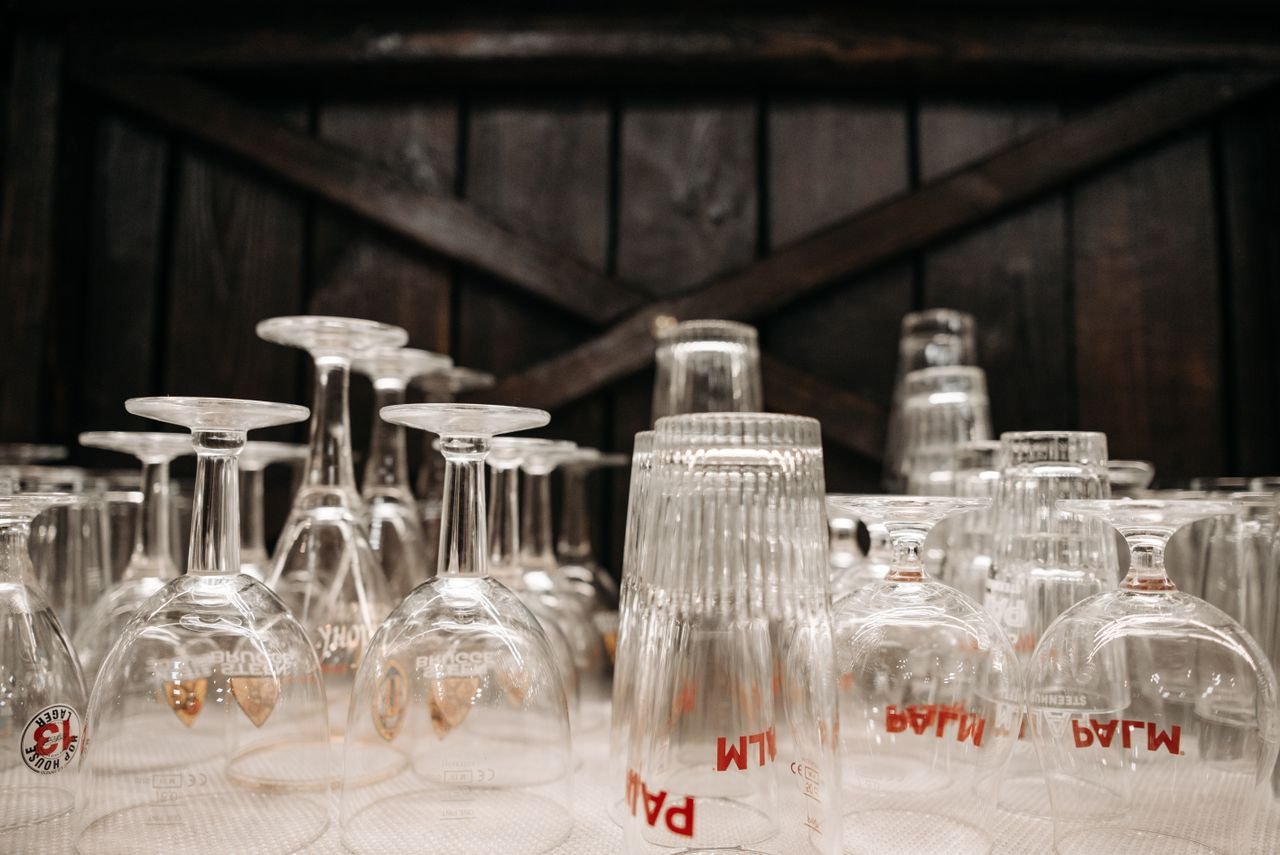
Hold the piece up to a bright light and read the pattern. An even white haze that wipes down to a faintly rough surface is a deposit and can be removed. Iridescent rainbow colors, a shift toward blue or purple, or cloudiness in bands point to etching, which is permanent.
White film, water spots, and soap scum
Hard water carries dissolved calcium and magnesium. When a rinsed glass dries, the water evaporates and those minerals stay behind as a chalky film, small spots, or a ring at the water line. Soap scum looks similar but forms when detergent is not fully rinsed away. Both sit on top of the glass, and a short acid soak normally lifts them.
Iridescence, cloudiness, and roughened surfaces
Etching looks different once you know the signs. The surface develops an iridescent sheen that shifts color as you tilt the piece, often turning blue, purple, pink, or brown, and cloudiness appears in bands or where one glass rests against another. Submerge the area in warm white vinegar for five to ten minutes: if the haze lifts, it was a deposit, and if nothing changes, the glass is corroded.
| What you see | Likely cause | Removable? |
| Even white haze, chalky to the touch | Hard water minerals | Yes. |
| Spotty rings that return after every wash | Mineral deposit and slow drying | Yes. |
| Greasy, streaky film that worsens after a hot wash | Detergent or rinse-aid residue | Yes. |
| Rainbow sheen, blue tint, cloudiness in patches | Etching of the glass surface | No |
| Fine internal cracks, sticky surface, musty smell | Crizzling, or glass disease | No |
How to remove white stains and haze from glassware
Work from the mildest method upward. Soak the glassware in a warm solution of equal parts white vinegar and water for 15 to 30 minutes, wash it as usual, rinse in clean water, and dry it straight away. For a stubborn patch, try a citric acid solution or a baking soda paste.
White vinegar and citric acid soaks
White vinegar is the default because it is mild and already in the cupboard. Use equal parts vinegar and warm, not hot, water, and give light to moderate film for 15 to 30 minutes. Heavy deposits can take an undiluted soak of several hours, so check the glass periodically rather than leaving it overnight. Citric acid powder works the same way and holds a more consistent strength across a batch. Keep acid contact short on lead crystal and decorated pieces, and finish with a rinse in clean water, distilled if the tap water is hard, then dry immediately.
Baking soda and other gentle abrasives
When soaking has loosened a deposit but not removed it, a paste of baking soda and a few drops of water gives the surface a gentle scrub. Apply it with a soft cloth in small circles, then rinse and dry. Skip steel wool, scouring pads, and powdered cleansers, which leave fine scratches that later become the places where etching starts.
Oxygen bleach for tea, coffee, and wine stains
Not every stain is mineral. Tea, coffee, and red wine leave brown or grey marks inside cups and teapots, and those respond to an oxygen-based bleach soak mixed at the label strength, followed by a thorough rinse. Strongly alkaline cleaners, chlorine bleach included, should not sit on glass for long, because alkalinity is what attacks the glass in the first place.
Cleaning the hard-to-reach parts
Narrow-necked decanters collect film where a cloth cannot reach. Fill one-third of a bowl with warm soapy water, add a spoonful of uncooked rice, and swirl it so the grains work the inside walls. Rinse, drain upside down, then twist a paper towel into a wick and push it into the neck.
Can glass be permanently stained?
Yes. Glass does not absorb a stain the way fabric does, but its surface can be permanently corroded, and the result looks almost identical to dirt. Alkaline detergent, high water temperatures, and repeated wet-and-dry cycles break down the silica network at the surface, leaving microscopic pits that scatter light instead of letting it through.
Why dishwashers cloud glass over time
Three things happen at once inside a dishwasher. The water is hot. The detergent is alkaline, and glass dissolves slowly in alkaline water. And the cycle repeats, so heat and moisture pulse through the surface dozens of times a year. Conservation specialists describe it as one of the harshest environments for glass, corroding it through heat, humidity cycling, and alkalinity together, as the Corning Museum of Glass explains in its guide to washing glass.
New glass is not as smooth as it looks. Forming leaves sub-microscopic scratches around the bowl, and corrosion attacks those first, which is why cloudiness often appears as a band rather than evenly across the piece. Soft water makes this worse, not better, because few minerals are left to buffer the detergent. Heat and strong alkali can also release lead from lead crystal, one more reason to hand-wash it.
When the problem starts in the glass itself
Some glass is unstable from the day it is made. When a formula contains too little silica to stabilize it or too much alkali, moisture in the air leaches alkali onto the surface, which turns hazy and slightly sticky. Left there, it forms an alkaline solution that breaks down the silica network, and badly affected glass eventually falls apart. This is crystallizing, or glass disease, and it cannot be reversed. It appears most often in 17th- and early 18th-century European glass and in some art glass, and the response is the same as for deposits: wash the alkali off, dry the piece thoroughly, and keep it somewhere stable and dry.

How to clean vintage and antique stained glass
Wash vintage glass by hand, one piece at a time, in tepid water with a mild, unscented detergent, and dry each piece straight away with a soft lint-free cloth. Keep it out of the dishwasher, do not soak it for hours, and never use an abrasive pad. With old glass, gentle handling matters more than a strong cleaner.
A safe hand-washing routine for delicate pieces
- Line the sink with a rubber mat so the glass never touches a hard surface.
- Fill it with warm water and a few drops of mild detergent, skipping perfumed and ammonia-based cleaners.
- Wash one piece at a time with a soft sponge, holding the bowl rather than the stem.
- Rinse under clean water, finishing with distilled water if the tap water is hard.
- Dry immediately with a lint-free cloth, then store the piece upright with a small gap around it.
Carry glass one piece at a time; most breakage happens in the hand, not the sink.
Decorated glass: gold trim, enamel, and painted finishes
Gilded rims, hand-painted decoration, and enamel work are the first things to suffer. Long soaking softens and lifts these finishes, and so does rubbing directly over them. Wipe around decorated areas rather than across them, keep soak times short, and never put a decorated piece in a dishwasher.
Lead crystal and long-term storage
Keep acid contact brief on lead crystal, and do not store wine, spirits, or juice in a crystal decanter for more than a day or two. Buff the crystal with a microfiber cloth, store it upright so nothing presses on the rim, and give it space, because crystal stored rim-down against a hard shelf chips eventually.
How to keep glassware from staining again
Control three things and the stains largely stop coming back: the water, the amount of detergent, and how fast the glass dries. Rinse in clean water, use only as much detergent as the load needs, dry glassware promptly instead of letting it air dry, and store it somewhere dry and closed.
Water, detergent, and rinse aids
If your water is hard, minerals are the source of the film, and a rinse aid helps water sheet off rather than pool and dry in place. A water softener or a filtered final rinse addresses the cause rather than the symptom. If your water is already soft, cut the detergent back instead, because soft water plus an alkaline detergent is the classic etching combination. Use the minimum dose, choose a shorter, cooler cycle, and do not overload the machine.
Drying and handling habits
Rinse glassware in clean water rather than leaving it in the wash water, and dry it while it is still warm. Air drying is convenient, but in hard water it is also how a mineral film gets built back onto a glass you have just cleaned. Do not stack wet glasses, and pick up clean glass by the bowl.
Storage that protects clarity
Good glassware storage does as much for clarity as any cleaner. Keep glass in a dry, closed glassware cabinet, away from direct sunlight and from the stove, where airborne grease settles on the surface and becomes a film that needs another wash. Leave space between pieces and store them upright, because rim-down storage puts the weight of the glass on its thinnest part.
Cleaning stained glassware at volume
In bars, hotels, and catering operations, stained glassware is usually a process problem rather than a cleaning-product problem. A fixed sequence of pre-rinse, wash, sanitize, and air dry, run the same way on every shift, keeps glass clear.
A repeatable wash-and-sanitize sequence
- Empty and pre-rinse glasses as soon as they reach the station, because residue that dries inside is harder to shift.
- Wash in warm soapy water, either in the first compartment of a three-compartment sink or in a commercial glass washer run to specification.
- Rinse in clean warm water in a separate compartment, changing both waters when they look soiled and on a fixed schedule.
- Sanitize in the third compartment, at the concentration and contact time stated on the sanitizer label.
- Air-dry upside down on a drainboard so air circulates inside the glass. Do not dry with bar towels or stack clean glasses while they are wet.
- Handle clean glass by the bowl, never by the rim.
Where the stains appear tells you what to fix. Rings at the water line point to drying and water quality; cloudiness across the bowl points to detergent dose, wash temperature, or the glass.
Choosing glassware that survives repeated washing
When a business runs through glass quickly, the cost of staining is the replacement rate and the labor spent rewashing.
- Formulation: high-silica borosilicate resists heat and chemical attack better than soda-lime glass, so it suits the pieces that go through the most cycles.
- Annealing and surface finish: better-controlled cooling leaves fewer micro-scratches for corrosion to start from, and thicker walls tolerate contact where thin decorative rims chip.
- Batch consistency: for matched glassware sets that must still look uniform after a year, buy in one run and keep spares of the same specification.
- Fit for the process: pieces that stack and nest reduce handling damage, and pieces that drain freely dry more evenly, which matters in glassware rental fleets where glass is washed, packed, and reissued.
If you buy by the pallet, put the glass formulation, annealing, and wall tolerance in writing, and confirm the supplier can repeat the specification next order.
FAQ
Does soaking glassware in vinegar damage it?
A short soak is safe for most everyday glass. The risks come from contact time and from the wrong pieces: leaving glass in acid overnight, soaking lead crystal or decorated glass, and skipping the rinse afterwards. Fifteen to thirty minutes in a diluted, warm solution is a reasonable standard.
Can a polishing compound fix etched glass?
No. Polishing does not remove etching, because the cloudiness is damage to the glass rather than a coating on top of it. Abrasive polishes that work on metal only add finer scratches. A polish only helps with a deposit that a soak did not fully lift.
Do borosilicate glasses stain less than ordinary soda-lime glass?
Generally yes. Borosilicate contains more silica and less alkali, so it reacts more slowly with hot water and alkaline detergent and resists clouding far better than standard soda-lime glass. It is not exempt, though: an aggressive cycle will eventually etch it, and it collects mineral film just as readily if it is dried in hard water.