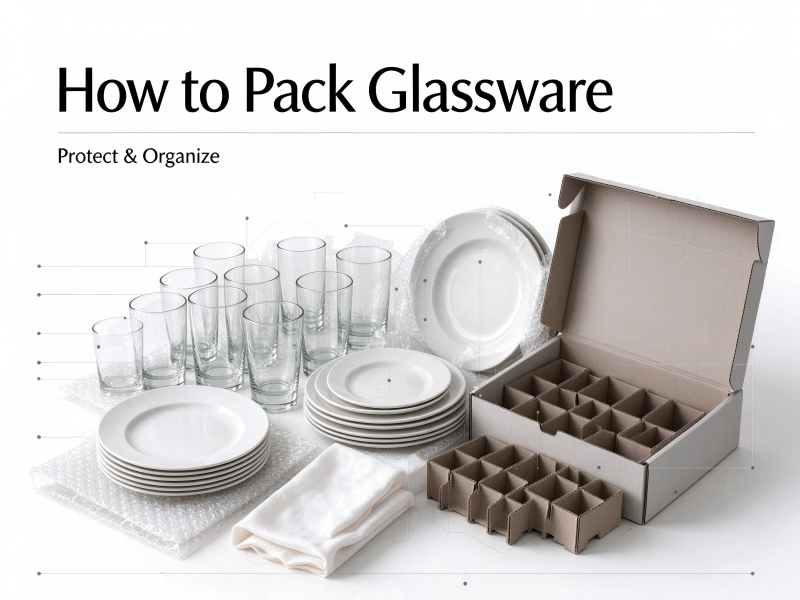
Every chipped rim and snapped stem traces back to two causes: glass touching glass and empty space inside the box that lets pieces shift. Better materials help, but technique decides most outcomes. A box packed with expensive wrap and loose contents still arrives in pieces.
The short answer: wrap each piece so it cannot touch its neighbors, fill every gap so nothing moves, and keep the box small enough that one person can carry it comfortably. Clean packing paper handles the surface layer, bubble wrap absorbs impact, and crumpled fill locks the load in place.
The same method covers a household move, a season of glassware storage, or a carton heading out to a customer. What changes is how densely you pack and how long the box has to hold.
What is the best packaging for glassware?
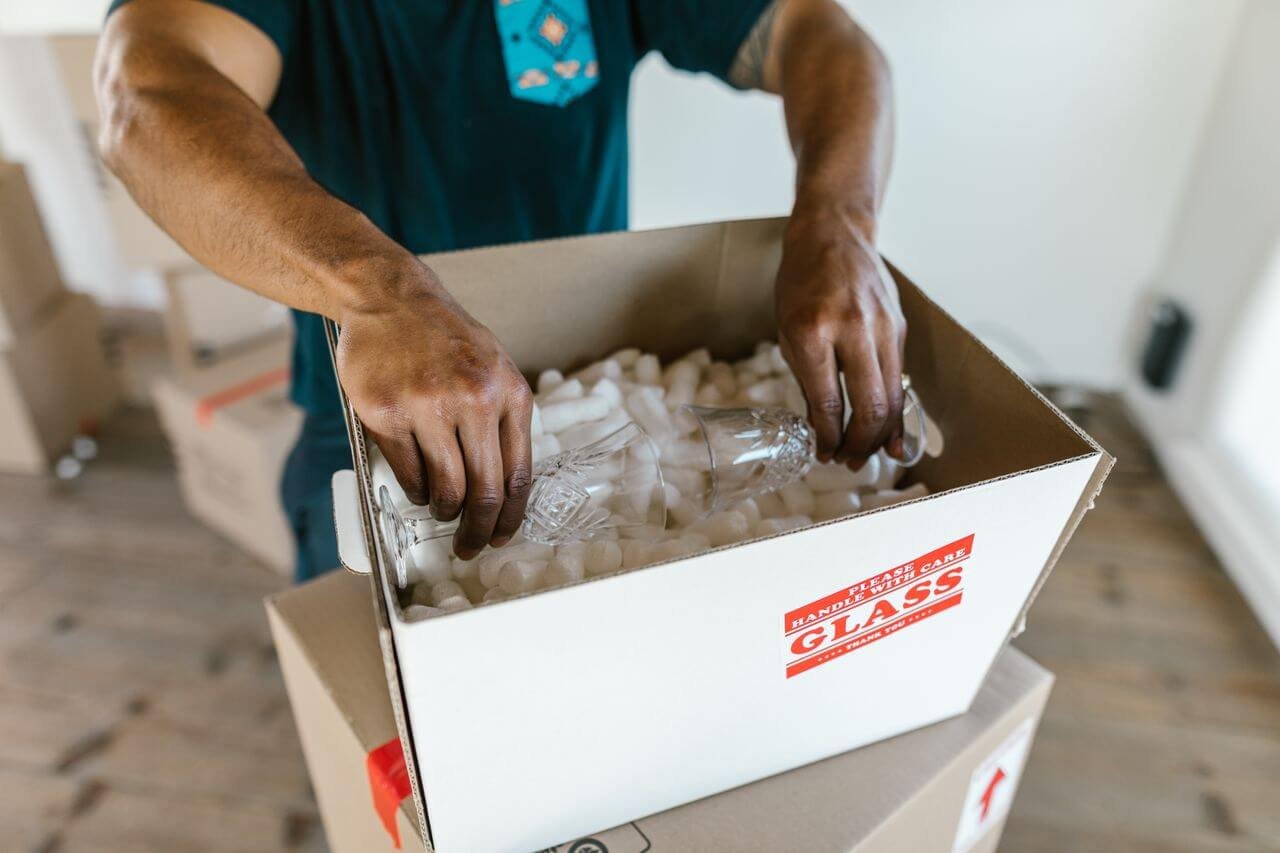
No single material wins on its own. The most reliable setup is a double-wall carton lined with crumpled paper, each piece wrapped in paper, bubble wrap added on anything fragile, and every gap filled until the box is silent when shaken.
Damage often comes from causes a wrapper cannot fix: a box that crushes under a stack, or contents that slide into each other. Build the packaging in layers.
| Material | What it does | Where it earns its place |
|---|---|---|
| Double-wall carton | Resists crushing under a stack | Any box holding more than a few pieces |
| Clean packing paper | Wraps surfaces and crumples into shock-absorbing fill | First layer on every piece |
| Bubble wrap, small bubble | Traps air to take knocks and vibration | Thin walls, stems, handles, rims |
| Cell dividers | Give each glass its own compartment | Glasses, stemware, mugs |
| Foam pouches | Slide over a single glass as a sleeve. | Stemware and narrow pieces |
| Two-inch packing tape | Seals seams and reinforces the base | Box assembly |
| Permanent marker | Marks contents and handling instructions | Every box, on two sides |
A few substitutions do more harm than they save. Printed newspaper transfers ink to porous glass, so keep it under the liner. Stretch film bundles items but cushions nothing. Loose packing peanuts shift and pack down, so use them only around an already-wrapped item.
Weight decides box size more than piece count does. A carton of glass can pass 40 pounds while still looking half empty, which makes it hard to carry down stairs. Smaller boxes, packed fully, travel better than one large box filled to the brim.
How to prepare glassware before you pack
Wash and dry everything completely. Moisture trapped under the wrap fogs a surface and softens the paper, keeping it sealed.
Sort by type and size, so glasses go in with glasses and plates with plates. Similar shapes pack tighter and need less filler. Pull out anything already chipped, because a damaged rim will not survive handling even with good padding.
Is it better to wrap glass in paper or bubble wrap?
Use paper as the first layer and bubble wrap as the second on anything fragile. Paper alone protects everyday tumblers and plates; thin walls, stems, and crystal need the air layer that bubble wrap provides.
The two materials do different jobs, which is why the argument never resolves. Crumpled paper fills space and cushions with its own give, and wrapped around an object, it puts a clean layer between surfaces so nothing scratches. Bubble wrap traps air, and each pocket flattens on impact to spread the force instead of letting it land on the glass.
| Factor | Packing paper | Bubble wrap |
|---|---|---|
| Main job | Surface protection and gap fill | Impact and vibration absorption |
| Space in the box | Low; packs tight | Higher; needs a slightly larger box |
| Best on | Everyday tumblers, plates, bowls | Stemware, crystal, thin rims |
| Layering order | Always first, against the glass. | Second, bubbles facing inward |
Wrap with the bubbles facing in and the flat side out, so tape grips the outside and the bubbles cradle the surface instead of pressing marks into a finish. On most pieces one layer of paper and one layer of bubble wrap are enough. Thin crystal or antique glass may need a second paper layer.
Is it better to pack glasses standing up or lying down?
Pack glasses standing upright. An upright glass carries the load down through its walls and base, while a glass on its side takes the same pressure across the thinnest part of the wall and the rim.
That is where damage begins. On the side, the rim becomes a load-bearing edge, and any weight above it concentrates on a few millimeters of glass.
Two habits make upright packing work. Crumple a small wad of paper inside each glass so the walls have support from within. Then sit each glass in its own compartment, because a glass leaning on its neighbor transfers every jolt straight through the contact point. Whether the opening faces straight up or tilts slightly to one side matters less than what sits above the rim. Nothing should rest on it.
What changes for stemware?
Stemware breaks at the stem first, so treat it in two passes. Wrap the narrow stem separately with a strip of bubble wrap, then wrap the whole piece in paper, and only then place it in the box.
Load heavier tumblers on the bottom layer, and keep crystal and thin stemware on top. How many glasses fit in one box depends on weight and padding rather than a fixed count: stop when the box reaches a weight you can lift with one hand on each side.
How to pack plates, bowls, and mugs
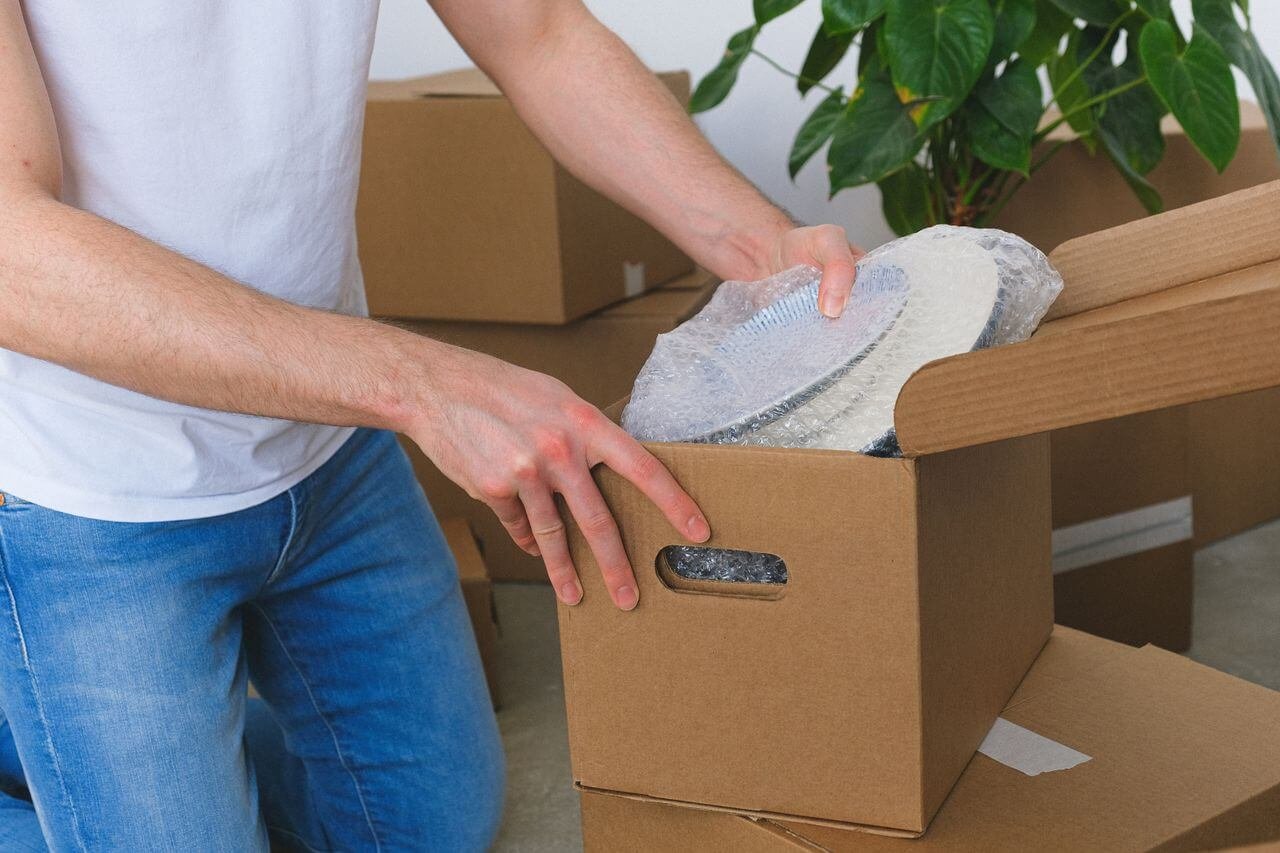
Pack plates on their edge, like records in a crate. Stacked flat, each plate absorbs the weight of everything above it and cracks across the center.
On edge, a plate flexes slightly under load and spreads the pressure along its strongest line. Flat, the bottom plate has nowhere to go and takes the full stack.
Wrap each plate in paper, then bundle two to four together with a folded sheet between the bundles so they do not rub. Stand the bundles upright, working from one wall to the other. Line the base and the top with crumpled paper, then fill every gap until the box stops shifting.
Keep heavier plates toward the bottom and lighter saucers on top. Before you tape the lid, lift the box and shake it. If you hear movement, add more paper. A well-packed box makes no sound.
Should you pack dishes vertically or horizontally?
Vertically, on the edge, without exception. Horizontal stacking is the most common packing mistake, and it fails for a physical reason: a plate in a flat stack cannot bend, so the one at the bottom carries every plate above it. Stand the same plates on edge, and each one can give a little, which is what keeps the glass intact. The rule applies to saucers, platters, and oval serving dishes too.
Bowls, mugs, and other awkward shapes
Wrap each bowl individually. If you nest them at all, stop at two and put a sheet of paper between them, then wrap the pair as one unit. Deep mixing bowls are the heaviest pieces in a kitchen box, so they belong near the bottom.
Mugs travel best upright with the inside stuffed, which stops the walls from being crushed. Wrap the handle separately, since it is the part that snaps when a box is compressed. Anything with a spout, a foot, or a decorative protrusion gets the same treatment: reinforce the weak point before wrapping the body.
How to pack glassware for storage instead of a move
Storage packing is stricter than moving packing because the box may sit untouched for months. Use denser padding, keep everything upright, and make sure no piece carries weight from above for that long.
A box that survives a two-hour drive can still fail over a season. Continuous pressure, humidity, and temperature swings do damage a short trip never would.
Choose the spot first. A cool, dry place out of direct light suits glass. Keep cartons off a concrete floor, since moisture wicks into corrugated board and weakens the whole stack.
Then think about how often you will open the box. For pieces you reach for regularly, a closed glassware cabinet at waist height keeps dust off. For long-term holding, use divided glassware storage containers or cell inserts that hold each piece in place even when the box is moved a little. Avoid stacking glasses rim to rim anywhere.
When you stack storage boxes, put the heaviest on the bottom, cap the number of layers, and keep stacks even. An uneven stack leans, and a leaning stack crushes the cartons at the low corner.
Packing glassware in bulk for resale, rental, or shipment
In bulk, the priority shifts from wrapping each piece to making sure nothing moves. Custom inserts and dividers replace individual wrapping, and the carton gets tested before it leaves the dock.
Individual wrapping does not scale. A foam or corrugated insert cut to the profile of the product holds each unit in place with less material and less labor, and it makes packing repeatable, which protects a whole shipment rather than one lucky box.
What the insert needs to do depends on who is buying.
- Resellers of glassware sets need matched pieces to arrive as complete sets, so pack by set rather than by size and label each carton with its contents.
- A glassware rental business, or any operation running repeated glassware rentals, sends the same pieces back and forth. In that cycle, an insert that survives twenty trips matters more than maximum cushioning on the first one.
- Glassware studios and small workshops deal in irregular, one-off shapes, where filler cut to fit the piece beats generic padding.
Once the box is designed, test it rather than assume. Drop and vibration tests, of the kind the International Safe Transit Association publishes, show whether a carton survives a sorting belt and a stacked pallet. For palletized loads, cross-stack the layers, add corner boards, and wrap the load with stretch film so it cannot shift.
If your volumes are steady and the shapes repeat, a supplier that controls both the product and its carton removes most of the guesswork, because sizing, glass type, and inserts can be matched to your shipment instead of forced into a generic box. Manufacturers supplying glass jars wholesale and custom drinkware build cartons around the product for exactly this reason. Ask three questions before you order: what glass they use, whether they provide export cartons, and whether they can cut the insert to your profile.
Common mistakes that break glassware
Nearly every breakage comes down to movement: glass touching glass or space that lets pieces shift.
- Stacking plates flat. Stand them on edge instead.
- Laying glasses on their side. Keep them upright and separated.
- Leaving space in the box. Fill it until a gentle shake produces nothing.
- Overloading the carton. Stop at a weight one person can lift.
- Letting two pieces touch. Wrap each one so no glass meets glass.
- Using stretch film or printed newspaper as protection. Both fail at cushioning.
- Trusting a fragile label to do the work. The label only helps if the packing inside is already tight.
- Opening a box from the side. Cut the top and lift items straight out.

FAQ
Can I pack glassware in a suitcase instead of a box?
Yes, if the case is rigid and closes tightly. Line the base with clothing or towels, wrap each piece as you would for a box, and fill every gap so nothing shifts. Carry the suitcase by the handle rather than laying it flat, and keep it out of a stack. Soft-sided cases bend under load, so treat them as a backup.
Does temperature affect glassware in storage?
Sudden changes do more than steady cold or heat. Rapid shifts stress the glass and can turn a small surface flaw into a crack. Keep stored boxes in a stable, dry spot away from radiators, sun-facing windows, and unheated outbuildings, and let packed glass return to room temperature before you unpack it.
How long can glassware stay packed before I repack it?
There is no fixed limit, but conditions matter more than time. In a dry, stable room with proper padding, boxes hold for months without attention. Check them once a season for damp board, sagging stacks, or loose fill, and repack anything that has shifted. If the area is humid or the stack leans, repack sooner.