Foggy glassware is the quiet problem in any kitchen that washes glass by machine. Caterers pull wine glasses from a cycle looking greyer than they went in, event fleets lose pieces to a haze, no towel shifts, and home cooks retire tumblers once guests start noticing. A piece built with the right balance of silica, flux, and lime holds up to alkaline detergent far better than one made to a cheaper formula, so a commercial custom glassware order and a discount set age differently.
Foggy glassware is one of two problems, and they need opposite responses. A white, chalky haze that lifts under acid is a film—minerals left behind as water dried, often with detergent dried on top of it—and it comes off. A milky or rainbow-tinted haze that survives acid is etching, where alkaline detergent has dissolved the glass surface itself. Test one glass before treating the rack, because the two look alike.
The order that saves the most glass is test, treat, then change what happens inside the machine.
How to tell film from etching on foggy glassware
A vinegar spot test, a look in raking light, and a fingernail separate almost every case in under a minute. Uniform white haze that reacts to acid is removable film. Rainbow interference color with a rough texture is permanent etching.
| What you see | What it is | How it feels | Can it be removed? |
|---|---|---|---|
| Even white haze, heaviest at the rim and base | Mineral film plus dried detergent | Slightly rough, consistent | Yes, with acid |
| Rainbow or oil-slick shimmer | Etching, a corroded surface | Rougher, sandy in patches | No |
| Grey smears inside the bowl. | Soap, oil, or protein residue | Slippery, then tacky | Yes, with washing |
The vinegar spot test
Put one drop of white vinegar on the thickest patch of haze, wait fifteen seconds, then wipe it dry and check it in daylight. A patch that clears was scale; if nothing changes, the light is bouncing off damage in the glass.
Reading the surface in raking light
Hold the glass at an angle to a window rather than looking through it. Film reads as matte white, while etching throws blue, purple, or brown. A slimy surface under the haze usually means alkali is still sitting there, and washing removes it.
What causes foggy glassware?
Three things fog glass: minerals left behind when hard water dries, alkaline detergent dissolving the surface, and residue that never rinsed away. Only the second one is permanent.
Hard water minerals
Calcium and magnesium dissolved in water are left behind the moment it evaporates. A sink wash carries most of them away, but a dishwasher’s final rinse dries in place, and scale builds where water collects: bases, rims, and tall narrow bowls.
Why some glasses stay permanently cloudy
This decides whether a glass is worth saving. Detergents are strongly alkaline, built on compounds such as sodium carbonate and sodium hydroxide, and those builders do not distinguish food residue from glass. Once surface pH climbs, hydroxide ions attack the silicon-oxygen bonds, and the surface dissolves into microscopic pits that scatter light.
The damage arrives in stages: faint dullness, then milkiness across a table, then roughness you can feel, by which point material is gone. Over-dosing detergent speeds it up, and so does very soft water, which carries too little mineral content to buffer the alkali. The Canadian Conservation Institute’s notes on caring for glass describe the same chemistry: unstable glass forms a cloudy alkaline layer that washes off early on and becomes a permanent network of fine cracks as deterioration advances.
Soap residue, food film, and thermal shock
Not every grey glass is corroded. Soap left by a weak rinse wipes away, protein from eggs or milk can set onto the surface in a hot cycle, and tall glasses washed upright never get water inside them. Thermal shock cracks glass rather than clouding it.
How to clean foggy glassware with white vinegar
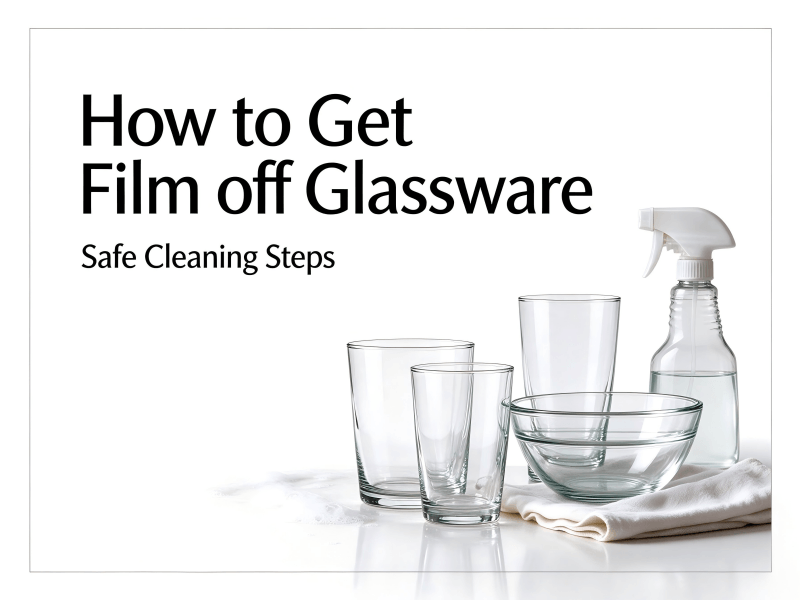
Mix white vinegar with warm water at roughly equal parts, submerge the glasses for fifteen to thirty minutes, then wipe, rinse, and dry by hand. That lifts mineral film and dried detergent and does nothing for etching.
- Rinse in warm water so the acid works on scale rather than grit.
- Fill a basin with equal parts white vinegar and warm water, deep enough to cover the glasses.
- Submerge for fifteen to thirty minutes. Heavy scale takes longer, so check hourly.
- Wipe the rim and base in circles with a soft cloth, where deposits sit thickest.
- Rinse in clean warm water. Hot water on a cold glass is a needless risk.
- Dry straight away with a lint-free cloth. Left to drain, the same minerals go back on.
What vinegar can and cannot fix
Vinegar removes carbonate scale, dried detergent film, and soap haze. It cannot remove etching, scratches, or internal stress marks. Keep abrasives off anything that already feels rough, since salt and baking soda polish the pits rather than fill them.
How to make cloudy glasses crystal clear again without vinegar
Plenty of people dislike the smell or have none in the cupboard, and the alternatives work. Citric acid, lemon with coarse salt, a baking soda paste, and oxygen-based cleaners all lift mineral film at different speeds, and none of them reverse etching.
| Method | Contact time | Best for | Watch out for |
|---|---|---|---|
| White vinegar | 15 to 30 minutes | Everyday mineral film | Lingering smell |
| Citric acid solution | 15 to 30 minutes | Thick scale | Dissolve fully first. |
| Lemon with coarse salt | Spot treatment | Rims and bases | Not for etched glass |
| Baking soda paste | 2 to 5 minutes | Light film | Rinse hard, or it dries chalky. |
| Oxygen-based cleaner | One empty cycle | Scale inside the machine | Cleans the machine |
Citric acid and lemon with salt
Citric acid comes as a powder, dissolves in warm water, and works faster than vinegar on a heavy scale. Lemon with coarse salt is the kitchen version: dip a cut lemon in salt, rub it over the cloudy area, then rinse.
Baking soda paste
Mix baking soda with a little water and work it in circles. It lifts film mechanically rather than dissolving it, so it is the wrong tool for anything that already feels rough.
Oxygen-based dishwasher cleaners and descalers
If the same film returns on every load, the dishwasher is part of the problem. An empty hot cycle strips mineral build-up from the tub, spray arms, and filter, and that scale is what redeposits on the next load.
How to make drinking glasses sparkle again
Sparkle is a drying problem more than a washing problem. Water left to evaporate puts its minerals back on the glass, so drying by hand with a clean lint-free cloth does more for shine than any additive.
Why air-drying works against you
Draining a glass, and the water does not vanish; it evaporates, leaving whatever it carried on the surface. That is why glasses left to dry in a hard water area come out dull, and why a heated drying cycle bakes the residue on.
Polishing without scratching
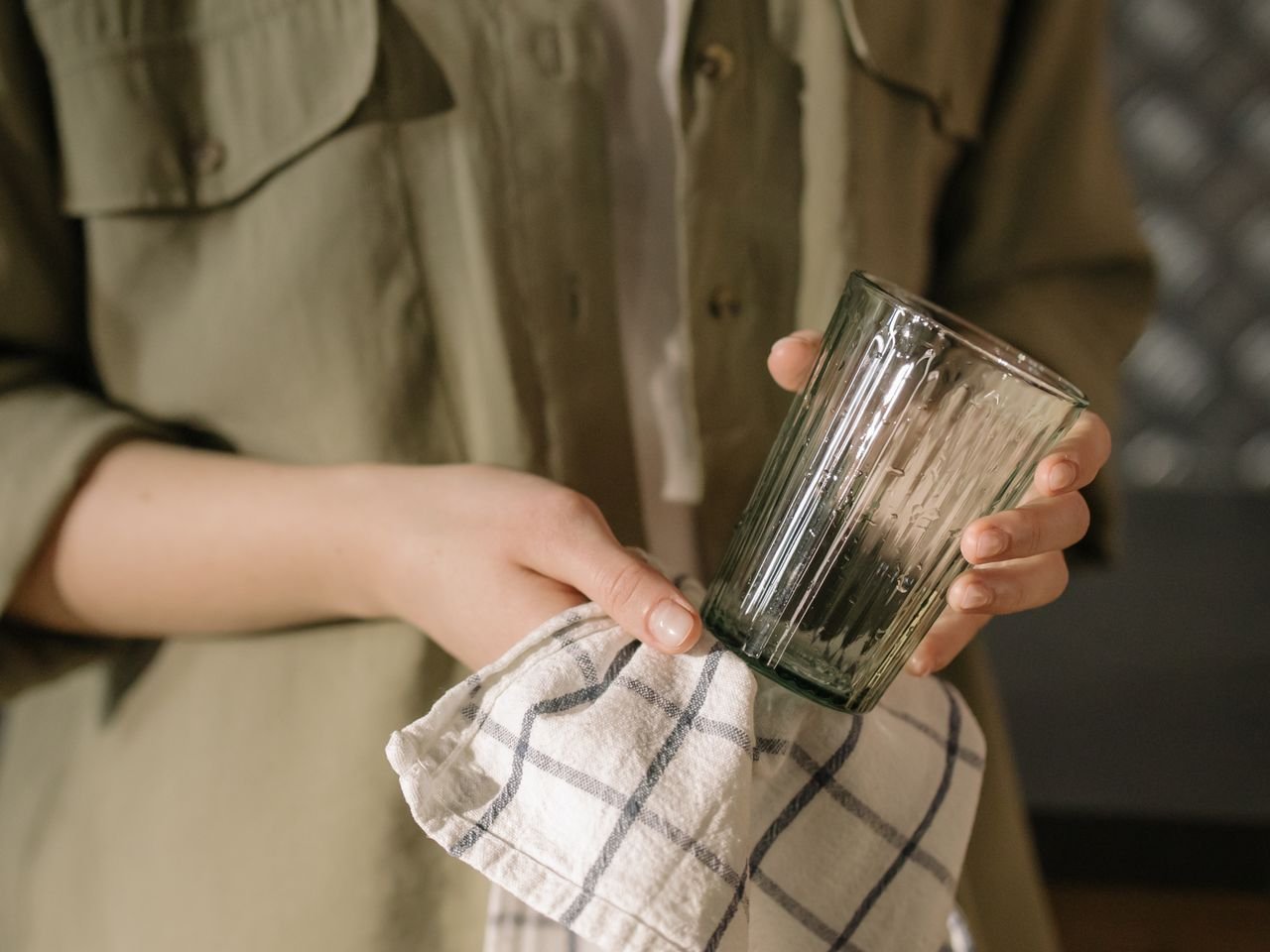
Dry with a clean microfiber or linen cloth while the glass is still slightly warm, holding the bowl rather than the stem. Wash drying cloths without fabric softener, which leaves a film behind.
Dishwasher settings that stop the haze coming back
Use less detergent, keep rinse aid and the salt reservoir topped up, and keep glassware out of the longest, hottest cycle with heated drying. Dose matters more than the name on the box.
Detergent dose and formulation
Extra detergent does not clean better, especially in soft water. It raises the alkalinity of the wash and leaves the glass with little to buffer it, which is the condition that etches surfaces.
Rinse aid, salt, and softener settings
Rinse aid makes water sheet off instead of forming droplets, and droplets are what leave spots as they dry. The salt reservoir feeds the built-in softener and should be set to local water hardness.
Load, cycle, and drying choices
Do not overcrowd. Glasses need space for water to reach them. Put glassware on the upper rack and take pieces out before the drying phase ends.
Preventing foggy glassware in restaurants and rental fleets
In a commercial setting fog is a cost line rather than a cosmetic detail: every etched piece lowers the look of a table and brings replacement forward. The levers are water quality, detergent dose, and a written inspection standard.
Water hardness and why soft water is harder on glass
Hard water deposits scale; soft water corrodes. Water carrying plenty of calcium and magnesium resists a change in pH, while water carrying almost none lets detergent push the wash towards the alkaline conditions that dissolve glass. Softening a supply and keeping the old detergent setting turns a film problem into an etching problem.
Dosing and cycle rules at volume
Commercial machines publish a dose table against water hardness. Three habits carry the rest: an empty descaling cycle on a schedule, glass racks on their own short gentle program, and a written log for rinse aid and salt.
Taking etched pieces out of the rental rotation
For glassware rentals, the inspection standard is the business case. A glass that fails the acid test should be retired before its next event, because a hazy glass reads as dirty to a guest. A pre-event check takes seconds per tray: raking light for color, a spot test on one piece, and a finger around the rim.
Training the dish team
Three rules cover most of it. Rinse glassware before it goes in, so detergent works on glass rather than dried food. Never top up the detergent dispenser to be safe. Pull glassware out before the drying cycle runs.
How to store clean glassware so it stays clear
Store glassware completely dry, spaced so pieces do not touch, and away from boards that release acidic vapours. Damp storage undoes a good wash faster than any detergent. For the routine after a service, this guide on how to store clean glasses and cups covers shelf layout, drying checks, and stemware handling.
Cabinet and shelf choices
A glassware cabinet should stay dry, stable in temperature, and out of direct sunlight. Museum guidance warns against solid wood and composite boards for high-soda glass because the acids they release attack the surface over years.
Containers, racks, and packing for storage and transport
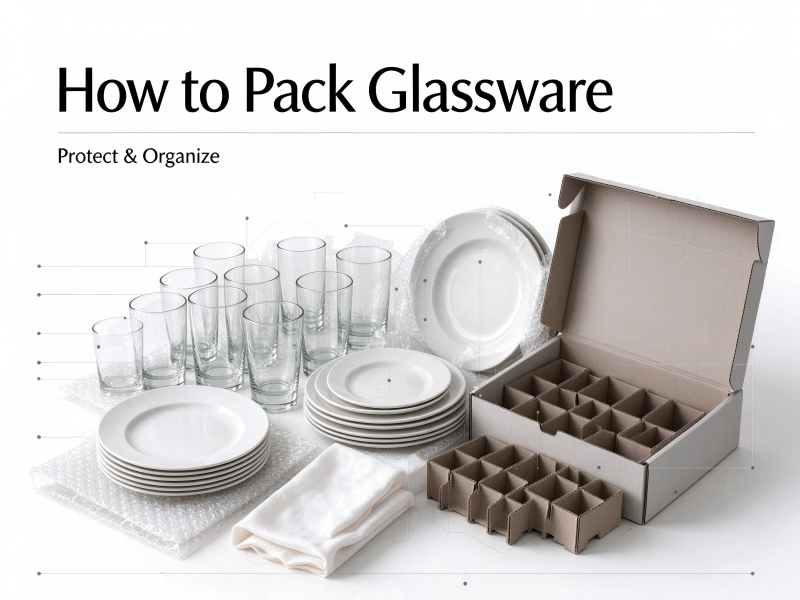
For glassware storage in bulk, use rigid crates rather than soft bags, and put foam or acid-free tissue between pieces so nothing rests rim to rim. Never pack glassware storage containers wet.
When to replace foggy glassware and how to choose the next set
Retire any piece that fails the acid test or shows a rainbow tint under a lamp. Etching cannot be polished out, and cloudy glass makes a table look neglected. Replace on inspection, not on a calendar.
Retirement criteria
The hard signs are a spot test that does not clear, iridescent color in raking light, and rough patches that catch a fingernail. Where the style is still in production, replacing retired sizes individually costs less than buying glassware sets again.
Glass types and how they behave in a dishwasher
Soda-lime glass, behind most tumblers and everyday glassware sets, is cheap and the least resistant to alkaline attack. Borosilicate handles heat and detergent better. Lead crystal is dense but soft, so it belongs in a hand-wash routine. Double-wall cups should be dried upside down, since water between the walls never really comes out. Glass from small glassware studios working on experimental formulas is less predictable than mass-produced ware.
Buying replacements in volume
Buyers replacing glassware at volume should work from a specification rather than a photo. Check that the maker labels the item dishwasher-safe, feel a sample for consistent wall thickness at the rim, and confirm that single sizes can be reordered.
FAQ
Is foggy glassware safe to use?
Yes, in almost every case. Etching changes the surface, not the composition of what you drink, and neither scale nor detergent film is a health risk once it has been washed off. The practical concern is hygiene: those pits hold residue, so an etched glass dulls again faster.
Does baking soda or salt scratch glass?
Not on its own. Both are far softer than glass, so they abrade dried film rather than the glass underneath, which is why a light paste works on scale. Damage comes from pressure and contamination: a grit-carrying sponge or heavy hands on a rough surface.
How often should a restaurant or rental fleet replace its glassware?
There is no reliable fixed interval, so a calendar is the wrong tool. Timing depends on water hardness, detergent dose, cycle temperature, and how often each piece is used, so two identical sites can be a year apart. Inspect instead, and retire on a failed acid test.