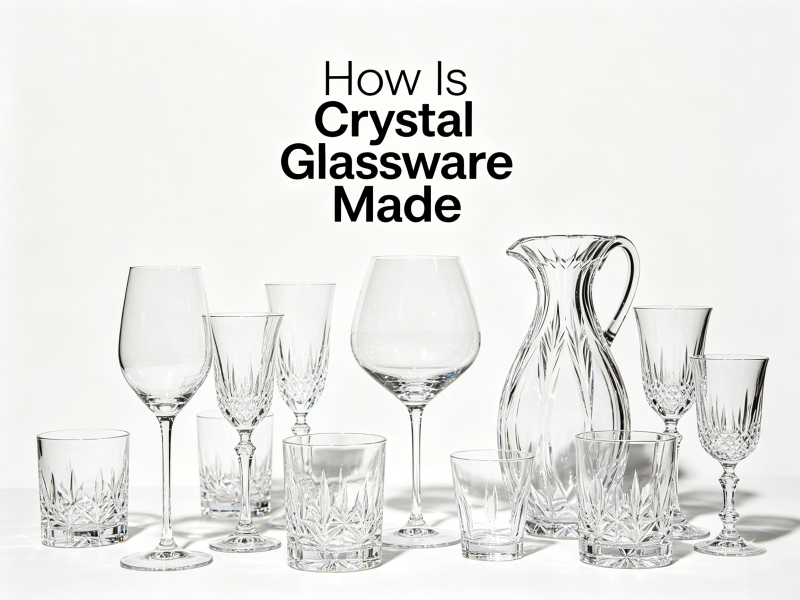
Crystal glassware holds the top of the tableware market for a reason. It weighs more, rings longer, and throws light further than ordinary glass, and all three effects come from the same place: what goes into the furnace and how the cooled piece is worked afterwards. Buyers comparing quotes from different factories often find that the difference between a pressed tumbler and a hand-cut goblet is invisible on a specification sheet. The manufacturing route explains it. For a hotel group specifying glassware for a restaurant floor, or a retailer planning an own-label range, that route is also where the cost sits.
Crystal glassware is made by melting a weighed batch of silica sand, potash, or soda ash and metal oxides such as lead oxide, barium oxide, or zinc oxide in a furnace at roughly 1400 to 1500°C, shaping the molten glass by hand blowing, mold blowing, or pressing, cooling it slowly in an annealing oven for 2 to 16 hours, and then cutting, engraving, and polishing the cooled blank so that the facets catch and scatter light.
Each stage below changes the finished product in ways a buyer can check, from the weight of the base to the sharpness of a facet edge.
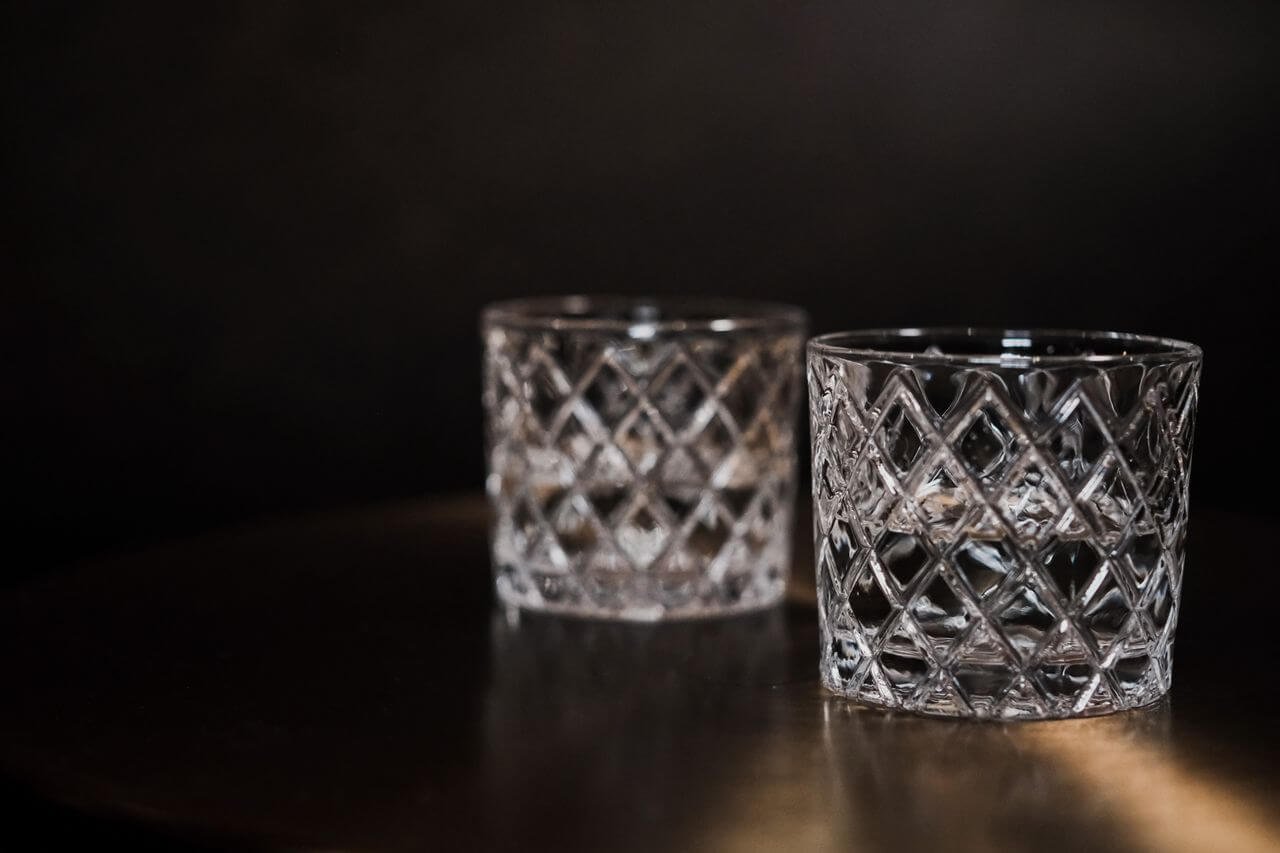
What crystal glassware is made of?
Crystal is glass with metal oxides added to raise its refractive index and density. Traditional lead crystal uses lead oxide at 24% or more by weight, while lead-free crystal substitutes barium, zinc, potassium, or strontium oxide to reach comparable optical performance without intentionally added lead.
| Property | Ordinary soda-lime glass | Lead crystal | Lead-free crystal |
|---|---|---|---|
| Main additive | None | Lead monoxide, 24% or more | Barium, zinc, potassium, or strontium oxide |
| Refractive index | About 1.50 to 1.52 | Up to about 1.70 | About 1.56 to 1.68 |
| Density | Lower | Roughly 2.9 g/cm³ and above | Comparable to lead |
| Sound when tapped | Short, dull thud | Sustained ring | Sustained ring |
| Wall thickness for equal strength | Thicker | Thinner | Thinner |
The recipe is closer to an industrial formula than a craft secret. A typical lead crystal batch runs about 48% silica sand, 24% potash, and 28% red lead oxide, against roughly 63% silica, 22% soda, and 15% limestone for ordinary soda-lime table glass. Small additions of potassium nitrate, borax, or coloring oxides adjust viscosity and tone.
Most furnaces also charge recycled material. Factory scrap and broken crystal, known as cullet, usually make up around 30% of the load. Cullet is not a cost shortcut. Because it has already been melted and refined, it helps cut down the number of small bubbles that survive into the finished piece.
Why the metal oxide changes everything
Adding lead or a substitute oxide does three things at once. It raises the refractive index, so light bends more sharply inside the glass and separates into the rainbow flashes the trade calls fire. It raises density, which produces the extra weight and the sustained note when the rim is flicked. And it softens the glass, which sounds like a disadvantage until you remember that a cutter has to grind deep V-shaped facets into the surface without shattering the piece. Hard soda-lime glass resists that; crystal accepts it.
The 17th-century English glasshouses that first patented a lead formula were solving a color problem, not a sparkle problem, and the material they produced happened to cut beautifully. Bohemian makers took the other road, reaching similar clarity with calcium and potassium instead of lead, and that split between leaded and lead-free chemistry is still the main division in the market today.
Melting the batch in the furnace
Melting turns the dry batch into a homogeneous, bubble-free liquid. Crystal furnaces run hotter and slower than ordinary glass furnaces, holding around 1400 to 1500 °C for many hours so the metal oxide fully combines with the silica before any glass is gathered for shaping.
| Stage | What happens | Typical values |
|---|---|---|
| Batch mixing | Silica sand, potash or soda ash, metal oxide, and cullet were weighed and blended. | About 70% raw batch to 30% cullet |
| Melting | A solid batch becomes molten glass. | 1400 to 1500°C |
| Refining | Held at a temperature so bubbles rise and break at the surface | Several hours, sometimes 24 hours or more |
| Cooling to working temperature | Glass thickens enough to gather on a pipe. | Around 1200 to 1250°C |
Two details separate a good melt from a mediocre one. The first is charging rhythm. Adding a batch in small scoops spread over hours melts more evenly than dumping a full load at once, and even melting means fewer trapped bubbles. The second is the slow descent back to working temperature. During that controlled cooling the glass contracts, and the contraction squeezes the remaining tiny bubbles down to nothing. Glassmakers also rake the molten surface as they work, which lifts out bubbles and reduces the faint wavy swirl that comes from surface glass evaporating slightly in the pot.
Shaping: blowing, molding, and pressing
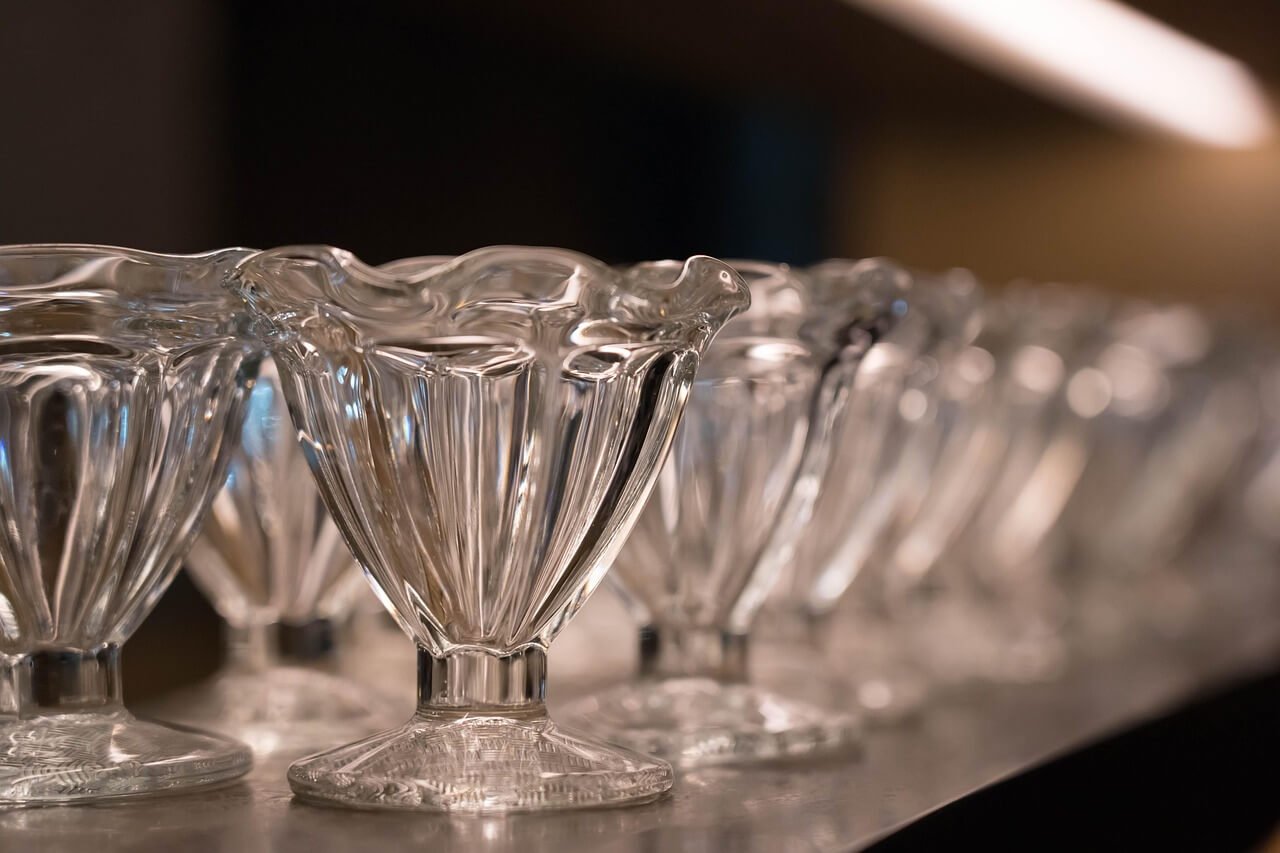
Molten crystal is shaped by hand blowing, mold blowing, pressing, or centrifugal casting. Hand blowing gives the thickest walls and the deepest later cuts; mold blowing trades some individuality for repeatability, and pressing is the fastest route to volume at the cost of softer detail.
Hand blowing
A team of four to seven works on each piece. One gathers molten glass on the end of a blowpipe, then shapes it with breath, gravity, wooden blocks, and a simple mold until the basic vessel, called the chamber, reaches the right wall thickness. Handles and stems are added while the glass is still hot enough to fuse, each in one movement, because the glass stiffens within seconds of leaving the furnace.
Mould blowing
The blower works into a mold that fixes the outer profile while still controlling thickness by hand. Output rises and dimensions become more consistent, which matters when a buyer needs a thousand pieces that stack the same way. Some of the character of hand blowing survives; the tool marks do not.
Pressing and centrifugal casting
Pressing drops a measured gob of glass into a mold and drives a plunger into it. It is fast, and for tumblers, plates, and simple bowls, it is the dominant method. The trade-off is that complex mold shapes generate more faults and rejects, and the finished detail is shallower than a cut facet. Centrifugal casting spins the mold so glass is thrown outwards against the wall, which reproduces fine surface detail and is used where a wide, evenly thin bowl is needed.
Annealing: the slow cool that prevents cracking
Annealing is a controlled slow cool in a lehr that relieves the internal stresses created by uneven thickness. Crystal spends 2 to 16 hours in the lehr depending on size and wall thickness, and a shortened or skipped anneal is the most common reason a piece cracks weeks after it leaves the factory.
Thin rims and thick bases cool at different rates, and if that happens in open air, the slower-cooling section keeps contracting after the rest has set. The result is locked-in stress that will not show up in inspection. It shows up later, when the piece meets hot water, a dishwasher cycle, or a hard knock, and splits along a line that looks like it came from nowhere. Pieces with added handles and stems are the most stress-prone, which is why annealing times run longer for decanters and pitchers than for plain tumblers.
Cutting, engraving, and polishing the blank
Cutting is what makes crystal look like crystal. A cooled blank is marked with a design, roughed out on powered abrasive wheels, then smoothed and polished until each facet is clear again. In cut work, skilled hours concentrate in the cutting shop rather than the furnace.
Marking and rough cutting
The pattern is drawn onto the vessel with a stencil of red lead and turpentine. Cutting then happens on powered wheels running under water lubrication, with the wheel profile deciding the shape of the cut: round-profile stones scoop concave hollows, square-profile stones cut line work and leaf forms, and mitred stones produce the V-shaped cuts that most people picture when they think of cut crystal. Diamond-tipped wheels take the deepest wedge facets; flat cuts use the same equipment at a shallower angle. Traditional stone wheels ranged from about 5 cm to 90 cm in diameter, with the large ones used for straight runs and the small ones for tight curves.
Smoothing and polishing
Rough cuts leave a grey, coarse surface. A finer stone wheel dresses them back to shape, and polishing follows on a wooden or cork wheel fed with pumice powder and water. Many factories finish with an acid polish, dipping the piece in a hydrofluoric and sulphuric acid mix that dissolves a thin surface layer and leaves a uniform lustre. Acid polishing is faster and cheaper than hand polishing, but it softens the edge of every cut, which is why the sharpest facets come from wheel-polished work.
Engraving
Engraving uses copper wheels rather than stone, smeared with a paste of emery or carborundum grit and oil. The soft copper carries the abrasive and can be re-profiled with a file as the design demands. Coarse grit at high speed excavates quickly; fine grit at low speed produces delicate work and a clearer polish. Learning to set, center, and maintain the wheels takes about five years, and much of the work is now done on much smaller diamond wheels that cut that training time to roughly a year.
Are crystal glasses actually crystal?
No. Crystal glassware is not crystalline. Like all glass, it is an amorphous solid with no ordered lattice, and the word “crystal” is a trade and regulatory term for glass whose metal oxide content pushes its density and refractive index above ordinary table glass.
| Test | Crystal | Ordinary glass |
|---|---|---|
| Tap the rim | Clear, sustained ring | Short, dull thud |
| Weight in hand | Heavier for the same size | Lighter |
| Base and edges | Often no mold seam; hand-cut facets show slight irregularity. | Mould seam and rounded edges possible |
| Held to light | Strong dispersion, rainbow flashes | Mild refraction |
None of these tests is conclusive on its own, and modern lead-free formulas imitate leaded crystal closely enough that a ring test proves very little. Composition is the only reliable answer, which is why the label matters more than the sound. A fuller comparison sits in this guide to crystal vs. glass.
Does all crystal glassware contain lead?
No. Lead crystal is one category, not the whole market. European rules separate full lead crystal, lead crystal, and crystal glass by their lead oxide content, and a large share of crystal sold today is lead-free, built on barium, zinc, potassium, or strontium oxide instead.
| Category | Metal oxide threshold | Labelling |
|---|---|---|
| Full lead crystal | 30% lead oxide or more | May be used as a description in both the origin and destination markets |
| Lead crystal | 24% lead oxide or more | May be used as a description in both the origin and destination markets |
| Crystal glass | At least 10% lead, barium, potassium, or zinc oxide; density at least 2.45 g/cm³; refractive index at least 1.52 | Description restricted to the language of the market where the goods are sold |
The thresholds and the rules that go with them are set out in the European Council Directive 69/493/EEC on crystal glass. Anything below those numbers is ordinary glass and cannot legally carry the crystal description in the European market.
How lead-free crystal performs
Lead-free formulas reach a refractive index of about 1.56 to 1.68 and a density close to that of leaded glass, so the weight and the sparkle survive the swap. The difference shows up on the wheel. Substituted glass is harder, so it resists scratching better in service but cuts more slowly and chips more readily at the edge of a deep facet.
The international workshop agreement IWA 43:2023 draws the current technical lines: crystal glass requires at least 10% total metal oxide, a density of 2.45 g/cm³, and a refractive index of 1.520, with lead capped at 100 ppm; crystal requires 24%, 2.67 g/cm³, and 1.535, with lead capped at 500 ppm; and lead crystal starts at 24% lead oxide with a density of 2.90 g/cm³ and a refractive index of 1.545.
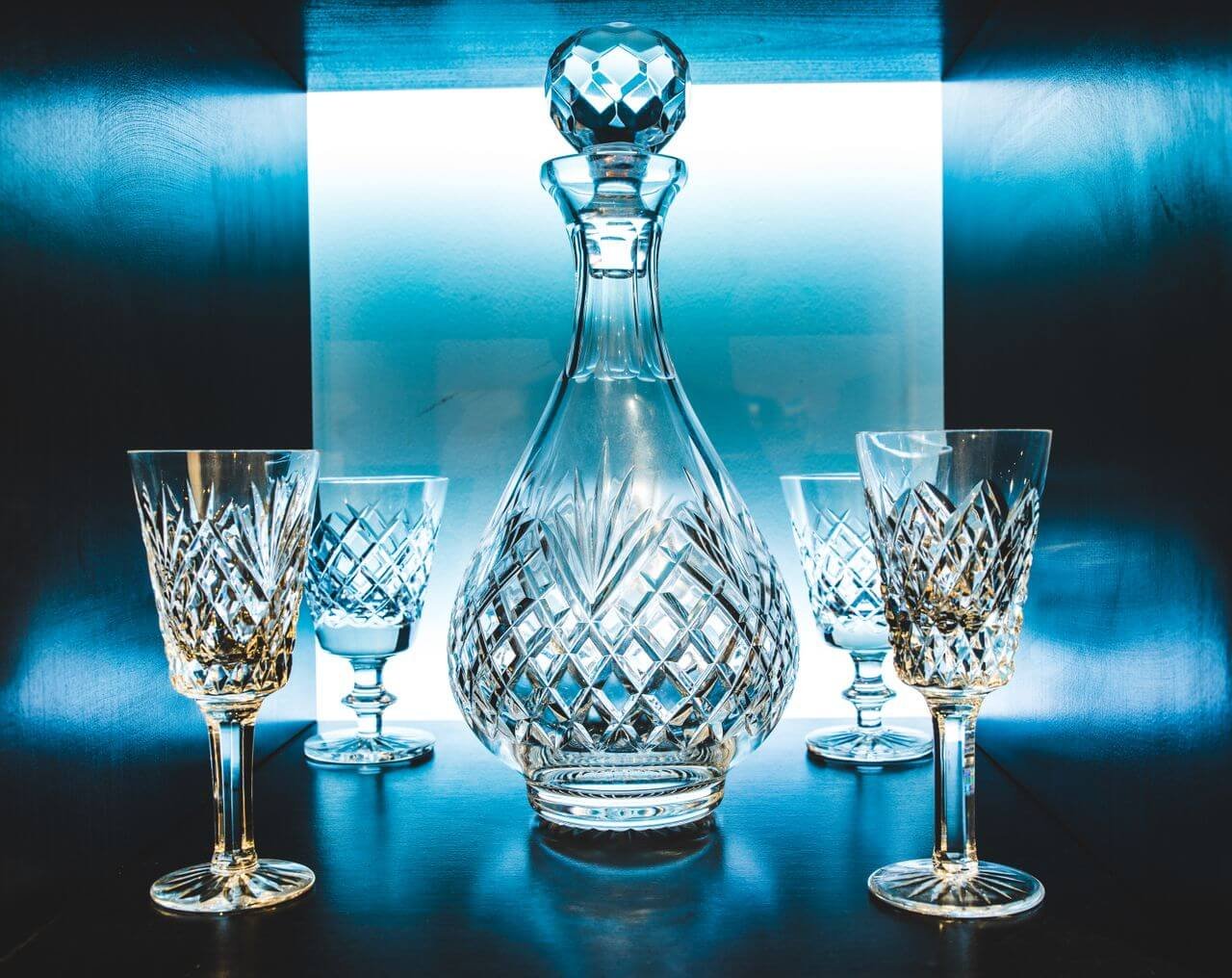
Is it good to drink out of crystal glasses?
For occasional serving, lead crystal is generally treated as acceptable. It is a poor choice for daily use and a bad choice for storage. Acidic drinks pull lead out of lead-containing glass, and the longer the contact, the higher the concentration in the liquid becomes.
| Condition | Reported lead level in the liquid |
|---|---|
| Port wine in a leaded crystal decanter, 4 months | About 3,500 µg/L |
| Sherry, port, or whisky in leaded crystal, 6 to 8 weeks | About 1,200 µg/L, with the first readings appearing within days |
| Spirits are stored long-term in leaded crystal decanters. | Up to about 21,500 µg/L |
| Wine in a leaded crystal glass, 30 minutes | Most of the total leaching happens in the first minute |
Those figures come from leaching studies published in the 1990s, and the pattern matters more than any single number: contact time and acidity drive the result, not the price of the glass. Lead has no established safe intake level, and the World Health Organization lead exposure guidance treats any avoidable intake as worth removing.
Practical rules that cover most of the risk:
- Serve from lead crystal; never store in it. Decanters and bottles hold liquid for weeks, which is where the worst numbers come from.
- Keep leaded crystal off the daily table. Water, juice, tea, and coffee all sit in the glass long enough to matter.
- Wash by hand with a mild, neutral detergent. Dishwasher cycles erode the surface and expose fresh lead-bearing glass.
- Retire chipped, cracked, or clouded pieces from food contact.
- If you want crystal for everyday use, choose a lead-free formula.
Is crystal glass worth any money?
Some pieces are, but most second-hand crystal sells close to ordinary glass prices. Value depends far more on how the piece was made and what condition it is in than on the word “crystal” on the label.
Four variables carry almost all the weight:
- Hand-cut or molded. Look for a mould seam and a pattern that repeats perfectly. Pressed pieces are made in seconds and priced accordingly; hand-cut facets show slight variation.
- Age and pattern. Older production from long-established crystal houses with documented factory marks attracts collectors. Current catalogue lines usually do not.
- Condition. Chips on rims and stopper edges, clouding inside the bowl, and worn gilding all cut value sharply.
- Completeness. Matched sets, original stoppers, original labels, and acid-etched marks all add. It is worth noting that a single odd glass rarely clears more than a few tens of dollars, while complete serving sets and older hand-cut stemware regularly reach the low hundreds.
A generic crystal label adds almost nothing on its own. The pieces that hold value were made by hand, cut by wheel, and kept intact.
Buying, storing, and caring for crystal glassware
Buying crystal is a specification exercise. Match the forming method and the cutting depth to how the piece will actually be used, then treat storage as part of the product’s service life, because most damage happens in the cabinet and the dishwasher rather than at the table.
Custom and wholesale programs usually quote from a specification rather than a catalogue: the mold cost sits in the tooling, and the unit price falls with volume. That is why buyers typically define glassware sets first, meaning the stemware, tumblers, carafes, or bowls that need to match, and only then discuss decoration. Bottle and jar ranges follow the same logic.
Storage deserves the same attention. Crystal should sit apart from other glass, ideally with a soft liner under each piece, because rim-to-rim contact in a crowded cabinet causes most chips. A glassware cabinet with shallow shelves and non-slip liners protects rims better than deep stacking. Where space is tight, glassware storage containers with padded dividers work better than boxes, and pieces should be stored either all rim-up or all rim-down, not mixed.
For one-off replacement pieces, repairs, or prototypes, small glassware studios that blow and cut on-site can produce single items that a production factory will not quote for. For events, glassware rental shifts breakage and replacement cost to the supplier, which makes sense for a single large function and rarely makes sense as a year-round arrangement for a restaurant. Buyers searching glassware near me will mostly find retail shops rather than manufacturers; for custom work, the relevant question is whether the supplier runs its own cutting shop.
FAQ
How long does it take to make a single crystal glass by hand?
Longer than the blowing suggests. The melt runs overnight or across a whole weekend; gathering and blowing take minutes, annealing adds 2 to 16 hours, and cutting and engraving are the slow parts. Complex relief work on a copper wheel can run 8 to 15 hours on one piece, while diamond-wheel engraving is considerably faster.
Is pressed crystal lower quality than hand-cut crystal?
It is a different product rather than a worse one. Pressing reproduces a shape from a mold in seconds with tight dimensional consistency, which suits high-volume tableware. Hand cutting produces sharper edges, irregular facets, and a level of detail no mold reproduces, and it carries a much higher resale value. Pressed crystal usually shows a mold seam and shallower detail.
Can crystal glassware be recycled or repaired?
Glass can be recycled indefinitely when it is not contaminated, and crystal factories routinely remelt their own scrap as cullet, at around 30% of a new batch. Household recycling of leaded crystal is more complicated because of the lead oxide, so check local rules before putting it in the glass bin. Chips and cracks cannot be repaired invisibly, but a shallow scratch or a dulled surface can often be re-polished on a wheel.