Uranium glass keeps turning up at flea markets, estate sales, and thrift stores. Sellers price it anywhere from a few dollars to a few hundred, and buyers usually have the same two questions: is the glow real, and is the piece actually worth the asking price? Because the glass looks ordinary in daylight and only reveals its color under a black light, most people walk past it without a second thought. That is changing as more collectors discover the green glow and start asking what it means in dollars.
The short answer is yes. Uranium glassware is worth something, and some pieces are worth a great deal. Common pieces sell for $10 to $75, rare forms and complete glassware sets routinely reach $200 to $500, and exceptional art glass has sold above $10,000 at auction. The exact number depends on age, rarity, condition, and how strongly collectors want the shape.
This guide covers what drives the value, how to spot vintage uranium glass, what typical pieces sell for, whether owning it raises any legal or safety questions, and how the glass was made.

What makes uranium glassware valuable?
Age, scarcity, condition, and demand for the shape set the price. A chipped common tumbler is worth a few dollars, while a pristine, rare vase can sell for a hundred times more.
Uranium glass was mass-produced in huge numbers between the 1880s and the early 1940s, which means most surviving pieces are not scarce at all. One often-cited estimate from Buckley et al. (1980) counted at least 4.16 million decorative uranium glass pieces made in the United States between 1958 and 1978, on top of the millions already in circulation. That production volume is why ordinary bowls and cups stay cheap. Value appears only when the piece sits outside that mass-produced middle ground.
Age and production history
Glass colored with uranium has been made since the 1830s, when European glassmakers first used uranium oxide extracted from pitchblende. Production stopped almost completely during World War II, when the U.S. government took control of all civilian uranium supplies. That wartime gap is important for pricing: pieces made before the early 1940s are older and scarcer than anything from the post-war period, and collectors pay for that difference. When production resumed around 1959, it switched to depleted uranium and mostly decorative items, so pre-war tableware remains the segment collectors prize most.
Scarcity of specific shapes
Manufacturers pressed thousands of identical plates and tumblers, but they made far fewer pitchers, cookie jars, candlesticks, and figural pieces. A shape that required a special mold, came out in small numbers, or failed in the market is automatically rarer than the pieces around it. Lidded pieces matter too: a sugar bowl or cookie jar with its original lid can be worth several times more than the same piece with a replacement or missing lid.
Condition and craftsmanship
Condition is the fastest way to separate a $15 piece from a $150 piece. Chips, cracks, and repairs cut value sharply, sometimes by 70 to 90 percent for serious damage. Scratches matter less but still count. Buyers also look at the quality of the glass itself, the complexity of the pattern, and how evenly the piece glows under UV light. A flawless piece with a detailed pattern from a known maker will always outprice an unmarked, worn tumbler.
Collectors who want to add to their display rather than resell often compare what they find at antique malls with the range of custom glassware manufacturers like Holinglass can supply, since the modern market now includes reproductions made with reclaimed uranium.
How to tell vintage uranium glass
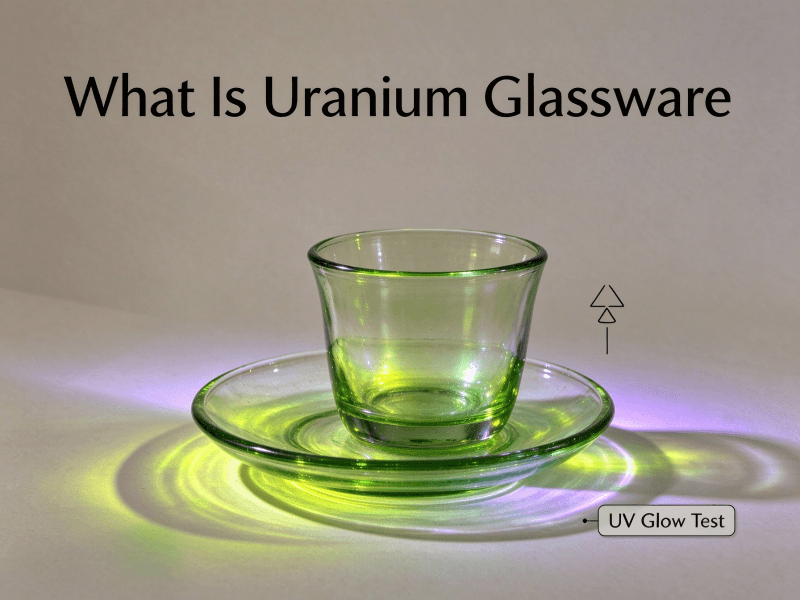
The ultraviolet light test is the fastest and most reliable way to confirm uranium glass. Shine a black light on the piece in a dark room, and genuine uranium glass glows bright green.
That green fluorescence is the signature of the material. No other common glass type produces the same neon green response, so a simple UV flashlight settles most identification questions in seconds. A 365 nm light is the standard tool collectors carry, and it costs roughly $10 to $20.
The ultraviolet light test
Hold the light close to the glass and look for a strong, even green glow. The color comes from uranium compounds in the glass reacting to the UV wavelength. A faint yellow or orange response usually means manganese, which was used as a decolorizer in old glass and can mislead beginners. Only the bright green response confirms uranium. One caution: a small share of uranium glass does not fluoresce, usually because it contains very little uranium or a different chemical mix, so the test is reliable in one direction but not perfect in the other.
What to look for in daylight
Uranium glass has a yellow-green tint in normal light, and the classic “vaseline” shade is a pale, oily-looking yellow that resembles petroleum jelly. Transparent pieces range from soft yellow to deep green, while custard glass and Burmese glass are opaque creams and pinks that still glow under UV. If you hold a piece up to sunlight, genuine uranium glass often shows a subtle oily sheen. That look, combined with the yellow-green color, is a strong hint before you even reach for the light.
Mold seams and maker marks
Vintage machine-pressed pieces show mold seams, and the seam details can date the piece. Turn the piece over and check the base for a maker’s mark or pattern number; marked pieces from recognized manufacturers command a clear premium over unmarked ones. Unmarked glass is harder to date, so buyers lean on color, mold style, and the intensity of the glow. When you are comparing materials, remember that the difference between uranium glass and ordinary lead crystal is easy to see under UV even when both look similar in daylight.

How much does uranium glassware sell for?
Most uranium glass sells for $10 to $75, and the price climbs quickly as rarity and condition improve. Rare and marked pieces regularly pass $500, and documented museum-quality examples have sold for five figures.
The table below shows realistic resale ranges based on auction records and collector price guides. Values shift with demand, so treat the ranges as a starting point rather than a fixed list.
| Item type | Typical resale range | Notes |
| Common tumblers and cups | $10-$75 | Depression-era pieces, usually sold singly |
| Plates, saucers, small bowls | $15-$60 | Pattern and condition drive the price |
| Larger bowls and serving pieces | $40-$120 | An original lid adds significant value |
| Vases and decorative glass | $50-$250 | Art glass shapes sell better than utility pieces |
| Complete glassware sets | $200-$600 | Matching sets earn a premium over singles |
| Maker-marked and rare art glass | $500-$2,000+ | Figural and sculptural pieces lead the market |
| Exceptional pieces | $3,000-$12,000+ | Documented auction records, museum quality |
A few auction results show the upper end. A sculpted uranium glass candlestick by a mid-century master studio sold for $11,995 in 2017. A rare ribbed uranium glass fishbowl sold for $3,139 in March 2023, and a lime green candy dish with its original lid sold for $3,051 in December 2023. On the high-end marketplace 1stDibs, uranium glass listings range from about $70 to nearly $88,000, with the average piece selling near $1,300.
Several factors push a piece toward the top of its range:
- Age. Pre-war pieces made before the 1940s uranium confiscation are scarcer and more desirable.
- Maker attribution. A confirmed mark from a known manufacturer adds a large premium.
- Color rarity. Blue and pink uranium glass command the steepest premiums in the category.
- Form and completeness. Lidded pieces, serving forms, and complete sets outprice open, common shapes.
- Condition. No chips, cracks, repairs, or heavy scratching is the baseline for top value.
The practical takeaway for anyone buying with resale in mind is that uranium glass is really two markets. Common, unmarked, mass-produced pieces behave like a flat commodity, while rare, attributed, or visually striking pieces appreciate like a niche asset. Before assuming a piece will go up in value, figure out which tier it belongs to. For buyers who want everyday pieces that are built to last rather than collectible antiques, a manufacturer’s glass cup sets offer a useful comparison point, since modern production glass is far more consistent than what vintage pieces show.
What are the most sought-after uranium glass pieces?
Depression-era tableware, art glass vases, and anything with a confirmed maker mark draw the strongest demand. Collectors also chase unusual forms and rare colors far more than plain utility pieces.
The most active segment of the market is Depression-era tableware from the 1920s and 1930s, when uranium glass was pressed in bulk and given away as premiums in oatmeal boxes, flour sacks, and movie theaters. That era produced the shapes collectors know best, and its common pieces remain the entry point for new buyers.
Depression-era tableware
Tumblers, plates, bowls, and pitchers from the Depression era are the backbone of the hobby. Common pieces stay affordable, but specific patterns and colors move fast. Complete table settings, matching services for eight, and serving pieces with lids are the most wanted items in this group. A complete matching set routinely sells for $200 to $600, while the same pieces bought one at a time would total far less.
Decorative glass and art pieces
Vases, bowls, candlesticks, and figural glass draw a different, higher-spending crowd. Art glass from the 1940s and 1950s, especially sculptural and hand-blown pieces, sells for $200 to $2,000 and up. The strongest results in recent auction records are all decorative: the sculpted candlestick at $11,995, the fishbowl at $3,139, and a Murano fish sculpture at $2,495. These pieces sell on beauty and maker attribution, not utility.
Rare colors and unusual forms
Blue uranium glass and pink uranium glass are the most desirable colorways, and they consistently pull the steepest premiums. Custard glass, with its opaque cream finish, and Burmese glass, with its pink-to-yellow gradient, are the rarest finishes of all, with Burmese pieces regularly topping $300 and reaching well past $1,200 at auction. Odd forms, including figural animals, jewelry, buttons, and lamp parts, attract niche collectors who pay for scarcity.

Is it illegal to own uranium glass?
No. Owning, displaying, and selling uranium glass is legal in the United States and in most other countries, and regulators treat it as a low-risk consumer product.
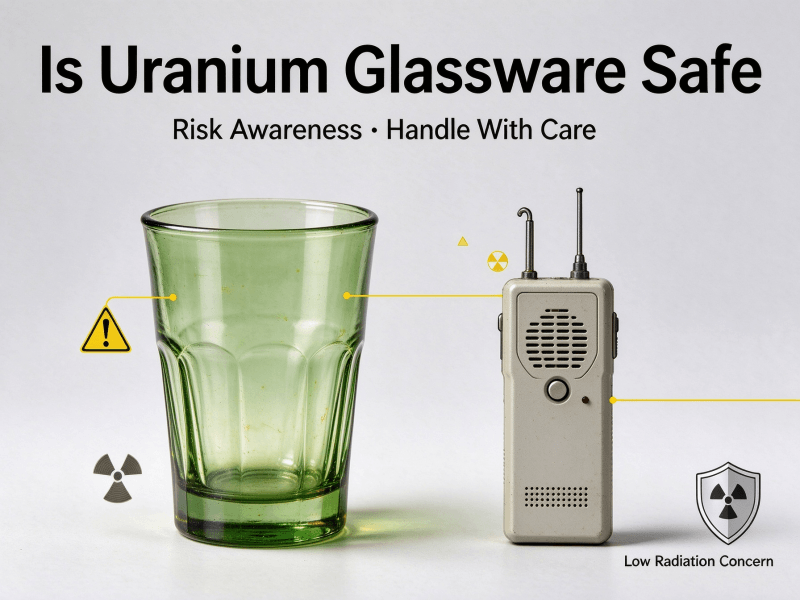
The radiation in uranium glass is real but very small. The U.S. Nuclear Regulatory Commission (NRC) exempts glassware containing up to 10 percent uranium by weight from licensing requirements, which covers nearly all uranium glass on the market. The NRC’s systematic assessment, NUREG-1717, estimated that a typical collector receives about 4 mrem per year from a collection, roughly 1 percent of the average person’s annual natural background dose.
How much radiation does it emit?
Most uranium glass contains about 2 percent uranium by weight, though some early 20th-century pieces reached as high as 25 percent. Even so, the exposure is tiny. Holding a piece at arm’s length produces less radiation than background levels a few feet away, and a display cabinet across the room adds essentially nothing. One standard comparison: an hour next to a display of uranium glass delivers roughly the same dose as eating a banana, while a single chest X-ray delivers about a thousand times more. Independent measurements show surface readings comparable to granite countertops, which no one treats as dangerous.
What the rules actually say
In the United States, the NRC classifies uranium glass as generally licensed or exempt material, and there are no federal restrictions on owning it. The European Union’s REACH regulation similarly exempts uranium glass from restriction as long as uranium content stays below 0.3 percent by weight. The main practical rule is about use rather than possession: most collectors display uranium glass instead of eating or drinking from it daily, and the FDA and NRC have said occasional use poses no measurable health risk. Avoid grinding, sanding, or polishing the glass without respiratory protection, because inhaling or ingesting glass dust is the only realistic way to turn a display item into a health concern.
The radiation is not the reason collectors keep uranium glass behind glass. It is fragile. For glassware storage, stable shelves away from traffic, padded racks, and normal dust control are all that is needed, and a simple glassware cabinet does the job perfectly well. When pieces need to be moved or shipped, padded glassware storage containers keep them safe and keep their value intact.
How is uranium glass made?
Uranium compounds are added to the molten glass batch as a colorant, which is why the glass carries its yellow-green tint and its fluorescent glow.
The process is a standard glassmaking run with one unusual ingredient. A glassmaker mixes silica, soda ash, and lime with uranium oxide, then melts the batch and shapes the glass by pressing, blowing, or molding it. The uranium is chemically bound into the glass matrix, which is why the material does not leach, off-gas, or shed radioactive dust under normal use.
The basic steps look like this:
- Weigh the batch ingredients, including uranium oxide at the target percentage.
- Melt the batch in a furnace at roughly 1,400 to 1,500 °C until it is fully liquid.
- Shape the glass by pressing into molds, blowing, or hand-forming.
- Anneal the finished pieces in a lehr to cool them slowly and prevent stress cracks.
- Finish and inspect each piece before it leaves the factory.
Uranium content and colors
The amount of uranium controls the color and the strength of the glow. A typical batch uses about 2 percent uranium by weight for the classic yellow-green vaseline shade. Early 20th-century makers sometimes used far more, and pieces with 10 to 25 percent uranium exist. Different metal oxides shift the color: iron turns it green, gold creates the pink gradient of Burmese glass, and other additives produce blue, amber, and custard shades. After World War II, producers switched to depleted uranium, and today a small number of licensed makers and glassware studios still produce new uranium glass, mostly decorative pieces using reclaimed depleted uranium oxide.
Modern production and the market today
Modern uranium glass is almost entirely decorative, and production volumes are a fraction of the pre-war era. That keeps vintage pieces scarce relative to the collector base. For businesses that need everyday glassware at scale, modern manufacturing is the practical route: factory-made pieces are uniform, consistent, and available in bulk, which is why commercial buyers rarely rely on antique stock. A supplier that offers custom shapes, sizes, and branding fills that role, and event planners often find that owning custom pieces beats glassware rental over the long run.
The bottom line on uranium glassware value
Uranium glass is worth owning if you know what you are looking at. Common pieces hold modest value and sell fast at $10 to $75. Marked, rare, or unusually colored pieces carry real collectible value and can appreciate. The safest buying approach is simple: carry a UV light, check condition before price, favor pre-war pieces and complete sets, and treat any piece with a maker’s mark as needing a closer look. Local antique malls, estate sales, and the shops that surface when you search “glassware near me” are where the underpriced finds tend to sit.
For collectors and businesses alike, the same principles apply to glass in general. A piece is only as good as its material, its making, and its condition. Holinglass is a glassware manufacturer that produces custom glassware, glass cup sets, jars, bottles, and bowls for commercial buyers, with OEM and ODM options, bulk wholesale, and factory-direct pricing.
Frequently asked questions
Is uranium glass rare?
Not in general. Millions of pieces were made between the 1880s and the 1970s, and common bowls, plates, and tumblers are easy to find. Rarity applies to specific things: pre-war pieces, unusual colors like blue and pink, figural forms, and anything with a confirmed maker’s mark. The scarce end of the market is what drives prices upward.
What is the most expensive uranium glass?
The top auction results are decorative art glass, not tableware. A sculpted uranium glass candlestick sold for $11,995 in 2017, and several pieces have passed $3,000 in recent years, including a ribbed fishbowl and a lidded candy dish. High-end marketplace listings have reached nearly $88,000 for museum-quality pieces. Burmese and blue uranium glass are the most expensive categories on a consistent basis.
Can you eat or drink from uranium glass?
Occasional use is considered safe by the FDA and the NRC, and leaching tests show uranium migration far below drinking water standards. Most collectors still treat uranium glass as decorative rather than functional, especially for acidic drinks like juice or wine, and no one should grind or sand the glass and breathe the dust. For daily food use, standard modern glassware is the better choice.