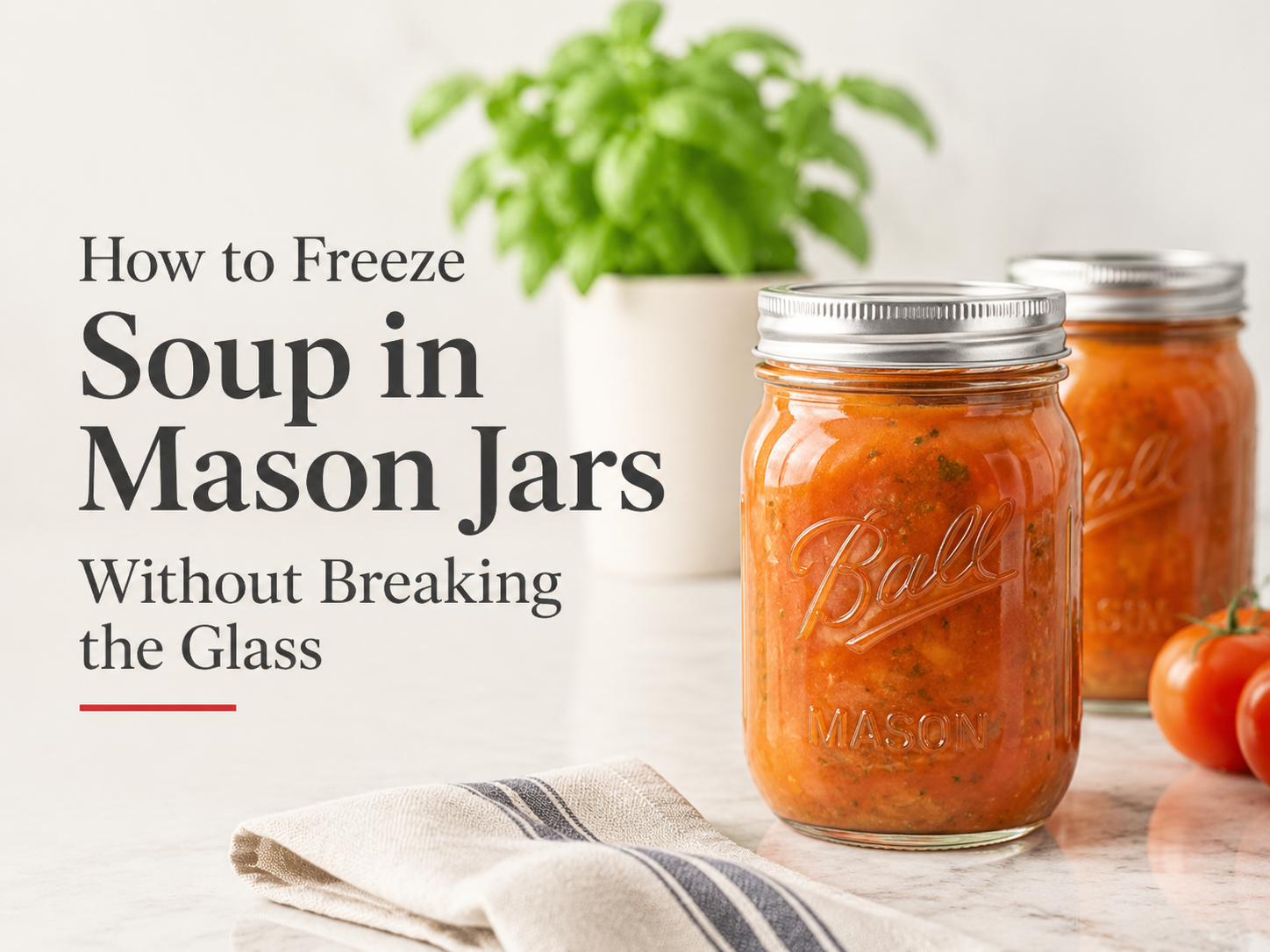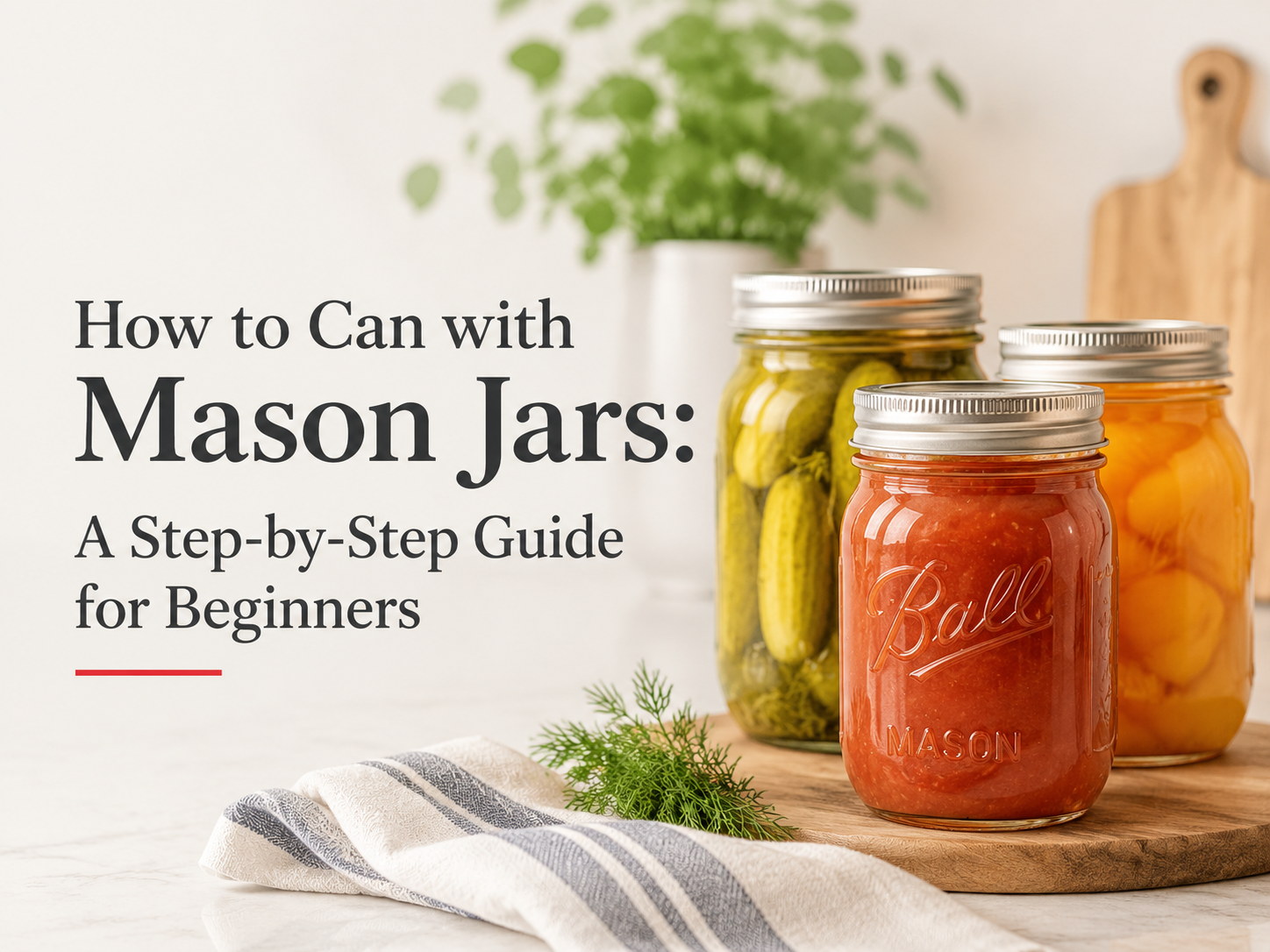
A glass jar is already most of a vacuum container: rigid body, impermeable wall, inert surface, nothing inside to collapse once air leaves the headspace. What it lacks is a closure held shut by pressure and a way to remove the air, which is why so many sealed jars quietly lose their vacuum within weeks.
You can vacuum seal a glass jar whenever three conditions hold at once: the rim is flat and undamaged, the lid carries a continuous elastomer gasket that can be compressed, and enough air is removed for atmospheric pressure to press the lid onto that gasket. A hand pump with a valve lid, an electric sealer with a jar attachment, a thumb-operated air-reducer lid and a hot fill that contracts on cooling all satisfy those conditions to different degrees. No method makes a sealed jar shelf stable unless the food is dry, acidic or heat processed.
The mechanics come first, because every method below reaches the same physical condition by a different route.
How a Vacuum Actually Forms Inside a Glass Jar
Any sound glass jar can hold a vacuum, but the sealer does not pull the lid shut. It removes air from the headspace, and the pressure difference between the room and the inside of the jar then presses the lid onto the gasket. The lid is the only part that moves, which is why the seal forms at the lid to rim interface and why a jar with a hairline chip leaks no matter how long the pump runs.
A vacuum bag collapses around its contents, so the film becomes the seal. A rigid jar cannot, so the whole load concentrates on one component.
What Actually Holds the Lid Down
At sea level the atmosphere presses with roughly 101 kilopascals. A 70 mm lid exposes about 0.0038 square metres, so a full one atmosphere differential puts close to 390 newtons on it, around 40 kilograms. Home pumps land near 0.7 to 0.8 bar absolute, leaving a differential of 0.2 to 0.3 bar and a load of 80 to 115 newtons. That resists a fingertip and keeps a lid concave, but it never makes the closure rigid.
The gasket does the sealing. Pressure drives the elastomer into the tool marks of the glass, and the same pressure that would push air inward also pushes the gasket against the rim, so the closure behaves like a one-way valve. Seals therefore fail gradually: heat and repeated compression reduce the gasket’s ability to recover, and once stored compression falls below the leak threshold, air returns along the path it left by.
Removing 99 percent of the headspace air leaves oxygen in the low tenths of a percent, which slows oxidation of fats and pigments and keeps insect eggs dormant. That is a shelf life effect, not sterilisation.
Four Methods Compared
The four routes differ less in the vacuum they reach than in how often the work repeats. A pump gives the most control and the slowest throughput, a sealer the fastest throughput, a thumb lid the weakest vacuum, and a hot fill a partial vacuum that is easy to mistake for a preserved product.
| Method | Typical vacuum | Best for | Limitation |
| Hand pump with valve lid | 0.7 to 0.8 bar absolute | Spices, coffee, grains | 5 to 15 strokes per jar |
| Sealer with jar attachment | 0.1 to 0.3 bar absolute | Batches of 10 to 20 jars | Adapter must match mouth diameter |
| Air-reducer lid | Partial | Jars opened daily | Short hold, frequent re-pumping |
| Hot fill and cooling | Partial | High-acid fills, jams | No heat process, unsafe for low-acid food |
Pumps, Sealers and Thumb Lids
Leave 2 to 3 cm of headspace, wipe the rim dry, and pump until resistance rises sharply. With a sealer, the attachment sits over the flat disc without the band: run the machine until the lid drops, then open the release valve before pulling the hose off, since reversing that order dumps the vacuum in a second. A thumb lid is pressed 10 to 20 times until the membrane stops returning; it reaches a lower differential and loses it faster, so it suits jars opened every day.
Heat and Contraction
Hot food goes into a warmed jar and the trapped steam displaces headspace air. On cooling it condenses to a volume roughly 1,600 times smaller and draws the lid down. Leave 2 cm of headspace, do not fully tighten the band until surface bubbling slows, and use glass rated for the swing. This is a partial vacuum, not a preserved product, so shelf-stable results require the heat processes covered in how to seal mason jars.
Jars and Lids That Hold a Vacuum
The jar body is rarely the failure point. What fails is the closure: a rim that is not flat, a gasket that has taken a permanent set, a lid panel too thin to stay concave under load, or a thread that lets the lid rock. A jar qualifies for vacuum work when all four are sound, not when the glass merely looks intact.
A single grain of salt in the sealing compound can produce a slow leak that takes days to show. Lid and mouth diameter also travel together, which is why glass jars with lids wholesale are specified as a matched set rather than ordered separately.
| Lid type | Vacuum retention | Service life | Notes |
| Two-piece metal with plastisol gasket | Excellent | 1 to 3 years | Disc can be adapted for a sealer attachment |
| Plastic lid with silicone valve | Excellent | About 1 year | Valve is replaceable |
| Lug or clamp lid with rubber ring | Good | 2 to 5 years | Ring is the wear item |
| Bamboo or wooden lid | Poor | Variable | Porous, decorative use only |
Glass Type and Reused Jars
Most kitchen jars are soda-lime glass, usually tempered, which tolerates the pressure swing but stays sensitive to uneven heating. Borosilicate has a much lower coefficient of expansion and handles hot fills better. Neither should move from a freezer to boiling water or be heated while sealed. Commercial sauce and jam jars can be reused if the gasket is intact, but the plastisol deformed to the rim it first met, and thread dimensions vary between suppliers.
Which Foods Are Safe to Vacuum Seal in Mason Jars
Dry, low-moisture foods that were already shelf stable are the safe category: grains, legumes, flour, pasta, nuts, seeds, coffee, tea, spices, dried fruit and dehydrated vegetables. Everything that needed refrigeration before sealing still needs it afterwards, because a vacuum does not lower water activity, raise acidity or apply heat. Vacuum sealing changes how fast quality declines, not whether a food is safe at room temperature.
| Food category | Examples | Storage after sealing |
| Dry staples | Rice, flour, pasta, oats, beans | Pantry, cool and dark |
| Nuts and seeds | Almonds, walnuts, sesame | Pantry short term or freezer |
| Coffee | Whole beans, ground | Pantry, freezer for long term |
| Spices and herbs | Pepper, paprika, oregano | Pantry, away from light |
| Cooked foods | Soups, stews, cooked grains | Refrigerator or freezer only |
Foods That Still Need Cold Storage
Vacuum packaging is a form of reduced oxygen packaging, and the low-oxygen environment that protects against freezer burn also favours anaerobic pathogens, including the organism responsible for botulism. Those organisms do not necessarily change colour, smell or texture, so a sealed jar that looks normal is not evidence of safety.
What Not to Vacuum Seal
- Fresh garlic, raw onion and fresh mushrooms, which are low-acid, moist and repeatedly associated with anaerobic risk
- Soft and mould-ripened cheeses, which keep ripening and release gas
- Granulated and brown sugar, which fuses into a block
- Brine or syrup packs, which get drawn into the valve
A Simple Decision Rule
If a food can sit safely in a closed cupboard for a week, vacuum sealing will extend its quality window several times over. If it normally lives in a refrigerator, it stays there after sealing. That rule removes almost every ambiguous case.
Sealing a Jar Step by Step
The sequence decides the outcome more than the equipment does. Clean and dry the jar, fill to the correct headspace, wipe the rim, seat the lid squarely, draw the vacuum, break the suction at the tool rather than at the lid, and verify the seal before the jar reaches a shelf.
- Wash the jar and lid, sterilize a glass jar where contamination matters, then dry both parts completely, since moisture on the rim prevents a clean seal.
- Cool hot ingredients unless the method is a deliberate hot fill.
- Fill to leave 2 to 3 cm of headspace, the most common reason a first attempt fails.
- Wipe the rim and check it against a light for chips.
- Seat the lid centrally, using the flat disc alone for a sealer attachment.
- Draw the vacuum until the centre stays dished, release the valve, then disconnect the hose.
- Label with contents and date, store away from light, and recheck every two weeks for two months.
Three Signs a Seal Is Holding
A concave centre that does not flex upward when pressed, a valve that makes no hiss when touched, and a lid that resists a firm lift. All three together are meaningful; any one alone is not, because a stiff gasket can hold a lid flat with no vacuum behind it.
Troubleshooting a Seal That Will Not Hold
| Symptom | Likely cause | Fix |
| Pump never reaches resistance | Gasket cut or hardened | Replace the lid or ring |
| Lid drops, then rises within minutes | Rim chip or moisture | Inspect, clean, dry, refill |
| Seal holds for days, then fails | Gasket taking a set | Replace it, store jars with lids loose |
| Contents climb toward the lid | Overfilled or vacuum too strong | Reduce fill level, use partial vacuum |
How Long Vacuum Sealed Jars Last
A vacuum buys months, not years, and the number depends on the food far more than on the vacuum. Whole dry goods with low fat content hold quality for one to two years, ground and fatty products for six to twelve months, and anything with residual moisture for a few months at best.
| Food | Ambient | Airtight jar | Vacuum sealed jar |
| Whole coffee beans | 1 to 2 weeks | 3 to 4 weeks | 6 to 12 months |
| Ground spices | 3 to 6 months | 6 to 12 months | 2 to 3 years |
| Shelled nuts | 1 to 2 months | 4 to 6 months | 8 to 12 months |
| Flour and grains | 1 to 2 months | 3 to 6 months | 6 to 12 months |
| Dried herbs and chillies | 2 to 4 months | 6 to 9 months | 1 to 2 years |
These figures describe quality, not safety, and assume a sound seal and a cool, dark shelf. One caveat applies to home equipment: a sealer attachment pulls air from under a flat lid without heating the sealing compound, so the closure may end up less airtight than a heat processed one, even when the lid looks correctly dished.
What Shortens Shelf Life
Light and heat accelerate the oxidation the vacuum was meant to slow. Repeated opening and resealing admits fresh air and compresses the gasket again. Ageing gaskets fail quietly, with the lid still down and the contents already softening. A cupboard above a cooker will roughly halve the figures above.
How to Airtight Seal a Glass Jar Without a Vacuum Sealer
Airtight and vacuum are different claims. An airtight jar keeps air from moving in or out; a vacuum jar also has lower pressure inside, which holds the lid down and gives you a visible indicator. You can achieve the first with no equipment at all, and a genuine vacuum only with a pump, a sealer or a heat process that contracts on cooling.
Mechanical and Displacement Closures
Lower a sheet of film onto the surface of a nearly full jar and let the displaced liquid carry it to the rim before closing. The film excludes headspace air, which suits cut fruit and leftovers kept for a few days, though it does nothing for dry goods. Jars with a rubber ring and metal clamp, or with a lever lid, seal mechanically rather than by pressure. The ring can be inspected and replaced when it hardens, but holding force comes from the spring, so any deformation of lid or ring leaks regardless of how hard the clamp is closed.
Heat Processing for High-Acid Foods
For jams, pickles and fruit in syrup, a boiling water bath is the only home method that yields a shelf-stable sealed jar. Filled jars are submerged with 2 to 3 cm of water above the lids and processed for the time a tested recipe specifies. It does not transfer to low-acid foods, which need pressure processing to reach temperatures that destroy spores.
Sealing Jars at Production Scale
At volume the question changes from whether a jar can hold a vacuum to whether every jar in the run holds the same vacuum. That is a closure specification problem, not an operator problem. Rim flatness, gasket lot consistency, applied torque, headspace and the vacuum reached at capping decide the reject rate, and each needs a number attached before the line runs.
A capping head loads the whole circumference at once, so a low spot on the rim becomes a leak at speed. Incoming checks should measure rim diameter, sealing surface width and thread start position against the drawing, and confirm gasket hardness by lot, since a harder gasket will seal on a slow line and fail on a fast one. Wide mouth glass jars are easier to fill and seal consistently, an advantage that disappears if product reaches the sealing surface.
| Control point | Method | Acceptance |
| Headspace | Fill height gauge or vision check | Within the range set for the product |
| Applied torque | Torque tester on removal | Inside the band for the closure, hourly |
| Seal integrity | Dye penetration or vacuum decay | No leakage on the sampled set |
A vacuum that survives the filling line can still fail in a container or on a shelf, which is why validation includes a transit simulation and a display test. Vacuum packing does not replace heat processing either, so a perishable product keeps the cold chain it needed before capping.
FAQ
Three questions that sit outside the sealing process itself: whether closures can be reused, whether a half-empty jar can be re-sealed, and what shipping conditions do to a seal that tested well on the line.
Can You Reuse Vacuum Lids and Gaskets
Metal discs with plastisol gaskets deform to the rim on first use and are not designed for a second seal, though they remain usable for dry storage. Silicone valve lids and rubber rings can be reused many times but are wear items: replace a ring when it loses elasticity or stays compressed after removal.
Can You Re-Seal a Jar That Is Already Half Empty
Yes, and it is one of the better uses of a hand pump, since the air to remove is mostly headspace. Wipe and dry the rim first, and accept that food open for weeks has already absorbed oxygen, so re-sealing slows further decline rather than restoring quality.
Do Vacuum Sealed Jars Survive Shipping and Hot Storage
The closure usually survives, the contents may not. For hot climates, specify a gasket rated above the expected peak and reduce stack height, since a warm container under a full pallet is what produces lids arriving flat instead of concave.