A quart jar looks like the simplest object in a kitchen until you have to fit one somewhere. Buyers measure cabinet shelves, engineers size cartons, and home canners check rack clearance before the water boils. A label reading 32 oz tells you how much goes in, not how much room it takes up, and the word quart hides a second problem: two jars of identical volume can be built to two different heights.
A standard quart mason jar stands about 6.5 to 7 inches (165 to 177 mm) tall from base to sealing rim. The regular mouth quart is the taller build at roughly 6.9 inches (175 mm), while the wide mouth quart runs about 6.7 inches (170 mm). Add roughly 3/8 inch for the lid and band, so allow 7.2 to 7.3 inches of clear height wherever the jar has to sit.
Those two builds trade width for height in a way that changes shelving plans, carton counts, and filling line settings, and that trade-off frames every number here.
How Tall Is a Quart Mason Jar?
Measured from base to rim, a production quart lands between 6.5 and 7 inches (165 to 177 mm). Regular mouth jars cluster at the upper end at 6.75 to 6.95 inches, while wide mouth jars sit near the lower end at 6.5 to 6.7 inches.
The spread is not sloppy manufacturing but the predictable result of forcing 946 millilitres into glass, where every millimetre added to the diameter has to come out of the height.
| Build | Typical height | Common range | Body diameter |
| Regular mouth quart | 6.9 in / 175 mm | 6.75 to 6.95 in | 3.5 in / 89 mm |
| Wide mouth quart | 6.7 in / 170 mm | 6.5 to 6.7 in | 3.7 in / 94 mm |
Why regular mouth and wide mouth quarts differ in height
The regular mouth design pays for its narrow 60 mm opening with a taller body and a shoulder that begins higher up the wall. The wide mouth design spends an extra 0.2 inch of diameter to buy back 0.2 inch of height. Two wide mouth quarts stacked occupy 0.4 inch less vertical space than two regular mouth quarts, and that fraction often decides whether a run of jars fits under a cabinet.
Height with the lid and band on
A flat lid plus a seated band adds about 3/8 inch (9 to 10 mm), pushing a regular mouth quart to roughly 7.3 inches and a wide mouth quart to about 7.1 inches. Plan clearance on the lidded figure, because the jar that fits by a quarter inch without a lid will not fit once it is sealed.
What Are the Dimensions of a 1-Quart Mason Jar?
A 1 quart mason jar measures about 6.9 inches tall by 3.5 inches across the body in regular mouth form, or 6.7 inches tall by 3.7 inches across in wide mouth form, closed with a 70 mm or 86 mm lid, and holds 32 US fluid ounces, or 946 millilitres.
| Dimension | Regular mouth quart | Wide mouth quart |
| Capacity | 946 mL / 32 fl oz / 4 cups | 946 mL / 32 fl oz / 4 cups |
| Brimful capacity | 1,000 to 1,050 mL | 1,000 to 1,050 mL |
| Height, no lid | 6.9 in / 175 mm | 6.7 in / 170 mm |
| Height with lid | 7.3 in / 185 mm | 7.1 in / 180 mm |
| Body diameter | 3.5 in / 89 mm | 3.7 in / 94 mm |
| Opening, inside | 2 3/8 in / 60 mm | 3 in / 76 mm |
| Lid diameter | 70 mm | 86 mm |
| Empty weight, with lid | 15 to 16 oz / 430 to 460 g | 16 to 18 oz / 450 to 500 g |
| Filled weight, water | 3.1 lb / 1.4 kg | 3.1 lb / 1.4 kg |
The two mouth standards behind those lid figures, a regular opening of about 2 3/8 inches and a wide opening of about 3 inches, are why lids and bands stay interchangeable across most production jars, as the general Mason jar reference sets out. Thread depth, wall thickness, and finish dimensions are broken down further in these mason jar specifications.
Nominal versus measured dimensions
The figure on a jar is nominal fill capacity, meaning volume at a sensible fill line rather than to the very top. Brimful capacity typically runs 5 to 10 percent higher, so a quart measuring 1,020 millilitres to the rim is behaving normally. Height varies by up to 1/16 inch between moulds in one family, diameter by around 1 millimetre, and glass weight by several percent, so measure the actual lot when a dimension is critical.
Millilitres, cups, and the imperial quart trap
In US usage a quart is 32 fluid ounces, or 4 cups, 946 millilitres, one quarter of a US gallon. An imperial quart is a different unit at 40 imperial fluid ounces, or 1,136 millilitres, so a jar sold as a quart under imperial measures can be nearly 200 millilitres larger. A metric 1 litre jar sits close to but not identical with the US quart at 33.8 fluid ounces.
What Is a 1 Quart Mason Jar?
A 1 quart mason jar is a tempered glass jar with a continuous screw thread and a two-piece vacuum closure that holds one US quart, equal to 32 fluid ounces, 4 cups, or 946 millilitres.
The term describes a capacity class and a closure system rather than one fixed shape. What unites the category is the thread finish, the flat self-sealing lid held down by a reusable band, and a body strong enough to take the heat of a water bath. The quart is also the largest size routinely recommended for boiling water canning, since half gallon jars do not heat through predictably enough for safe processing.
Where the quart sits in the size lineup
The quart is the second largest standard size and the point where the range splits into two builds.
| Size | Volume | Typical height |
| Quarter pint | 4 oz / 118 mL | 2.2 to 2.3 in |
| Half pint | 8 oz / 237 mL | 2.5 in wide, 3.9 in regular |
| Jelly jar | 12 oz / 355 mL | 5.25 in |
| Pint | 16 oz / 473 mL | 4.6 to 5.2 in |
| Pint and a half | 24 oz / 710 mL | 6.6 to 6.8 in |
| Quart | 32 oz / 946 mL | 6.5 to 6.95 in |
| Half gallon | 64 oz / 1,893 mL | 9.1 to 9.2 in |
Against that ladder the quart is nearly 2 inches taller than a regular mouth pint and half an inch shorter than a half gallon. Diameters for every step are laid out in this guide to mason jar sizes.
What a quart jar is used for
946 millilitres is the smallest volume that still covers a family portion and the largest that still fits comfortably on a shelf. Whole tomatoes, peach halves, dill pickles, and beet kvass all suit it, and it is the default vessel for fermenting vegetables because the surface area to volume ratio keeps oxygen exposure low. Outside preservation it works as a dry goods canister, a meal prep container, and a cold brew vessel. The one use it resists is freezing, since expanding liquid pushes up into the shoulder of a regular mouth jar rather than rising in a straight wall.
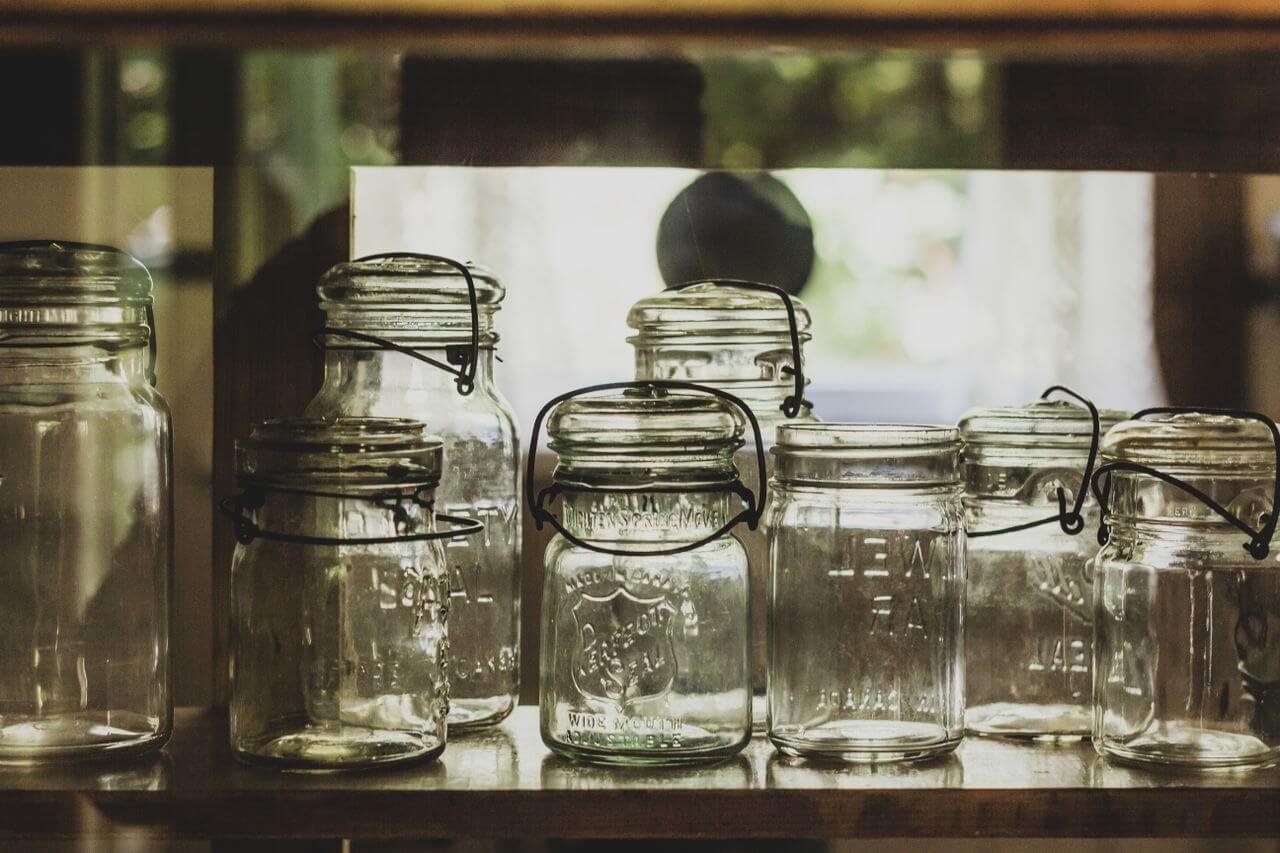
Regular Mouth Versus Wide Mouth Quart Jars
Both hold 946 millilitres, but the wide mouth quart is shorter, wider, and easier to fill and clean, while the regular mouth quart pours more accurately and closes with the smaller 70 mm lid.
The two formats are not interchangeable at the closure. A 70 mm band will not seat on an 86 mm finish, and the mismatch is the most common reason a lid purchase goes wrong across a mixed jar inventory. Beyond the lid, the difference is one of access: the wide mouth opening measures 76 mm inside against 60 mm on the regular, which changes what can be reached with a hand, a scoop, or a bottle brush.
Which mouth style fits your product
The decision follows the product’s behaviour rather than its volume. Anything that pours, such as juice, brine, or sauce, benefits from the narrow opening, which gives the stream a defined edge. Anything packed by hand or scooped out, such as whole cucumbers or grain, benefits from the wide opening where a hand or scoop can reach the base. On a production line the choice also changes throughput, since a wide mouth jar accepts a larger nozzle and fills faster. This range of wide mouth glass jars shows how much the shorter, broader profile changes case packing.
What Does a Quart Size Mason Jar Look Like?
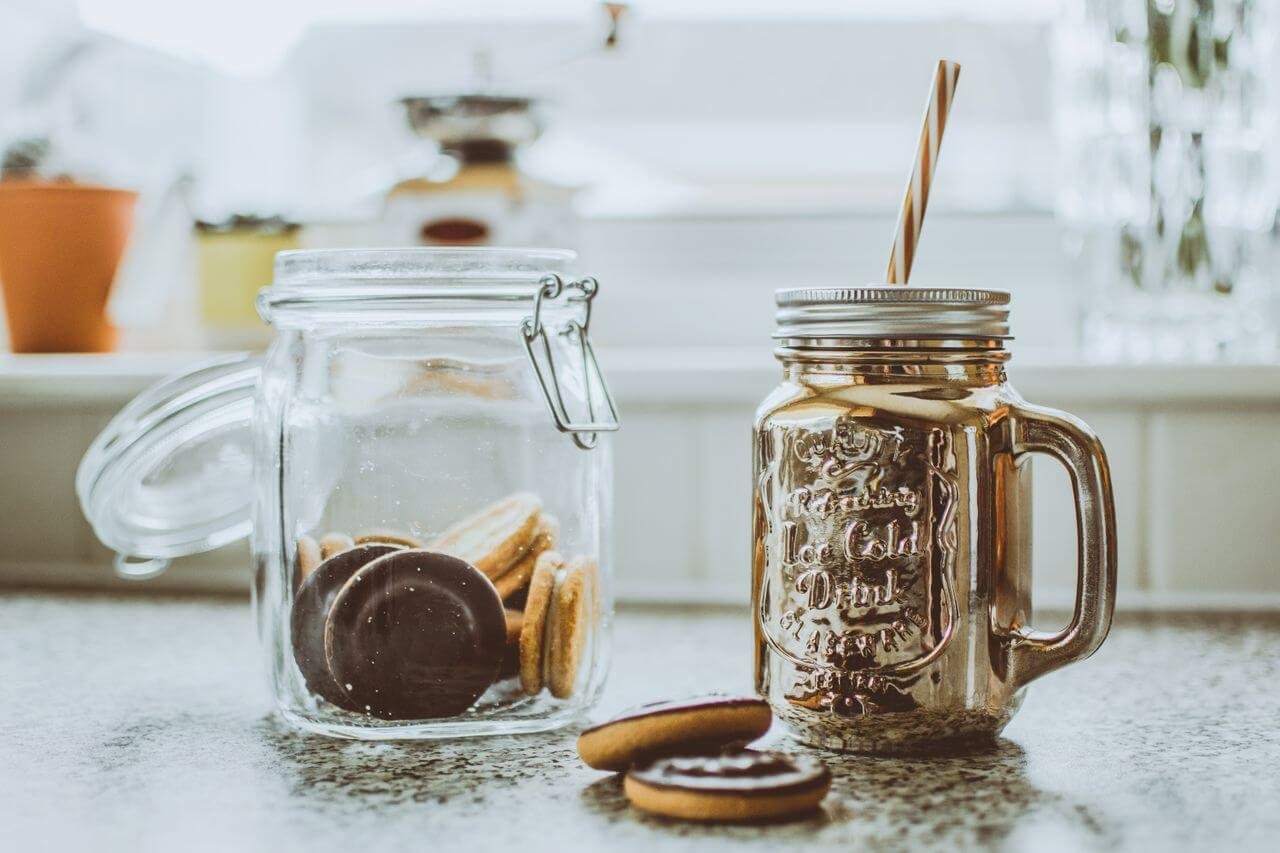
A quart mason jar is a tall glass cylinder with a straight or slightly tapered wall, a rounded shoulder about an inch below the neck, a short threaded neck, and a height close to twice its widest point.
The proportions are the giveaway. A regular mouth quart reads as narrow and tall, with the shoulder rising steeply into a small neck. A wide mouth quart reads as balanced rather than stretched, because the extra diameter brings the height down and leaves a broader, flatter shoulder.
Identifying a quart jar without a ruler
The quickest check is displacement: fill the jar to the brim and pour it into a measuring jug, and a quart reads close to 1,000 to 1,050 millilitres. The lid is the second clue, with 70 mm pointing to regular mouth and 86 mm to wide mouth, though the lid alone will not confirm capacity. The third is comparison, since a regular mouth pint stands about 5 inches tall and a quart is nearly 2 inches taller.
Look-alikes that are not quart jars
Straight-sided storage jars often share the diameter and closure of a quart without sharing its capacity, because they lack the shoulder and run shorter. Recycled commercial sauce jars accept a standard lid and look convincing while being made of thinner glass that will not survive canning. A 24 oz wide mouth jar is the hardest to separate by eye at only 0.1 to 0.2 inch shorter, despite holding a quarter less.
Will a Quart Jar Fit Your Shelf, Fridge, and Canner?
A quart jar needs about 7.3 inches of clear height with its lid on, which clears a standard 12 inch cabinet shelf with 4.7 inches to spare, sits upright on a fridge shelf but rarely in the door, and fits seven to a rack in a standard boiling water canner.
Shelf and cabinet clearance
Standard upper cabinets give about 12 inches between shelves, so a lidded quart leaves room for a short row of half pints in front but not for a second layer of quarts. Two stacked quarts need 14.6 inches and will not clear, which is why pantry storage is almost always single layer.
Fridge door, drawer, and canner fit
Door bins typically offer 5 to 6 inches, which rules out a quart standing upright, though a wide mouth quart on its side can be worked into a deep bin. Crisper drawers run 7 to 9 inches, so a quart fits but sits tight against the lid. A standard boiling water canner takes seven quarts upright and needs depth for the jars plus 1 inch of water above the lids, or roughly 8.5 inches of interior height.
Carton and pallet math
A 12 count carton is the common trade unit for quarts, running 7.5 to 8 inches deep once jars and dividers are inside. Pallet count follows the carton footprint, and layer count is capped by your warehouse height limit, so carton depth rather than jar diameter usually sets how many layers can be stacked.
How Much Does a Quart Mason Jar Hold and Weigh?
A quart jar holds 946 millilitres, or 4 cups, to its fill line and 1,000 to 1,050 millilitres to the brim. Empty with its lid it weighs around 1 pound (430 to 470 g), and filled with water it comes to roughly 3.1 pounds (1.4 kg).
Headspace rules for a quart
Fill level, not jar height, decides how much actually goes in. For freezing, guidance from the National Center for Home Food Preservation sets headspace by pack type and container shape rather than volume alone.
| Use | Wide top opening | Narrow top opening |
| Liquid pack, fruit in syrup | 1 inch | 1.5 inch |
| Dry pack, no liquid | 0.5 inch | 0.5 inch |
| Juice | 1 inch | 1.5 inch |
| Jams and jellies | 0.25 inch | 0.25 inch |
| Low acid foods, pressure canned | 1 to 1.25 inch | 1 to 1.25 inch |
The narrower the opening and the wetter the pack, the more headspace the jar needs, because liquid climbs a narrow neck faster than it rises in a wide one.
Filled weight for shipping and storage
Shipping weight follows product density, and the jar contributes a fixed pound.
| Contents | Density | Net weight per quart |
| Water | 1.00 g/mL | 2.1 lb / 0.95 kg |
| Brine or syrup | 1.02 to 1.10 g/mL | 2.1 to 2.3 lb |
| Honey | 1.42 g/mL | 3.0 lb / 1.35 kg |
| Dry rice or beans | 0.75 to 0.85 g/mL | 1.6 to 1.8 lb |
| Flour | 0.55 to 0.65 g/mL | 1.1 to 1.3 lb |
A case of twelve water filled quarts therefore lands near 37 pounds plus packaging, which is the figure to use when specifying carton board grade.
Quart Mason Jar Dimensions for Packaging and Sourcing
For packaging work the tolerances matter as much as the nominal figures. Height typically holds within plus or minus 1/16 inch, body diameter within about 1 millimetre, and brimful capacity within 2 percent, which is why a purchase order should specify all three rather than capacity alone.
What to specify on a purchase order
- Thread finish, 70 mm regular or 86 mm wide, since the two are not interchangeable and drive lid inventory.
- Overall height without the lid, with an explicit tolerance rather than a nominal figure.
- Body diameter at the widest point and at the base, because taper affects stacking and label application.
- Brimful capacity in millilitres, plus the intended fill line and its tolerance.
- Printable wall height and label panel position, measured from base to shoulder.
- Carton count, divider style, and pallet pattern.
The wider range of wholesale glass jars shows how much these six items vary across formats, and why a single capacity figure is a weak basis for comparison.
Why height consistency matters on a filling line
Height variation compounds along a line. Nozzles set to clear the tallest jar in a lot will overfill the shortest, cappers sized for a nominal height lose torque consistency when jars run short, and label applicators keyed to a fixed shoulder drift by the same amount the jar drifts. A tolerance of 1/16 inch sounds harmless until it is read by three separate machines across a pallet, so buyers who need uniform behaviour should ask for the height distribution of the lot rather than the specification range.
FAQ
How tall is a quart jar in centimetres? A regular mouth quart measures about 17.5 centimetres to the rim and roughly 18.5 centimetres with its lid on. A wide mouth quart measures about 17 centimetres, or 18 centimetres lidded. The regular mouth build is consistently taller by roughly half a centimetre.
Can you stack quart jars two high on a standard shelf? Not under a standard 12 inch cabinet shelf, since two lidded quarts need about 14.6 inches. Open shelving with 15 inches or more between shelves will take a two high stack, provided the lower jars are not carrying the full weight of the upper row on their lids alone.
Are all quart jars the same width? No. Body diameter varies with mouth style, running about 3.5 inches for regular mouth and 3.7 inches for wide mouth, and it shifts again with mould design, taper, and decorative panels. Vintage and non-standard jars can differ by several millimetres more, which is why sleeves, racks, and carton dividers are specified against a measured jar rather than a nominal size.